Deals rarely disappear overnight. They get stuck in the wrong stage, missed in follow-ups, or overlooked because your team lacks visibility.
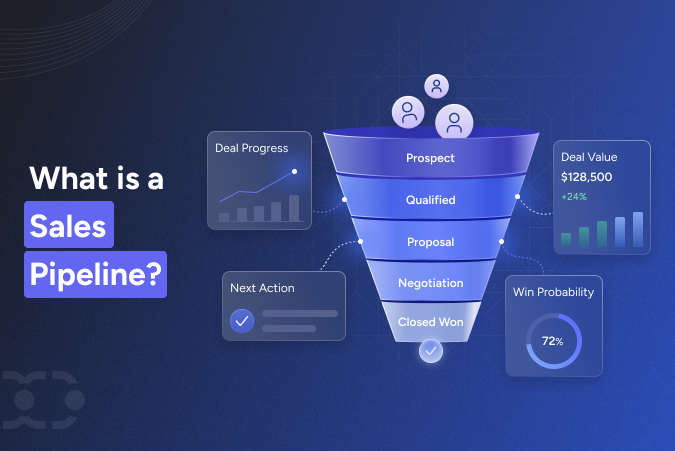
A sales pipeline is a visual, stage-by-stage view of your active sales opportunities, showing where each deal stands from initial contact to closed-won or closed-lost.
A well-managed pipeline helps reps prioritize opportunities, managers spot stalled deals early, and teams understand where potential revenue is coming from.
In this guide, you’ll learn what a sales pipeline is, how it differs from a sales funnel and sales process, and how to build and manage one that keeps deals moving.
Sales pipeline vs Sales funnel vs Sales process
These terms are often used interchangeably, but they describe different things.
| Sales pipeline | Sales funnel | Sales process |
|---|
| Tracks active opportunities | Tracks prospect volume and conversion | Defines how your team sells |
| Focuses on individual deals | Focuses on the buyer journey | Focuses on sales activities |
| Helps reps manage opportunities | Helps analyze conversion | Gives reps a repeatable framework |
Simply put, a sales funnel reflects prospect volume and conversion across the buyer's journey, while a sales pipeline tracks the deals your team is actively pursuing from the seller’s perspective of the customer journey.
Need more clarity?: Read our guide on sales pipeline vs sales funnel.
What are the key stages of a sales pipeline?
Every deal follows its own path, but most sales teams can organize that journey into a series of clear milestones.
The stage names may vary by business, but the goal is the same: know where each opportunity stands, what has happened, and what needs to happen next.
A typical sales pipeline looks like:
Prospecting→ Qualification → Discovery → Demo → Proposal → Negotiation → Close
| Stage | What happens | Move forward when |
|---|
| Prospecting | Find potential-fit prospects | Prospect matches your ICP |
| Qualification | Assess need, fit, buying potential | Opportunity meets qualification criteria |
| Discovery | Understand needs, goals, budget, timeline | Clear problem and buying context are established |
| Demo | Show the solution against their needs | Prospect confirms solution fit |
| Proposal | Present pricing, scope, and terms | Prospect agrees to review/negotiate |
| Negotiation | Resolve objections and finalize terms | Key concerns are resolved |
| Close | Mark won or lost | Buyer makes a final decision |
How to build a sales pipeline for better sales performance?
A strong sales pipeline gives your team more than a place to track deals. It creates a structured way to manage opportunities, prioritize prospects, and move deals through each stage of the sales process.
Building an effective pipeline starts with a clear sales process and continues with consistent management, accurate data, and the right automation.
1. Define your ideal customer
Identify your ideal customers and establish clear criteria for what makes an opportunity worth pursuing so sales and marketing efforts stay aligned around the right prospects.
2. Establish qualification criteria
Set clear criteria for what makes a prospect worth pursuing, based on factors such as company fit, needs, budget, decision-making authority, and buying intent.
3. Create clear sales pipeline stages
Build stages around your actual buying journey and define clear entry and exit criteria for each one. This keeps deal progression consistent and your pipeline data reliable.
4. Prioritize deals and define next steps
Give every active deal a specific next action, owner, and timeline, since a clear next action is what moves a deal forward.
5. Automate routine sales activities
Use sales automation for repetitive tasks such as follow-up reminders, lead assignments, email sequences, and activity notifications.
6. Clean pipeline and measure performance
Regularly update deal information, remove stale opportunities, and track sales pipeline metrics such as win rate, conversion rate, sales pipeline velocity, and pipeline value.
Also read: What is sales pipeline management? A complete guide.
Sales pipeline metrics for better forecasting
Track a few core metrics to understand pipeline performance:
- Pipeline value: Total value of active opportunities.
- Win rate: Percentage of opportunities that become closed-won deals.
- Stage conversion rate: Percentage of deals moving from one stage to the next.
- Sales velocity: How quickly qualified opportunities generate revenue.
- Pipeline coverage: Whether your qualified pipeline is large enough to support your revenue target.
For a deeper look at these metrics, see our guide to sales pipeline metrics. You can also use insights from your sales process to identify where deals slow down and which stages need improvement.
How to keep your sales pipeline healthy
A full pipeline isn't necessarily a healthy one. An effective sales pipeline contains qualified opportunities that are progressing, accurate deal data, clear next steps, and realistic close dates, helping sales teams focus on opportunities most likely to become paying customers.
1. Remove stalled deals
Use buyer engagement, customer feedback, and lead qualification signals to decide whether a deal still has a realistic path to closing. If it doesn't, close or disqualify it instead of letting it inflate your pipeline.
2. Keep data accurate
Accurate data gives sales leaders a reliable view of pipeline health and helps sales professionals make better decisions throughout their own sales process.
3. Fix pipeline bottlenecks
If deals stall after an official sales offer, investigate pricing, objections, decision-makers, or whether the product or service addresses the buyer's pain points. Tracking sales cycle length by stage can reveal where momentum is being lost.
4. Monitor pipeline coverage
Pipeline value means little without context. Compare qualified pipeline against your sales goals, historical win rate, average deal size, and sales cycle length.
For example, if your team needs $100,000 in new revenue and closes 20% of qualified opportunities:
$100,000 × 20% = $20,000 expected revenue
To support a $100,000 target, you’d need about $500,000 in qualified pipeline:
$100,000 ÷ 20% = $500,000
5. Make reviews actionable
A pipeline review should end with decisions, not just updated numbers. Sales leaders should identify risks, assign follow-ups, remove weak opportunities, and determine where sales professionals need support.
The goal is to keep your pipeline accurate, active, and focused on opportunities with a realistic path to closing deals.
How is AI making sales pipelines smarter?
AI is turning the sales pipeline from a static tracker into an intelligent decision engine. It analyzes deal activity, buyer interactions, and historical outcomes to identify opportunities, surface patterns, and flag risks before they affect the forecast.
Gartner’s 2026 research shows sales teams using AI-powered next-best actions are 2.6x more likely to achieve commercial growth.
AI agents take this further by automating pipeline tasks such as lead qualification, CRM updates, and meeting scheduling.
Teams can replace 15–22 hours of manual pipeline review with 1–3 hours of automated monitoring and recommendations, while mature programs deliver ~92% pipeline health accuracy and ~85% forecast precision.
Sales leaders can act on real-time intelligence, prioritize stronger opportunities, and move qualified deals forward with greater confidence.
Manage your sales pipeline smarter with Salesmate
A sales pipeline is only valuable when your team can see what matters, act on it, and keep opportunities moving. Salesmate brings pipeline management, deal tracking, automation, and AI together in one CRM.
With sales pipeline management, teams can organize new leads and qualified leads across customizable stages, get a visual view of pipeline progress, and quickly see which opportunities need attention.
Deal management helps teams keep important opportunity details in one place. Reps can track deal value, activities, contacts, notes, and progress, making it easier to understand the status of each opportunity and keep deals moving.
Salesmate also brings AI into the sales workflow. Its unified AI-powered CRM can help sales teams work with customer and deal data more efficiently.
AI agents can handle parts of the sales journey, including lead qualification agents, answering questions, and scheduling meetings, and they can also support new customers after handoff where relevant.
This allows reps to focus more of their time on opportunities that require human involvement.
Together, these capabilities turn Salesmate from a place to simply track your sales pipeline into a system that helps your team manage, automate, and move opportunities forward.
Build a sales pipeline you can rely on
A pipeline can look healthy on paper and still tell you very little about what will actually close.
The real value comes from understanding what is happening across the customer journey. Which potential buyers are moving forward?
Where are sales conversations breaking down? Are your marketing qualified leads becoming sales qualified leads? And what does that tell you about your company’s sales process?
When you connect these signals, your sales pipeline helps you see more than individual deals. It shows how well your AI lead generation, qualification, relationship building, and sales efforts are working together to support your revenue targets.
That is what makes a pipeline worth managing: not simply knowing where a deal stands, but understanding what the data is telling you about how to sell better.








Key takeaways
Deals rarely disappear overnight. They get stuck in the wrong stage, missed in follow-ups, or overlooked because your team lacks visibility.
A sales pipeline is a visual, stage-by-stage view of your active sales opportunities, showing where each deal stands from initial contact to closed-won or closed-lost.
A well-managed pipeline helps reps prioritize opportunities, managers spot stalled deals early, and teams understand where potential revenue is coming from.
In this guide, you’ll learn what a sales pipeline is, how it differs from a sales funnel and sales process, and how to build and manage one that keeps deals moving.
Sales pipeline vs Sales funnel vs Sales process
These terms are often used interchangeably, but they describe different things.
Simply put, a sales funnel reflects prospect volume and conversion across the buyer's journey, while a sales pipeline tracks the deals your team is actively pursuing from the seller’s perspective of the customer journey.
What are the key stages of a sales pipeline?
Every deal follows its own path, but most sales teams can organize that journey into a series of clear milestones.
The stage names may vary by business, but the goal is the same: know where each opportunity stands, what has happened, and what needs to happen next.
A typical sales pipeline looks like:
Prospecting→ Qualification → Discovery → Demo → Proposal → Negotiation → Close
Manage Your Entire Sales Pipeline in One Place
Keep deals, activities, conversations, follow-ups, and customer data connected in one unified sales workspace.
How to build a sales pipeline for better sales performance?
A strong sales pipeline gives your team more than a place to track deals. It creates a structured way to manage opportunities, prioritize prospects, and move deals through each stage of the sales process.
Building an effective pipeline starts with a clear sales process and continues with consistent management, accurate data, and the right automation.
1. Define your ideal customer
Identify your ideal customers and establish clear criteria for what makes an opportunity worth pursuing so sales and marketing efforts stay aligned around the right prospects.
2. Establish qualification criteria
Set clear criteria for what makes a prospect worth pursuing, based on factors such as company fit, needs, budget, decision-making authority, and buying intent.
3. Create clear sales pipeline stages
Build stages around your actual buying journey and define clear entry and exit criteria for each one. This keeps deal progression consistent and your pipeline data reliable.
4. Prioritize deals and define next steps
Give every active deal a specific next action, owner, and timeline, since a clear next action is what moves a deal forward.
5. Automate routine sales activities
Use sales automation for repetitive tasks such as follow-up reminders, lead assignments, email sequences, and activity notifications.
6. Clean pipeline and measure performance
Regularly update deal information, remove stale opportunities, and track sales pipeline metrics such as win rate, conversion rate, sales pipeline velocity, and pipeline value.
Sales pipeline metrics for better forecasting
Track a few core metrics to understand pipeline performance:
For a deeper look at these metrics, see our guide to sales pipeline metrics. You can also use insights from your sales process to identify where deals slow down and which stages need improvement.
How to keep your sales pipeline healthy
A full pipeline isn't necessarily a healthy one. An effective sales pipeline contains qualified opportunities that are progressing, accurate deal data, clear next steps, and realistic close dates, helping sales teams focus on opportunities most likely to become paying customers.
1. Remove stalled deals
Use buyer engagement, customer feedback, and lead qualification signals to decide whether a deal still has a realistic path to closing. If it doesn't, close or disqualify it instead of letting it inflate your pipeline.
2. Keep data accurate
Accurate data gives sales leaders a reliable view of pipeline health and helps sales professionals make better decisions throughout their own sales process.
3. Fix pipeline bottlenecks
If deals stall after an official sales offer, investigate pricing, objections, decision-makers, or whether the product or service addresses the buyer's pain points. Tracking sales cycle length by stage can reveal where momentum is being lost.
4. Monitor pipeline coverage
Pipeline value means little without context. Compare qualified pipeline against your sales goals, historical win rate, average deal size, and sales cycle length.
For example, if your team needs $100,000 in new revenue and closes 20% of qualified opportunities:
$100,000 × 20% = $20,000 expected revenue
To support a $100,000 target, you’d need about $500,000 in qualified pipeline:
$100,000 ÷ 20% = $500,000
5. Make reviews actionable
A pipeline review should end with decisions, not just updated numbers. Sales leaders should identify risks, assign follow-ups, remove weak opportunities, and determine where sales professionals need support.
The goal is to keep your pipeline accurate, active, and focused on opportunities with a realistic path to closing deals.
How to prevent deals from getting stuck?
Keep deals moving by defining clear stage criteria, assigning a specific next step and owner, and regularly reviewing inactive opportunities. Remove or requalify deals that show no progress so your pipeline reflects genuine opportunities.
How is AI making sales pipelines smarter?
AI is turning the sales pipeline from a static tracker into an intelligent decision engine. It analyzes deal activity, buyer interactions, and historical outcomes to identify opportunities, surface patterns, and flag risks before they affect the forecast.
Gartner’s 2026 research shows sales teams using AI-powered next-best actions are 2.6x more likely to achieve commercial growth.
AI agents take this further by automating pipeline tasks such as lead qualification, CRM updates, and meeting scheduling.
Teams can replace 15–22 hours of manual pipeline review with 1–3 hours of automated monitoring and recommendations, while mature programs deliver ~92% pipeline health accuracy and ~85% forecast precision.
Sales leaders can act on real-time intelligence, prioritize stronger opportunities, and move qualified deals forward with greater confidence.
Manage your sales pipeline smarter with Salesmate
A sales pipeline is only valuable when your team can see what matters, act on it, and keep opportunities moving. Salesmate brings pipeline management, deal tracking, automation, and AI together in one CRM.
With sales pipeline management, teams can organize new leads and qualified leads across customizable stages, get a visual view of pipeline progress, and quickly see which opportunities need attention.
Deal management helps teams keep important opportunity details in one place. Reps can track deal value, activities, contacts, notes, and progress, making it easier to understand the status of each opportunity and keep deals moving.
Salesmate also brings AI into the sales workflow. Its unified AI-powered CRM can help sales teams work with customer and deal data more efficiently.
AI agents can handle parts of the sales journey, including lead qualification agents, answering questions, and scheduling meetings, and they can also support new customers after handoff where relevant.
This allows reps to focus more of their time on opportunities that require human involvement.
Together, these capabilities turn Salesmate from a place to simply track your sales pipeline into a system that helps your team manage, automate, and move opportunities forward.
Turn Your Sales Pipeline into a Growth Engine
See how Salesmate brings your deals, automation, and AI together to help your team focus on the right opportunities and move them forward.
Build a sales pipeline you can rely on
A pipeline can look healthy on paper and still tell you very little about what will actually close.
The real value comes from understanding what is happening across the customer journey. Which potential buyers are moving forward?
Where are sales conversations breaking down? Are your marketing qualified leads becoming sales qualified leads? And what does that tell you about your company’s sales process?
When you connect these signals, your sales pipeline helps you see more than individual deals. It shows how well your AI lead generation, qualification, relationship building, and sales efforts are working together to support your revenue targets.
That is what makes a pipeline worth managing: not simply knowing where a deal stands, but understanding what the data is telling you about how to sell better.
Frequently asked questions
1. What are common sales pipeline mistakes?
Common sales pipeline mistakes include adding unqualified leads, keeping inactive deals open, using inconsistent stage definitions, failing to update deal information, and relying on unrealistic close dates. These issues can make the pipeline harder to manage and reduce forecast accuracy.
2. How many deals should be in a sales pipeline?
There is no ideal number of deals for every sales team. The right pipeline size depends on your sales target, average deal value, win rate, and sales cycle. Focus on maintaining enough qualified opportunities to support your revenue goals, based on how many qualified leads you need to reach those goals and your sales targets, rather than simply increasing the number of deals.
3. How often should you update your sales pipeline?
Sales teams should update pipeline data whenever there is a meaningful change in a deal, such as a new conversation, stage progression, change in deal value, or updated close date. A regular pipeline review can also help catch outdated or stalled opportunities.
4. How do you forecast sales from a pipeline?
Sales forecasting uses pipeline data such as deal value, stage, probability of winning, close date, and historical conversion rates to estimate expected revenue. You can also use average deal size and conversion rates to estimate future sales revenue. A clean, consistently managed pipeline makes these forecasts more reliable.
Shivani Tripathi
Shivani TripathiShivani is a passionate writer who found her calling in storytelling and content creation. At Salesmate, she collaborates with a dynamic team of creators to craft impactful narratives around marketing and sales. She has a keen curiosity for new ideas and trends, always eager to learn and share fresh perspectives. Known for her optimism, Shivani believes in turning challenges into opportunities. Outside of work, she enjoys introspection, observing people, and finding inspiration in everyday moments.