You already know the feeling. Netflix shows you something you didn't search for but somehow wanted to watch anyway.
An online store remembers what you almost bought last week.
A support chat already knows you've asked about this exact problem before.
All of that runs on AI personalization, and it's quietly become one of the bigger gaps between brands that convert well and brands that don't.
This guide explains what AI personalization is, how it differs from traditional personalization, where it fits across the customer journey, and how to implement it using real customer data.
What AI personalization really means
AI personalization uses customer behavior, purchase history, and browsing history to decide what a specific person should see, get offered, or be told next.
The goal of any effective AI personalization strategy is to deliver content and experiences that feel tailored to each customer, not pulled from a shared template.
Adding someone's first name to a sales email isn't this. That's a basic rule, and rules have been around for decades.
AI works differently. It reads live signals like user behavior, intent, support tickets, and chat messages, then uses machine learning to spot patterns and recommend the next best action instead of following fixed rules.
The same underlying approach shows up in targeted advertising, too, where ad platforms use these same behavioral signals to decide which ad a specific person actually sees.
The question your system is really trying to answer is simple: what does this person need right now, based on what they're actually doing?
To answer it, AI personalization solutions typically look at:
- Page views, search queries, and time spent on specific content
- (Customer Relationship Management) CRM stage, deal status, and past sales conversations
- Email opens, clicks, and social media interactions
- Product usage inside a trial or paid account
- Support queries and ticket history
- Previous purchase history and browsing history
When this works, the payoff is real, and it's been measured.
McKinsey's research found AI personalization can cut customer acquisition costs by as much as 50%, lift revenue by 5 to 15%, and improve marketing ROI by 10 to 30%.
Faster-growing companies also generate 40% more revenue from personalization than slower-growing peers.
That makes AI personalization a real competitive advantage, but only when the data, strategy, and execution are strong enough to invest and pay off.
How does AI personalization work? AI personalization uses artificial intelligence, machine learning algorithms, natural language processing (NLP), and data analytics to analyze customer behavior, user preferences, and historical data. By identifying patterns across multiple data points, AI delivers personalized content and recommendations tailored to individual customer preferences. |
How AI personalization differs from what you're probably doing now
Most teams already personalize something. The real difference between traditional personalization methods and AI-powered personalization comes down to who, or what, is making the decision.
| What it relies on | How the decision happens | A simple example |
|---|
| Rule-based personalization | Name, location, static segment, last purchase | A person wrote the rule ahead of time | "Hi John" in a subject line |
| AI personalization | User behavior, CRM data, engagement history, intent signals | A model predicts the next best action from live data | A case study gets sent automatically once a lead views the pricing page and a competitor comparison |
| Real-time personalization | Live, in-session behavior | The experience adjusts mid-visit | The homepage CTA shifts based on what you just clicked |
Rule-based systems are easy to audit and predictable. They just can't react to anything outside the rules someone already wrote.
AI personalization tools trade some of that predictability for relevance, which is a genuine tradeoff worth knowing about before you lean fully into automation, especially for anything sensitive.
The same idea powers dynamic pricing, where prices adjust based on demand and buying signals, and mobile apps, where notifications and offers change based on how people use the app.
Blockquote: Personalized email marketing: A guide to higher ROI.
What this looks like in practice
Picture a visitor who reads three blog posts on sales automation, opens an email about automated follow-ups, then checks your pricing page on mobile apps twice in a week.
A static system treats them exactly like someone landing on your homepage for the first time. A system actually deploying AI personalization can:
- Raise their lead score based on the full pattern, not one isolated click
- Create a task for the assigned rep, with the specific pages they viewed attached
- Send a relevant case study instead of a generic newsletter
- Adjust the website itself, showing a demo-focused CTA rather than a newsletter signup
None of that needs guesswork. It needs your CRM data, content engagement, and page visits to be actually connected, which is usually the part that teams underinvest in compared to the AI tools themselves.
Every page view, email click, and support call is a customer touchpoint, and analyzing data across all of them together is what actually lets a system deliver highly customized experiences instead of a single lucky guess.
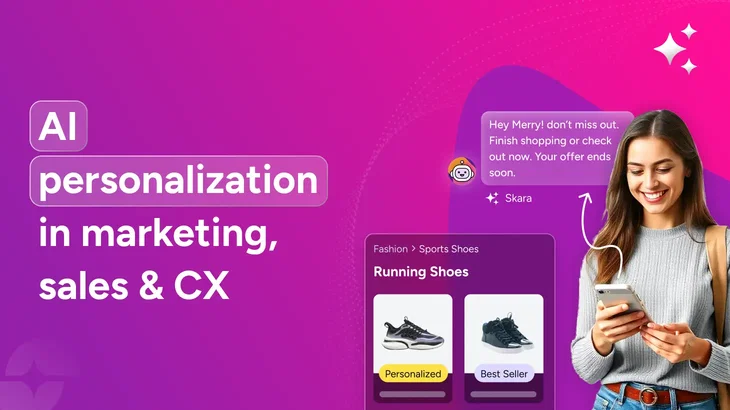
The same applies to ecommerce. A shopper browsing several rings in one category and abandoning a cart deserves a different next message than someone landing on your homepage for the first time. Anticipate customer needs based on what they actually did, not a blanket discount code sent to everyone.
Build the shopping experience customers will expect tomorrow
From product recommendations to order updates and support, Skara AI Agents create always-on, personalized experiences designed for the future of eCommerce.
AI personalization is most useful when every team uses customer data to make the next interaction more relevant, timely, and useful.
1. Marketing
The shift is from one message blasted to a whole list, to varying that message based on what a lead has already engaged with.
Someone who downloaded a deep automation guide is further along than someone reading a beginner article, and a single nurture sequence serving both will be wrong for at least one of them.
This usually means adjusting email content based on past downloads or page views, varying landing page CTAs by intent, recommending relevant content based on reading behavior, and timing send times around when a specific lead has historically opened an email rather than a single company-wide schedule.
Content personalization built this way tends to outperform broader marketing strategies aimed at an entire list, mostly because user engagement goes up when the content matches where someone actually is.
Some teams take this further with dynamic website content, where the homepage itself rearranges based on what a returning visitor looked at last time.
2. Sales
The real advantage for sales isn't personalization in the marketing sense. It's context. A rep who already knows a lead, has read a competitor comparison, and has revisited pricing twice can open with something sharper than "what are you looking for?"
That alone tends to move the conversation along faster, since the buyer doesn't have to re-explain where they are.
In practice, this means lead scoring based on actual behavior rather than just job title or company size, talking points surfaced automatically from what a lead viewed, and alerts when an active deal goes quiet.
The same read on purchase behavior and broader consumer behavior that ecommerce teams use to recommend products can just as easily flag which specific customer segments in a sales pipeline are closest to ready, instead of treating every lead in a given segment the same way.
3. Ecommerce
Product discovery, cart recovery, and order value are the metrics most affected here. A recommendation tied to what someone actually browsed beats a storewide discount sent to everyone.
Cart recovery messages that mention the exact item left behind, plus sizing or delivery details relevant to it, tend to outperform a generic "you forgot something" template, mostly because they actually address the hesitation that caused the abandonment.
Blockquote: Personalization in retail: Key to enhancing customer experience.
4. Support
The clearest win in support is cutting repetition. Someone who's already opened three tickets about the same problem shouldn't have to explain it again to a bot with no memory of any of it.
This usually means surfacing ticket history automatically, flagging sentiment so frustrated customers get prioritized, and routing repeat or high-value issues straight to a senior agent.
Reading past customer queries before a new customer interaction even starts is a small thing, but it's the difference between a customer who feels remembered and one who feels like a number in a queue.
5. Customer success
This is mostly about catching adoption gaps before they turn into churn. A customer who finished onboarding but never touched a core feature should get outreach pointed at that exact gap, not a generic product update.
A usage drop before a renewal date is one of the more reliable early churn signals out there, and it's only useful if someone, or something, is actually watching for it.
The teams that get good at this can predict future behaviors with reasonable accuracy, and acting on those predictions early is usually what separates a renewal from a quiet cancellation, which is part of why personalized accounts tend to show higher customer lifetime value over time.
What are the benefits of AI personalization? The key benefits of AI personalization include improved customer engagement, more effective personalization efforts, and increased revenue growth. Using predictive analytics and AI algorithms, businesses can anticipate customer needs, understand purchase patterns, and deliver more relevant experiences across the customer journey. |
Building a strategy that survives contact with real customers
Start with an actual business problem, not the idea of using more AI technology. Ask where customers are dropping off, slowing down, or getting the wrong experience.
That might be low demo bookings, cart abandonment, stalled trial activation, or rising churn. Whatever you pick, align personalization strategies with a real business objective from the start, something a leadership team would actually recognize among its broader business objectives, rather than chasing personalization as a goal in itself.
Pick one stage to fix first. Trying to personalize the whole customer journey at once is how most of these projects stall out.
There's too much to connect and not enough to measure against. If demo conversion is the issue, narrow your focus to high-intent visitors specifically, like people hitting pricing, demo, and comparison pages, rather than everyone who lands on your site.
For each workflow, answer four questions up front: what signal are you tracking, what does it actually mean, what action follows from it, and how will you know if it worked?
Skipping that last question, measurement, is the most common reason these efforts quietly fail. Teams build the trigger, ship it, and never check whether the personalized version beats the generic one.
Some examples of trigger logic worth starting with:
- A lead visits pricing twice in a week, so a sales task gets created with the pages they viewed
- A trial user goes quiet for three days, so an onboarding nudge goes out tied to the feature they haven't touched
- A cart gets abandoned, so the recovery message references the specific item, not a blanket discount
- Usage drops noticeably before a renewal date, so customer success gets alerted
- A customer opens a third ticket on the same issue, so it escalates automatically rather than restarting the bot flow
Then connect the systems behind it. Personalization built on scattered data across marketing, CRM, and support tools will always be less effective than personalization powered by a unified customer record.
Tools that bring CRM, communication and automation together in one place, such as Salesmate among several options alongside HubSpot and Salesforce, depending on your size and budget, exist to close that exact gap.
The platform matters far less than whether your customer data is connected across systems. Effective AI personalization depends on AI accessing the same customer record across email, chat, phone, and website interactions.
Test before you scale. Run one segment, one channel, one workflow against a non-personalized control, and look at the real difference before rolling it out everywhere.
Turn customer data into personalized experiences at scale
Unify sales, marketing, and support in one AI-powered CRM that helps you engage customers with the right message at the right time.
Where teams get AI-driven personalization wrong
A handful of mistakes show up often enough to call out directly, and most of them come back to maintaining customer satisfaction somewhere along the personalization process.
No clear goal. "Improve AI personalization" can't be measured. "Increase demo bookings from high intent visitors by 20%" can.
Collecting more data than any workflow uses. Extra data doesn't make the experience more relevant on its own. It just adds privacy exposure and maintenance work for no real return.
Showing your hand on the tracking. "We noticed you visited pricing three times last night," tells someone exactly how closely they're being watched. "Still comparing plans?
Here's a quick breakdown:" delivers the same insight without the discomfort. That line matters. It's what separates AI personalization that makes customers feel valued from personalization that triggers an opt-out.
Losing context between teams. A well personalized marketing email, followed by a sales rep who has no idea what it said, breaks the experience the customer just had. Context needs to travel with the person, not stay locked inside whichever tool generated it.
Tracking clicks instead of outcomes. A high click rate on a personalized email that never turns into a pipeline or revenue isn't a win. It's a vanity metric wearing an AI personalization label.
Skipping human review where it actually matters. Enterprise deals, billing disputes, refunds, and anything touching health, legal, or financial sensitivity shouldn't run on full automation, no matter how confident the model is. A wrong automated call in these situations costs more than the efficiency gain is worth.
Blockquote: How to drive business growth with hyper personalization in CRM?.
Actually measuring customer satisfaction and whether it's working
Tie every workflow to one outcome before you launch it, not after.
| Function | What to track |
|---|
| Marketing | Lead conversion rate, content engagement, pipeline tied to marketing efforts and campaigns |
| Sales | Lead to demo rate, sales cycle length, and win rate |
| Ecommerce | Cart recovery rate, average order value, repeat purchase rate |
| Support | Resolution time, escalation rate, CSAT |
| Customer success | Feature adoption, renewal rate, and expansion revenue |
Keep an eye on the signals that something's gone too far. Rising unsubscribes, more opt-outs, more data deletion requests, or a jump in complaints about feeling tracked.
Those tend to show up before your revenue numbers do, so they're worth checking even when everything else looks fine.
Improved customer satisfaction on a dashboard means nothing if it's coming alongside a quiet rise in people opting out altogether.
The cleanest test stays the same no matter what you're personalizing: run the personalized version against a control on the same segment and look at the actual gap in conversion, revenue, and satisfaction.
Personalized messages and dynamic customer experiences should each get judged this way individually, not lumped into one vague "personalization is working" conclusion, since some user interactions respond to messaging changes and others respond to changes in the experience itself.
If there's no gap, the added complexity isn't paying for itself yet, and that's a more useful answer than assuming personalization is automatically worth it.
The honest bottom line
AI personalization isn't about generating more messages or stacking on more automation. It's about using the data you already have, once it's actually connected, to make each interaction a bit more relevant than the generic version would've been.
The businesses seeing real results aren't running the fanciest models. They've got clean, connected data, a narrow starting point, and a habit of checking whether each workflow actually moved a number that matters before they expand it further.
Successful AI personalization starts with understanding customer satisfaction, preferences, behavior, and intent across every touchpoint.
The most effective AI-driven personalization strategies combine customer data, predictive insights, and automation to deliver personalized experiences that feel relevant rather than intrusive.
Whether it's a handful of user queries in a support chat or a full marketing sequence, the businesses that engage customers well are the ones paying attention to what's actually being asked, not just what's being clicked.
Frequently asked questions
1. What's an example of AI personalization?
An online store recommending products based on browsing history and previous purchases, or a B2B site triggering a sales follow-up after a lead hits the pricing page a few times, are both common examples.
2. How is AI personalization different from regular personalization?
Rule-based personalization follows a fixed instruction someone set up in advance, like segmenting by industry. AI personalization uses machine learning models to predict the next best action from live behavioral and CRM data, so it can react to situations nobody explicitly planned for.
3. What data do you actually need?
A mix of first-party data from your own site, CRM, and product, zero-party data customers tell you directly, behavioral data showing what they actually do, and conversational data from calls, chats, and tickets. It needs to be connected well enough to act on, not exhaustive.
4. What are the real risks?
Disconnected data leading to irrelevant triggers, personalization that feels like surveillance rather than help, biased recommendations if your underlying data has gaps, and over-automating decisions, like billing disputes or enterprise deals, that genuinely need a person involved.








Key takeaways
You already know the feeling. Netflix shows you something you didn't search for but somehow wanted to watch anyway.
An online store remembers what you almost bought last week.
A support chat already knows you've asked about this exact problem before.
All of that runs on AI personalization, and it's quietly become one of the bigger gaps between brands that convert well and brands that don't.
This guide explains what AI personalization is, how it differs from traditional personalization, where it fits across the customer journey, and how to implement it using real customer data.
What AI personalization really means
AI personalization uses customer behavior, purchase history, and browsing history to decide what a specific person should see, get offered, or be told next.
The goal of any effective AI personalization strategy is to deliver content and experiences that feel tailored to each customer, not pulled from a shared template.
Adding someone's first name to a sales email isn't this. That's a basic rule, and rules have been around for decades.
AI works differently. It reads live signals like user behavior, intent, support tickets, and chat messages, then uses machine learning to spot patterns and recommend the next best action instead of following fixed rules.
The same underlying approach shows up in targeted advertising, too, where ad platforms use these same behavioral signals to decide which ad a specific person actually sees.
The question your system is really trying to answer is simple: what does this person need right now, based on what they're actually doing?
To answer it, AI personalization solutions typically look at:
When this works, the payoff is real, and it's been measured.
McKinsey's research found AI personalization can cut customer acquisition costs by as much as 50%, lift revenue by 5 to 15%, and improve marketing ROI by 10 to 30%.
Faster-growing companies also generate 40% more revenue from personalization than slower-growing peers.
That makes AI personalization a real competitive advantage, but only when the data, strategy, and execution are strong enough to invest and pay off.
How does AI personalization work?
AI personalization uses artificial intelligence, machine learning algorithms, natural language processing (NLP), and data analytics to analyze customer behavior, user preferences, and historical data. By identifying patterns across multiple data points, AI delivers personalized content and recommendations tailored to individual customer preferences.
How AI personalization differs from what you're probably doing now
Most teams already personalize something. The real difference between traditional personalization methods and AI-powered personalization comes down to who, or what, is making the decision.
Rule-based systems are easy to audit and predictable. They just can't react to anything outside the rules someone already wrote.
AI personalization tools trade some of that predictability for relevance, which is a genuine tradeoff worth knowing about before you lean fully into automation, especially for anything sensitive.
The same idea powers dynamic pricing, where prices adjust based on demand and buying signals, and mobile apps, where notifications and offers change based on how people use the app.
What this looks like in practice
Picture a visitor who reads three blog posts on sales automation, opens an email about automated follow-ups, then checks your pricing page on mobile apps twice in a week.
A static system treats them exactly like someone landing on your homepage for the first time. A system actually deploying AI personalization can:
None of that needs guesswork. It needs your CRM data, content engagement, and page visits to be actually connected, which is usually the part that teams underinvest in compared to the AI tools themselves.
Every page view, email click, and support call is a customer touchpoint, and analyzing data across all of them together is what actually lets a system deliver highly customized experiences instead of a single lucky guess.
The same applies to ecommerce. A shopper browsing several rings in one category and abandoning a cart deserves a different next message than someone landing on your homepage for the first time. Anticipate customer needs based on what they actually did, not a blanket discount code sent to everyone.
Build the shopping experience customers will expect tomorrow
From product recommendations to order updates and support, Skara AI Agents create always-on, personalized experiences designed for the future of eCommerce.
Where AI-powered personalization shows up across the customer journey
AI personalization is most useful when every team uses customer data to make the next interaction more relevant, timely, and useful.
1. Marketing
The shift is from one message blasted to a whole list, to varying that message based on what a lead has already engaged with.
Someone who downloaded a deep automation guide is further along than someone reading a beginner article, and a single nurture sequence serving both will be wrong for at least one of them.
This usually means adjusting email content based on past downloads or page views, varying landing page CTAs by intent, recommending relevant content based on reading behavior, and timing send times around when a specific lead has historically opened an email rather than a single company-wide schedule.
Content personalization built this way tends to outperform broader marketing strategies aimed at an entire list, mostly because user engagement goes up when the content matches where someone actually is.
Some teams take this further with dynamic website content, where the homepage itself rearranges based on what a returning visitor looked at last time.
2. Sales
The real advantage for sales isn't personalization in the marketing sense. It's context. A rep who already knows a lead, has read a competitor comparison, and has revisited pricing twice can open with something sharper than "what are you looking for?"
That alone tends to move the conversation along faster, since the buyer doesn't have to re-explain where they are.
In practice, this means lead scoring based on actual behavior rather than just job title or company size, talking points surfaced automatically from what a lead viewed, and alerts when an active deal goes quiet.
The same read on purchase behavior and broader consumer behavior that ecommerce teams use to recommend products can just as easily flag which specific customer segments in a sales pipeline are closest to ready, instead of treating every lead in a given segment the same way.
3. Ecommerce
Product discovery, cart recovery, and order value are the metrics most affected here. A recommendation tied to what someone actually browsed beats a storewide discount sent to everyone.
Cart recovery messages that mention the exact item left behind, plus sizing or delivery details relevant to it, tend to outperform a generic "you forgot something" template, mostly because they actually address the hesitation that caused the abandonment.
4. Support
The clearest win in support is cutting repetition. Someone who's already opened three tickets about the same problem shouldn't have to explain it again to a bot with no memory of any of it.
This usually means surfacing ticket history automatically, flagging sentiment so frustrated customers get prioritized, and routing repeat or high-value issues straight to a senior agent.
Reading past customer queries before a new customer interaction even starts is a small thing, but it's the difference between a customer who feels remembered and one who feels like a number in a queue.
5. Customer success
This is mostly about catching adoption gaps before they turn into churn. A customer who finished onboarding but never touched a core feature should get outreach pointed at that exact gap, not a generic product update.
A usage drop before a renewal date is one of the more reliable early churn signals out there, and it's only useful if someone, or something, is actually watching for it.
The teams that get good at this can predict future behaviors with reasonable accuracy, and acting on those predictions early is usually what separates a renewal from a quiet cancellation, which is part of why personalized accounts tend to show higher customer lifetime value over time.
What are the benefits of AI personalization?
The key benefits of AI personalization include improved customer engagement, more effective personalization efforts, and increased revenue growth. Using predictive analytics and AI algorithms, businesses can anticipate customer needs, understand purchase patterns, and deliver more relevant experiences across the customer journey.
Building a strategy that survives contact with real customers
Start with an actual business problem, not the idea of using more AI technology. Ask where customers are dropping off, slowing down, or getting the wrong experience.
That might be low demo bookings, cart abandonment, stalled trial activation, or rising churn. Whatever you pick, align personalization strategies with a real business objective from the start, something a leadership team would actually recognize among its broader business objectives, rather than chasing personalization as a goal in itself.
Pick one stage to fix first. Trying to personalize the whole customer journey at once is how most of these projects stall out.
There's too much to connect and not enough to measure against. If demo conversion is the issue, narrow your focus to high-intent visitors specifically, like people hitting pricing, demo, and comparison pages, rather than everyone who lands on your site.
For each workflow, answer four questions up front: what signal are you tracking, what does it actually mean, what action follows from it, and how will you know if it worked?
Skipping that last question, measurement, is the most common reason these efforts quietly fail. Teams build the trigger, ship it, and never check whether the personalized version beats the generic one.
Some examples of trigger logic worth starting with:
Then connect the systems behind it. Personalization built on scattered data across marketing, CRM, and support tools will always be less effective than personalization powered by a unified customer record.
Tools that bring CRM, communication and automation together in one place, such as Salesmate among several options alongside HubSpot and Salesforce, depending on your size and budget, exist to close that exact gap.
The platform matters far less than whether your customer data is connected across systems. Effective AI personalization depends on AI accessing the same customer record across email, chat, phone, and website interactions.
Test before you scale. Run one segment, one channel, one workflow against a non-personalized control, and look at the real difference before rolling it out everywhere.
Turn customer data into personalized experiences at scale
Unify sales, marketing, and support in one AI-powered CRM that helps you engage customers with the right message at the right time.
Where teams get AI-driven personalization wrong
A handful of mistakes show up often enough to call out directly, and most of them come back to maintaining customer satisfaction somewhere along the personalization process.
No clear goal. "Improve AI personalization" can't be measured. "Increase demo bookings from high intent visitors by 20%" can.
Collecting more data than any workflow uses. Extra data doesn't make the experience more relevant on its own. It just adds privacy exposure and maintenance work for no real return.
Showing your hand on the tracking. "We noticed you visited pricing three times last night," tells someone exactly how closely they're being watched. "Still comparing plans?
Here's a quick breakdown:" delivers the same insight without the discomfort. That line matters. It's what separates AI personalization that makes customers feel valued from personalization that triggers an opt-out.
Losing context between teams. A well personalized marketing email, followed by a sales rep who has no idea what it said, breaks the experience the customer just had. Context needs to travel with the person, not stay locked inside whichever tool generated it.
Tracking clicks instead of outcomes. A high click rate on a personalized email that never turns into a pipeline or revenue isn't a win. It's a vanity metric wearing an AI personalization label.
Skipping human review where it actually matters. Enterprise deals, billing disputes, refunds, and anything touching health, legal, or financial sensitivity shouldn't run on full automation, no matter how confident the model is. A wrong automated call in these situations costs more than the efficiency gain is worth.
Actually measuring customer satisfaction and whether it's working
Tie every workflow to one outcome before you launch it, not after.
Keep an eye on the signals that something's gone too far. Rising unsubscribes, more opt-outs, more data deletion requests, or a jump in complaints about feeling tracked.
Those tend to show up before your revenue numbers do, so they're worth checking even when everything else looks fine.
Improved customer satisfaction on a dashboard means nothing if it's coming alongside a quiet rise in people opting out altogether.
The cleanest test stays the same no matter what you're personalizing: run the personalized version against a control on the same segment and look at the actual gap in conversion, revenue, and satisfaction.
Personalized messages and dynamic customer experiences should each get judged this way individually, not lumped into one vague "personalization is working" conclusion, since some user interactions respond to messaging changes and others respond to changes in the experience itself.
If there's no gap, the added complexity isn't paying for itself yet, and that's a more useful answer than assuming personalization is automatically worth it.
The honest bottom line
AI personalization isn't about generating more messages or stacking on more automation. It's about using the data you already have, once it's actually connected, to make each interaction a bit more relevant than the generic version would've been.
The businesses seeing real results aren't running the fanciest models. They've got clean, connected data, a narrow starting point, and a habit of checking whether each workflow actually moved a number that matters before they expand it further.
Successful AI personalization starts with understanding customer satisfaction, preferences, behavior, and intent across every touchpoint.
The most effective AI-driven personalization strategies combine customer data, predictive insights, and automation to deliver personalized experiences that feel relevant rather than intrusive.
Whether it's a handful of user queries in a support chat or a full marketing sequence, the businesses that engage customers well are the ones paying attention to what's actually being asked, not just what's being clicked.
Frequently asked questions
1. What's an example of AI personalization?
An online store recommending products based on browsing history and previous purchases, or a B2B site triggering a sales follow-up after a lead hits the pricing page a few times, are both common examples.
2. How is AI personalization different from regular personalization?
Rule-based personalization follows a fixed instruction someone set up in advance, like segmenting by industry. AI personalization uses machine learning models to predict the next best action from live behavioral and CRM data, so it can react to situations nobody explicitly planned for.
3. What data do you actually need?
A mix of first-party data from your own site, CRM, and product, zero-party data customers tell you directly, behavioral data showing what they actually do, and conversational data from calls, chats, and tickets. It needs to be connected well enough to act on, not exhaustive.
4. What are the real risks?
Disconnected data leading to irrelevant triggers, personalization that feels like surveillance rather than help, biased recommendations if your underlying data has gaps, and over-automating decisions, like billing disputes or enterprise deals, that genuinely need a person involved.
Shivani Tripathi
Shivani TripathiShivani is a passionate writer who found her calling in storytelling and content creation. At Salesmate, she collaborates with a dynamic team of creators to craft impactful narratives around marketing and sales. She has a keen curiosity for new ideas and trends, always eager to learn and share fresh perspectives. Known for her optimism, Shivani believes in turning challenges into opportunities. Outside of work, she enjoys introspection, observing people, and finding inspiration in everyday moments.