AI customer service agents are NLP-powered support tools that automate repetitive, data-driven customer interactions, speed up resolution, and connect with business systems, but they deliver the best results when they hand complex issues to human agents with full context.
That distinction matters more in 2026 than it did a year ago. Businesses and customer service teams evaluating AI customer service agents are no longer just asking whether sales automation can reduce ticket volume or cut costs.
They need to know whether it improves resolution rate, protects customer satisfaction, and fits how customers actually want to get help as sentiment shifts back toward human support.
This guide looks at where AI customer service agents genuinely improve support performance, where they still fall short, and how to choose the right platform based on your channels, customer data, and support model.
Understanding customer service AI agents
A basic chatbot answers from a fixed script. Live chat puts you straight through to a person. An AI customer service agent sits in between.
It reads what a customer actually means, not just the words they typed, and pulls answers from your customer records, order history, and past conversations.
When the moment calls for it, it can take action inside your enterprise systems: updating a record, triggering a refund, moving a workflow forward.
Most of this runs on natural language processing and machine learning models trained on multiple customer interactions across many companies, which is also why response quality varies so much between platforms.
| Basic chatbot | Live chat | AI customer service agent |
|---|
| Main role | Scripted FAQ answers | Connects you to a human | Resolves requests using your customer data |
| Context | Limited | Depends on the agent | Full customer history across CRM, tickets, orders |
| Takes action | Rarely | The human takes it | Can trigger workflows and update enterprise systems |
| Escalation | Often weak | Native | Should hand off with context attached |
| Best fit | Simple FAQs | Complex or emotional conversations | Repetitive, action-based requests at scale |
Where customer support AI agents deliver the biggest impact
Used well, these agents become a real part of your AI customer service agents operations rather than a bolt-on add-on. Here's where that actually plays out.
a. Routine tasks and the questions that repeat every day
Customer support AI agents are ideal for handling high-volume, repetitive queries like shipping updates, warranty terms, plan limits, and integration questions.
Powered by natural language processing (NLP), they automate these customer interactions with fast, accurate, and consistent responses, allowing support teams to focus on more complex issues.
b. Order, account, and service status
This is where the data backs the use case up strongly. Bank of America's Erica, running since 2018, passed 3 billion client interactions by its August 2025 milestone, averaging 58 million interactions a month with a reported 98% accuracy rate.
Its most recent 2026 disclosures put cumulative interactions above 3.2 billion. That's a decade of narrow, well-scoped use: balance checks, transaction status, eligibility questions.
Exactly the kind of accurate, repeatable answer AI is built for, and the kind of narrow use case that supports broader AI customer service agents' workflows.
c. Returns, refunds, and service requests
The point isn't automating every decision. It's collecting the right details fast and routing exceptions to a human who can approve them, with customer sentiment and full history attached.
d. Helping customers before they buy
Pre-sale questions about sizing, compatibility, or plan fit are a growing use case, especially as shopping assistants start offering personalized support based on past conversations and customer records, not just generic comparisons.
e. Routing the requests that shouldn't stay with AI
A capable agent should pick up on urgency and customer sentiment, identify the issue type, and hand off with context attached, so customers aren't repeating themselves to the next person.
f. Supporting human agents, not just replacing them
Summarizing long threads, surfacing the most relevant information from your knowledge base, and drafting suggested replies are some of the more durable wins.
Most agent platforms run on a shared team inbox, so your human agents collaborate with the AI in real time rather than working around it.
g. Proactive support before customers have to ask
Delivery delay alerts, failed payment reminders, renewal nudges. This turns your support operations from reactive to proactive and helps them stay responsive during spikes, as long as the underlying customer data is reliable enough to trust the alert.
B2B teams use the same approach for customer success check-ins and renewals.
Best AI customer service agents don't just answer questions
See how Skara AI Agents help you automate repetitive customer interactions, streamline customer service workflows, and deliver more personalized support across every channel.
Is AI actually making customer service worse for your customers
Worth asking honestly before you deploy anything, because the answer shapes your whole customer experience, not just your support budget, and it depends on which year's data you trust.
Through 2024 and most of 2025, the story was that customers had warmed up to AI-powered customer service, with the "81% of customers prefer self-service" stat appearing on nearly every vendor blog.
That number's sourcing is shaky, and it's already aging. A Verint-backed report covered by CX Today found 61% of customers now prefer talking to a human agent over an AI service, up five points year over year, with the steepest rise among 18 to 34 year olds, the group most service teams were counting on to self-serve.
A June 2026 survey of 6,000 consumers found 82% had asked to speak with a human instead of an AI agent, most of them more than once, and 61% said they got frustrated having to explain their issue to AI before getting transferred.
None of that means AI customer service agents are failing across the board. It means you can't assume your customers are happy self-serving just because that was the conventional wisdom two years ago.
What are the benefits of AI customer service agents? The biggest benefits of AI customer service agents include faster response times, 24/7 customer support, lower operational costs, and consistent service across multiple channels. When integrated with CRM, billing, and help desk platforms, they can automate repetitive tasks such as order tracking, refunds, account updates, and ticket routing, allowing human support teams to focus on complex, high-value customer interactions. |
A 2022 UJET survey, still one of the more concrete data points here, found 63% of customers said their chatbot interaction didn't lead to a resolution, and 78% eventually got bounced to a human anyway.
That's the pattern worth designing around: your AI layer should shorten the path to a resolved request, not stand between your customer and the person who can actually help them.
Get that wrong, and you lose customer loyalty fast, no matter how clean your dashboard looks.
Customer service AI agents are easy to buy and surprisingly easy to get wrong. Here's what's actually working with customer service AI agents in 2026, what isn't, and how to tell the difference before you sign a contract.
Klarna lesson: Good metrics don't guarantee customer satisfaction
Klarna's AI assistant, built on OpenAI, shows up in almost every article about AI customer service agent automation, and the early numbers earned that.
In its first month live, back in February 2024, it handled 2.3 million customer interactions, two-thirds of Klarna's total chat volume, doing work the company estimated at 700 full-time agents, while matching human agents on customer satisfaction and cutting resolution time from 11 minutes down to under 2.
What usually gets skipped is what came after. By mid 2025, Klarna was rehiring for customer service AI agent roles it had cut during the AI-first push.
A spokesperson told CX Dive the company now wants customer interactions to always have the option to reach a human, calling it an investment in the human side of service, even as AI kept handling roughly two-thirds of chat volume.
Klarna's AI still does most of the heavy lifting in 2026. What changed was the recognition that handling volume and keeping customers happy aren't the same metric, and a strategy built only around the first one eventually needs a correction, the way Klarna's did.
Also read: What is customer service automation? [A detailed guide].
The platform landscape: Who's strongest for what
Pricing structures across this category shifted a lot in the months leading up to this update, so treat what's below as directional and confirm current rates directly with each vendor.
| Platform | Best for | Worth knowing in 2026 |
|---|
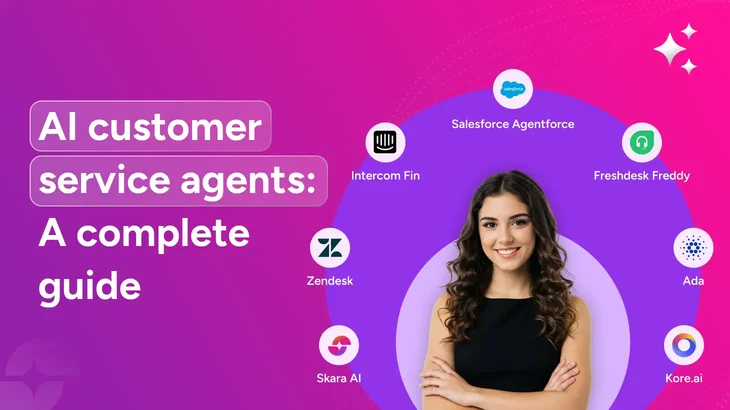
| Skara AI Agents (Salesmate) | Sales, support, and ecommerce in one AI agent platform | Strongest reviews are for the Salesmate CRM overall; Skara, as a standalone product, has less independent review volume |
| Zendesk AI Agents | Teams already running Zendesk's helpdesk | Moved to fully outcome-based pricing in May 2026, away from the older seat plus add-on model |
| Intercom Fin | SaaS and digital-first support teams | Priced per resolution at $0.99 an outcome, meaning a conversation closed without human intervention; independently reported real-world resolution rates run 42 to 50%, lower than the marketing implies |
| Salesforce Agentforce | Enterprise teams already on Salesforce, especially Service Cloud | Salesforce markets it as an autonomous AI agents platform; it now runs three pricing models at once (a free Foundations tier, Flex Credits, and the original $2 per conversation rate) after customers pushed back on cost predictability |
| Freshdesk Freddy AI Agent | SMB and mid-market teams want no-code tools | Handles backend support tasks like refunds and subscription changes; strong multilingual support across 60+ languages; bundles a limited number of free AI sessions into its plans |
| Ada | Enterprise teams needing multilingual, omnichannel scale across complex workflows | Sales-assisted pricing only; cited case studies show solid automation gains, though these are vendor-published, not independently audited |
| Kore.ai | Large, regulated enterprises in banking, healthcare, and telecom | Strong on governance, role-based access controls, and multi-agent orchestration; pricing is fully custom |
A few honest caveats to carry into your own evaluation. Vendor published resolution rates, satisfaction scores, and ROI figures are self-reported unless a source says otherwise, and they're measured under conditions that favor the vendor's own platform.
Weigh them against independent reviews on G2 and Capterra, and against your own pilot data, before you treat any single number as the deciding factor. None of these figures tells you much about day-to-day service quality on its own.
Must check: How AI agents change customer journey [For businesses].
Why businesses choose Skara AI Agents for customer support
Many AI customer service platforms focus only on support automation. Skara AI Agents, built into Salesmate CRM, take a broader approach by connecting customer support, sales, and customer engagement in one platform.
Instead of working as a standalone chatbot, Skara AI Agents can access customer records, conversation history, deal information, and support ticketing sofware to deliver more personalized responses and automate actions across the customer journey.
Some of the capabilities that make Skara AI Agents stand out include:
- AI-powered conversations across web chat and other customer channels
- Native CRM integration for a complete customer context
- Automated ticket creation, routing, and follow-up workflows
- Shared inbox for seamless collaboration between AI and human agents
- Lead qualification agents and customer support from a single platform
- Workflow automation that reduces repetitive support tasks
- Reporting and analytics to measure AI performance, resolution rates, and customer satisfaction
For businesses that want an AI customer service solution without stitching together multiple products, Skara AI Agents offer a unified approach that combines CRM, automation, and AI in one system.
Ready to see AI customer service agents in action?
Discover how Skara AI Agents help your team automate repetitive customer interactions, resolve support requests faster, and deliver personalized customer experiences.
How to choose customer service AI agents
Start with the customer inquiries and customer requests your customer service team actually fields every week, and map them to the workflows your team actually runs, not the ones a demo is built to showcase.
Then check whether a platform can take action, not just generate accurate responses: does it update a ticket, trigger a refund, or only point to a knowledge base article?
Check for seamless integration with the enterprise systems you already run, your CRM software, your knowledge base, your billing platform, since a bolt-on tool that can't see your real customer records will struggle no matter how good its language model is.
Match it to the digital and voice channels your customers already use, because a platform that shines on web chat but struggles on WhatsApp or voice gives you a two-tier experience.
Look closely at the handoff. A billing dispute or an upset customer needs to reach a person with full context attached, not a blank slate and a request to repeat themselves.
Track AI agent performance and overall customer satisfaction together, not deflection on its own. Strong systems can improve their own performance over time, but only if you measure outcomes against real support results.
A tool that hides tickets while frustrating your customers is optimizing for the wrong thing, the same trap Klarna had to correct for in 2025.
And test it with real, messy customer queries before you commit: ambiguous requests, billing disputes, an angry customer, a multi-step request.
A sales demo is built to succeed. Your actual support queue is where you'll find out whether a platform holds up.
How do you choose the right AI customer service platform? Choose an AI customer service platform based on its ability to improve customer satisfaction—not just automate conversations. Look for strong CRM and help desk integrations, omnichannel support, reliable AI-to-human handoffs, workflow automation, transparent pricing, multilingual capabilities, and proven resolution rates. Running a pilot with real customer conversations is the best way to evaluate long-term performance. |
Conclusion
AI customer service agents are no longer a competitive advantage simply because they exist—they're valuable only when they improve the customer experience.
The most successful deployments use AI to automate repetitive, data-driven interactions, support human agents, and resolve issues faster without making customers fight to reach a person when they need one.
As 2026 has shown, customer expectations are changing. Resolution rate, customer satisfaction, and seamless human handoffs matter far more than ticket deflection or automation percentages.
When evaluating customer support AI agents, focus on real business outcomes, integration with your existing systems, transparent pricing, and the quality of the end-to-end support experience.
The right platform won't replace your support team; it will help them deliver faster, more consistent, and more personalized customer service at scale.
Frequently asked questions
1. Is AI customer service getting worse for customers, or is that overstated?
The data's mixed and moving. Independent 2026 research, including Verint-backed reporting and a June 2026 consumer survey, both show rising preference for human agents over AI, which reverses a couple of years of "customers are fine self-serving" messaging.
2. How is an AI customer service agent different from a basic chatbot?
A chatbot follows a script. An AI agents for a customer platform reads intent, pulls from your customer data such as CRM records and order history, can take action inside your systems, and should hand off to a human with context when the conversation needs one.
3. Can AI customer service agents replace your support agents entirely?
Klarna's experience says no. It automated roughly two-thirds of its chat volume by 2024 and still does, but walked back its plan to cut human headcount in 2025 once it became clear customers needed a reliable way back to a person.
4. What's the most reliable way to measure whether an AI agent is actually helping?
Track resolution rate and overall customer satisfaction together, not ticket deflection alone. A platform can quietly reduce visible support volume while leaving plenty of customers unhappy, and that gap is exactly what's showing up in 2026's rising human preference numbers.
5. Do AI customer service platform prices hold steady enough to compare confidently?
Not right now. Zendesk rebuilt its AI pricing model in May 2026, and Salesforce runs three different pricing models simultaneously after pushback on its original flat rate. Get a live quote before you budget, rather than relying on any published figure, including the ones here.








Key takeaways
AI customer service agents are NLP-powered support tools that automate repetitive, data-driven customer interactions, speed up resolution, and connect with business systems, but they deliver the best results when they hand complex issues to human agents with full context.
That distinction matters more in 2026 than it did a year ago. Businesses and customer service teams evaluating AI customer service agents are no longer just asking whether sales automation can reduce ticket volume or cut costs.
They need to know whether it improves resolution rate, protects customer satisfaction, and fits how customers actually want to get help as sentiment shifts back toward human support.
This guide looks at where AI customer service agents genuinely improve support performance, where they still fall short, and how to choose the right platform based on your channels, customer data, and support model.
Understanding customer service AI agents
A basic chatbot answers from a fixed script. Live chat puts you straight through to a person. An AI customer service agent sits in between.
It reads what a customer actually means, not just the words they typed, and pulls answers from your customer records, order history, and past conversations.
When the moment calls for it, it can take action inside your enterprise systems: updating a record, triggering a refund, moving a workflow forward.
Most of this runs on natural language processing and machine learning models trained on multiple customer interactions across many companies, which is also why response quality varies so much between platforms.
Where customer support AI agents deliver the biggest impact
Used well, these agents become a real part of your AI customer service agents operations rather than a bolt-on add-on. Here's where that actually plays out.
a. Routine tasks and the questions that repeat every day
Customer support AI agents are ideal for handling high-volume, repetitive queries like shipping updates, warranty terms, plan limits, and integration questions.
Powered by natural language processing (NLP), they automate these customer interactions with fast, accurate, and consistent responses, allowing support teams to focus on more complex issues.
b. Order, account, and service status
This is where the data backs the use case up strongly. Bank of America's Erica, running since 2018, passed 3 billion client interactions by its August 2025 milestone, averaging 58 million interactions a month with a reported 98% accuracy rate.
Its most recent 2026 disclosures put cumulative interactions above 3.2 billion. That's a decade of narrow, well-scoped use: balance checks, transaction status, eligibility questions.
Exactly the kind of accurate, repeatable answer AI is built for, and the kind of narrow use case that supports broader AI customer service agents' workflows.
c. Returns, refunds, and service requests
The point isn't automating every decision. It's collecting the right details fast and routing exceptions to a human who can approve them, with customer sentiment and full history attached.
d. Helping customers before they buy
Pre-sale questions about sizing, compatibility, or plan fit are a growing use case, especially as shopping assistants start offering personalized support based on past conversations and customer records, not just generic comparisons.
e. Routing the requests that shouldn't stay with AI
A capable agent should pick up on urgency and customer sentiment, identify the issue type, and hand off with context attached, so customers aren't repeating themselves to the next person.
f. Supporting human agents, not just replacing them
Summarizing long threads, surfacing the most relevant information from your knowledge base, and drafting suggested replies are some of the more durable wins.
Most agent platforms run on a shared team inbox, so your human agents collaborate with the AI in real time rather than working around it.
g. Proactive support before customers have to ask
Delivery delay alerts, failed payment reminders, renewal nudges. This turns your support operations from reactive to proactive and helps them stay responsive during spikes, as long as the underlying customer data is reliable enough to trust the alert.
B2B teams use the same approach for customer success check-ins and renewals.
Best AI customer service agents don't just answer questions
See how Skara AI Agents help you automate repetitive customer interactions, streamline customer service workflows, and deliver more personalized support across every channel.
Is AI actually making customer service worse for your customers
Worth asking honestly before you deploy anything, because the answer shapes your whole customer experience, not just your support budget, and it depends on which year's data you trust.
Through 2024 and most of 2025, the story was that customers had warmed up to AI-powered customer service, with the "81% of customers prefer self-service" stat appearing on nearly every vendor blog.
That number's sourcing is shaky, and it's already aging. A Verint-backed report covered by CX Today found 61% of customers now prefer talking to a human agent over an AI service, up five points year over year, with the steepest rise among 18 to 34 year olds, the group most service teams were counting on to self-serve.
A June 2026 survey of 6,000 consumers found 82% had asked to speak with a human instead of an AI agent, most of them more than once, and 61% said they got frustrated having to explain their issue to AI before getting transferred.
None of that means AI customer service agents are failing across the board. It means you can't assume your customers are happy self-serving just because that was the conventional wisdom two years ago.
What are the benefits of AI customer service agents?
The biggest benefits of AI customer service agents include faster response times, 24/7 customer support, lower operational costs, and consistent service across multiple channels. When integrated with CRM, billing, and help desk platforms, they can automate repetitive tasks such as order tracking, refunds, account updates, and ticket routing, allowing human support teams to focus on complex, high-value customer interactions.
A 2022 UJET survey, still one of the more concrete data points here, found 63% of customers said their chatbot interaction didn't lead to a resolution, and 78% eventually got bounced to a human anyway.
That's the pattern worth designing around: your AI layer should shorten the path to a resolved request, not stand between your customer and the person who can actually help them.
Get that wrong, and you lose customer loyalty fast, no matter how clean your dashboard looks.
Customer service AI agents are easy to buy and surprisingly easy to get wrong. Here's what's actually working with customer service AI agents in 2026, what isn't, and how to tell the difference before you sign a contract.
Klarna lesson: Good metrics don't guarantee customer satisfaction
Klarna's AI assistant, built on OpenAI, shows up in almost every article about AI customer service agent automation, and the early numbers earned that.
In its first month live, back in February 2024, it handled 2.3 million customer interactions, two-thirds of Klarna's total chat volume, doing work the company estimated at 700 full-time agents, while matching human agents on customer satisfaction and cutting resolution time from 11 minutes down to under 2.
What usually gets skipped is what came after. By mid 2025, Klarna was rehiring for customer service AI agent roles it had cut during the AI-first push.
A spokesperson told CX Dive the company now wants customer interactions to always have the option to reach a human, calling it an investment in the human side of service, even as AI kept handling roughly two-thirds of chat volume.
Klarna's AI still does most of the heavy lifting in 2026. What changed was the recognition that handling volume and keeping customers happy aren't the same metric, and a strategy built only around the first one eventually needs a correction, the way Klarna's did.
The platform landscape: Who's strongest for what
Pricing structures across this category shifted a lot in the months leading up to this update, so treat what's below as directional and confirm current rates directly with each vendor.
A few honest caveats to carry into your own evaluation. Vendor published resolution rates, satisfaction scores, and ROI figures are self-reported unless a source says otherwise, and they're measured under conditions that favor the vendor's own platform.
Weigh them against independent reviews on G2 and Capterra, and against your own pilot data, before you treat any single number as the deciding factor. None of these figures tells you much about day-to-day service quality on its own.
Why businesses choose Skara AI Agents for customer support
Many AI customer service platforms focus only on support automation. Skara AI Agents, built into Salesmate CRM, take a broader approach by connecting customer support, sales, and customer engagement in one platform.
Instead of working as a standalone chatbot, Skara AI Agents can access customer records, conversation history, deal information, and support ticketing sofware to deliver more personalized responses and automate actions across the customer journey.
Some of the capabilities that make Skara AI Agents stand out include:
For businesses that want an AI customer service solution without stitching together multiple products, Skara AI Agents offer a unified approach that combines CRM, automation, and AI in one system.
Ready to see AI customer service agents in action?
Discover how Skara AI Agents help your team automate repetitive customer interactions, resolve support requests faster, and deliver personalized customer experiences.
How to choose customer service AI agents
Start with the customer inquiries and customer requests your customer service team actually fields every week, and map them to the workflows your team actually runs, not the ones a demo is built to showcase.
Then check whether a platform can take action, not just generate accurate responses: does it update a ticket, trigger a refund, or only point to a knowledge base article?
Check for seamless integration with the enterprise systems you already run, your CRM software, your knowledge base, your billing platform, since a bolt-on tool that can't see your real customer records will struggle no matter how good its language model is.
Match it to the digital and voice channels your customers already use, because a platform that shines on web chat but struggles on WhatsApp or voice gives you a two-tier experience.
Look closely at the handoff. A billing dispute or an upset customer needs to reach a person with full context attached, not a blank slate and a request to repeat themselves.
Track AI agent performance and overall customer satisfaction together, not deflection on its own. Strong systems can improve their own performance over time, but only if you measure outcomes against real support results.
A tool that hides tickets while frustrating your customers is optimizing for the wrong thing, the same trap Klarna had to correct for in 2025.
And test it with real, messy customer queries before you commit: ambiguous requests, billing disputes, an angry customer, a multi-step request.
A sales demo is built to succeed. Your actual support queue is where you'll find out whether a platform holds up.
How do you choose the right AI customer service platform?
Choose an AI customer service platform based on its ability to improve customer satisfaction—not just automate conversations. Look for strong CRM and help desk integrations, omnichannel support, reliable AI-to-human handoffs, workflow automation, transparent pricing, multilingual capabilities, and proven resolution rates. Running a pilot with real customer conversations is the best way to evaluate long-term performance.
Conclusion
AI customer service agents are no longer a competitive advantage simply because they exist—they're valuable only when they improve the customer experience.
The most successful deployments use AI to automate repetitive, data-driven interactions, support human agents, and resolve issues faster without making customers fight to reach a person when they need one.
As 2026 has shown, customer expectations are changing. Resolution rate, customer satisfaction, and seamless human handoffs matter far more than ticket deflection or automation percentages.
When evaluating customer support AI agents, focus on real business outcomes, integration with your existing systems, transparent pricing, and the quality of the end-to-end support experience.
The right platform won't replace your support team; it will help them deliver faster, more consistent, and more personalized customer service at scale.
Frequently asked questions
1. Is AI customer service getting worse for customers, or is that overstated?
The data's mixed and moving. Independent 2026 research, including Verint-backed reporting and a June 2026 consumer survey, both show rising preference for human agents over AI, which reverses a couple of years of "customers are fine self-serving" messaging.
2. How is an AI customer service agent different from a basic chatbot?
A chatbot follows a script. An AI agents for a customer platform reads intent, pulls from your customer data such as CRM records and order history, can take action inside your systems, and should hand off to a human with context when the conversation needs one.
3. Can AI customer service agents replace your support agents entirely?
Klarna's experience says no. It automated roughly two-thirds of its chat volume by 2024 and still does, but walked back its plan to cut human headcount in 2025 once it became clear customers needed a reliable way back to a person.
4. What's the most reliable way to measure whether an AI agent is actually helping?
Track resolution rate and overall customer satisfaction together, not ticket deflection alone. A platform can quietly reduce visible support volume while leaving plenty of customers unhappy, and that gap is exactly what's showing up in 2026's rising human preference numbers.
5. Do AI customer service platform prices hold steady enough to compare confidently?
Not right now. Zendesk rebuilt its AI pricing model in May 2026, and Salesforce runs three different pricing models simultaneously after pushback on its original flat rate. Get a live quote before you budget, rather than relying on any published figure, including the ones here.
Shivani Tripathi
Shivani TripathiShivani is a passionate writer who found her calling in storytelling and content creation. At Salesmate, she collaborates with a dynamic team of creators to craft impactful narratives around marketing and sales. She has a keen curiosity for new ideas and trends, always eager to learn and share fresh perspectives. Known for her optimism, Shivani believes in turning challenges into opportunities. Outside of work, she enjoys introspection, observing people, and finding inspiration in everyday moments.