Key takeaways
- Returns and exchanges are trust moments, not just cost centers. AI agents turn confusing policies into clear, order-specific conversations that reduce friction and increase repeat purchases.
- AI-powered return and exchange agents automate eligibility checks, status updates, and RMAs while consistently enforcing your rules across every channel, 24/7.
- The biggest revenue win comes from smart exchanges. By detecting intent and checking real-time inventory, AI agents can nudge refunds into size or variant exchanges at the right moment.
- With guardrails in place, AI handles the predictable cases and escalates edge scenarios to humans, cutting ticket volume while giving teams cleaner data and better return insights.
AI agents are rapidly transforming the eCommerce landscape, especially when it comes to returns and exchanges.
By leveraging natural language processing, AI agents can interpret customer requests in real time, making sense of even the most complex return policies and turning them into clear, actionable steps for shoppers.
This not only saves time and resources for retailers but also builds trust and confidence with shoppers, encouraging repeat business.
Returns and exchanges are trust moments, not just cost centers. AI agents turn confusing policies into clear, order-specific conversations that reduce friction and increase repeat purchases.
The biggest revenue win comes from smart exchanges. By detecting intent and checking real-time inventory, AI agents can nudge refunds into size or variant exchanges at the right moment.
With guardrails in place, AI handles the predictable cases and escalates edge scenarios to humans, cutting ticket volume while giving teams cleaner data and better return insights.
For most ecommerce brands, returns and exchanges live in the “necessary evil” category. Customers don’t enjoy digging through policy pages to figure out if something is eligible.
Returns have become one of the largest financial and operational burdens for modern retailers, quietly eroding margins and increasing inefficiencies. In fact, processing a return can cost up to 65% of the original sale.
But when you zoom in, returns aren’t just a cost problem: they’re a trust moment. If a customer experience includes smooth & easy returns or exchanges, they’re far more likely to come back and buy again.
A seamless return experience can significantly impact repeat purchases, with 96% of shoppers indicating its importance.
That’s where AI-powered Return & Exchange Agents come in: they turn a confusing, manual process into a guided, conversational flow that runs 24/7 and still respects your rules.
Why returns and exchanges feel so broken today
Most brands already have the basic infrastructure in place:
- A return policy page is linked in the footer.
- A “Request return” form or portal.
- A help article explaining timelines and conditions.
Shoppers usually begin the return or exchange process through an online portal or form.
On paper, it looks like the job is done. In reality, support still gets hammered with messages like:
- “Can I return this if I’ve worn it once?”
- “Are sale items included?”
- “Can I exchange for a larger size instead of a refund?”
- “I dropped my return - when will I get my money back?”
Customers often need to contact support for clarification or assistance with returns and reverse logistics.
Don't miss: Reducing E-commerce support tickets with an AI agent in E-commerce.
What’s actually broken isn’t the existence of a policy; it’s the experience around it:
- Policies are long, legalistic, and generic. Customers want a simple yes/no answer for their order.
- Most retailers in 2026 require returned items to be in original condition and accompanied by a receipt, which adds to eligibility confusion.
- Agents repeatedly perform the same checks: order date, item category, final sale flags, and country rules.
- Returns are initiated on multiple channels: email, live chat, WhatsApp, Instagram DMs, and context gets scattered.
- Once a return is in progress, customers feel like their parcel disappears into a black box, so they keep chasing updates.
All of this makes returns feel slow, opaque, and reverse logistics slightly adversarial.
An AI agent doesn’t change your policy; it changes how your customers discover, understand, and use that policy.
What a return & exchange AI agent actually does
A Return & Exchange AI Agent is not just a chatbot stuck to your policy page. It’s a policy-aware, data-connected assistant that understands:
- Your return and exchange rules at a granular level
- Your orders and line items in real time
- The customer’s intent expressed in natural language
AI agents work by having defined roles, personalities, and communication styles, along with specific instructions and available tools to complete tasks.
These features enable the agent to reason, use tools, and maintain security while performing complex tasks efficiently.
From the shopper’s perspective, it feels simple:
“I want to return my last order; the shoes are too small.”
Behind that one line, the agent is doing quite a bit of work.
It identifies the user, pulls up their latest order, checks if the shoes are within the return window, verifies that they aren’t “final sale,” and then responds with clear options: refund, store credit, or exchange, whatever your policy allows.
The agent is designed to complete tasks efficiently, such as processing returns and exchanges.
Instead of forcing customers to interpret a wall of text and fill a form, the agent translates your rules into a conversation that progresses the request step by step.
Returns management software allows customers to start returns online, choose convenient drop-off options, and track their return status in real time.
Key return & exchange flows that are perfect for automation
There are a few high-impact moments in the returns journey where AI agents shine. These are the places where the questions are repetitive, the rules are clear, and the expectations are high.
AI agents excel at handling repetitive tasks, freeing up human agents to focus on more complex or creative issues.
Returns management software minimizes manual effort by automating return approvals, generating prepaid labels, and tracking return shipments.
1. Instant eligibility checks without policy confusion
This is the most common and the most straightforward use case.
Today, a customer has to:
- Find the policy
- Match their product category to your rules.
- Calculate days since delivery.
- Interpret edge cases like “final sale” or “hygiene items.”
An AI agent can compress all of that into one interaction:
“These jeans were delivered on 10 December and are eligible for return until 24 December as long as the tags are attached, and they’re unused.
You can choose a refund to your original payment method or store credit with 10% extra. Would you like me to start the return?”
Same policy, completely different experience.
2. Turning return requests into exchanges
Returns hurt revenue. Exchanges protect it. The tricky part is offering an exchange at exactly the right moment.
When a customer says:
“The shirt is nice, but the size is too tight. I want to return it.”
The AI agent can:
- Detect that the issue is fit, not dissatisfaction with the product
- Check real-time inventory for the same item in other sizes or colors.
- Apply your rules for free or discounted exchanges.
- Propose an exchange before defaulting to a refund
For example:
“Totally understand, this style can run a bit small. I can exchange your size M for size L with free exchange shipping, or process a standard refund. What would you prefer?”
If they pick exchange, the agent can automatically:
- Create the exchange order.
- Generate a return label or pickup instruction.
- Confirm timelines for the replacement
You keep the customer experience and the revenue. The customer feels like you tried to rescue the purchase, not just process a transaction.
3. Conversational returns instead of static forms
Classic RMA flows are form-heavy and unforgiving. Traditional forms are designed to handle simple tasks, but often fail when the process becomes more complex.
If a customer makes a mistake, they feel stuck. An AI agent breaks complex tasks into a guided, adaptive conversation.
A typical flow could look like this:
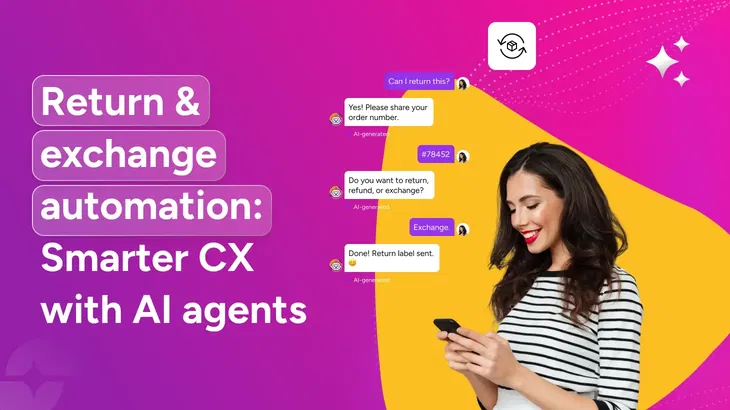
- Customer: “I want to return order #12345.”
- Agent confirms identity securely.
- The agent lists items and asks which one(s) they want to return.
The agent asks follow-up questions based on your policies:
- Reason for return (size, color, defect, changed mind, etc.)
- Condition of the item (unworn, lightly used, damaged)
- Optional photos for defects or damage
- The agent evaluates eligibility based on your rules.
Agent generates:
- Return label or QR code
- Instructions for packaging and drop-off/pickup
- Expected timeline for inspection and refund
Returning items typically involves taking them back with proof of purchase within a time limit of 30-90 days to receive a refund, exchange, or store credit.
To the customer, it feels like talking to a competent agent who never asks them to “go fill another form.”
Also read: Conversational AI: The game changer for e-commerce.
4. “Where is my return?” and refund anxiety
After a package leaves the customer’s hands, uncertainty kicks in. That’s when support teams see a flood of:
- “Have you received my package?”
- “Has my return been approved?”
- “When will I get my refund?”
An AI agent with access to your return/RMA system and shipping events can answer these in seconds:
“Your return was received at our warehouse yesterday and is currently under inspection. This usually takes one to two business days.
Once approved, your refund will be initiated to your original card and should appear within three to five business days. I’ll notify you as soon as it’s processed.”
Same process for exchanges:
“Your return was approved this morning. The replacement in size L is scheduled to ship tomorrow; I’ll send you a tracking link as soon as it’s on the way.”
These small, clear updates dramatically reduce anxiety and ticket volume.
Automation with guardrails: where AI acts and when humans step in
Putting an AI agent in charge of returns doesn’t mean giving it a blank cheque. The goal is to automate the predictable while keeping humans in the loop for edge cases.
AI agents help streamline business processes by automating routine return and exchange workflows, making organizational operations more efficient.
A sensible setup usually starts with:
- Structured rules for eligibility
- Return windows by product/category and region.
- Exceptions for hygiene, intimate, or custom items
- Conditions for sale vs full-price products
- Allowed actions for the AI agent
- Auto-approve standard returns under a certain value
- Offer size exchanges within defined stock and policy rules
- Create RMAs, labels, and support tickets.
- Trigger notifications and status updates
- Escalation rules where humans step in
- High-order values or bulk orders
- Suspected fraud or abuse patterns
- VIP customers where you want extra flexibility
- Complex defects, legal complaints, or strong negative sentiment
Advanced returns management software also offers fraud prevention, sustainability programs, and analytics dashboards to improve your returns strategy over time.
The AI agent becomes the first line of decision-making inside a clear sandbox.
It handles the bulk of straightforward cases and hands off the tricky ones, already pre-filled with all the context your human team needs.
Why the conversation should feel natural but stay structured
From the customer’s experience point of view, the interaction should feel relaxed and human:
“Hey, this dress isn’t what I expected. Can I send it back?”
But under the hood, the agent should be collecting structured data you can use to improve the business:
- Normalized reason codes (size, quality, style, shipping damage, etc.)
- Condition tags (unopened, tried once, used, damaged)
- Product and category-level return patterns
- Preferences for store credit vs refunds vs exchanges
Over time, this gives you a far clearer picture of why products come back:
- Do certain styles run small?
- Are specific images or descriptions misleading?
- Are particular carriers causing more damage?
The AI agent does the boring part, asking and organizing the details, so your team can focus on fixing root causes and optimizing policies.
Returns are omnichannel. Your agent should be, too.
Customers don’t think, “I will now use the official returns portal.” They think, “I’ll just message the brand here.”
Shoppers expect a cohesive experience whether they shop online or in-store, and the return and exchange process should reflect that.
That “here” might be:
- Website chat
- In-app chat
- Email
- WhatsApp or SMS
- Instagram or Facebook DMs
If each of those channels is handled separately, one return conversation gets fragmented into multiple threads. An AI agent with a unified brain can follow the thread across channels:
- Customer initiates a return via website chat.
- Later asks for status on WhatsApp.
- Shares a damaged photo via Instagram DM
The agent should still know:
- Who they are
- Which order are they talking about
- Which items are included in the return
- Where the package is in the process
That kind of continuity is what makes automation feel premium instead of robotic.
In fact, 86% of shoppers prefer in-person returns, highlighting the importance of convenient drop-off locations as part of a seamless shop experience.
Available tools and technologies for AI-powered returns & exchanges
The backbone of AI-powered returns and exchanges lies in advanced technologies like large language models, foundation models, and generative AI.
These external tools enable AI agents to process vast amounts of customer data, analyze return reasons, and deliver actionable insights to retailers.
By integrating with external systems, such as inventory management platforms and shipping providers, AI agents can automate the generation of return labels, issue prepaid labels, and handle refund processing with minimal manual intervention.
Retailers benefit from these technologies by gaining a deeper understanding of why products are returned, which helps them optimize inventory and reduce unnecessary costs.
Automated tools can track and process return reasons efficiently, ensuring that refunds are issued promptly and that inventory is updated in real time.
With access to rich data and insights, businesses can continuously improve their return processes, making them more efficient and customer-friendly.
Must-read: What Is SKARA? Salesmate’s AI Agent for Sales & Support.
How Skara AI powers Return & exchange automation
Skara AI is designed around specialized AI Agents for ecommerce journeys, offering different agent types tailored to various roles, capabilities, and environments, including customer support, returns, and product recommendations.
Returns and exchanges are one of the highest-leverage places to deploy them.
A Skara Return & Exchange Agent can:
- Connect to your ecommerce stack.
- Sync orders, items, delivery dates, and statuses from your platform.
- Read the return and exchange rules from your policies and internal systems.
- Apply your policies consistently.
- Enforce return windows, regional rules, and product/category exceptions.
- Offer refunds, store credits, or exchanges based on your business logic.
- Automate end-to-end flows.
- Coordinate with other agents to complete complex workflows.
- Check eligibility and suggest exchanges.
- Create return or exchange requests.
- Trigger label generation or pickup instructions.
- Provide real-time status updates and refund timelines.
- Work across channels.
- Web and in-app chat
- WhatsApp, SMS
- Social DMs
- Email
- Surface useful analytics.
- Top return reasons by product and category.
- Share of returns converted into exchanges.
- Impact on support ticket volume and response time.
- Influence on repeat purchase rate and customer lifetime value.
Skara for eCommerce provides a range of services, including personalized customer support and product recommendations, across multiple channels to enhance the overall customer experience.
You get a return experience that feels responsive and human to customers, while your team benefits from automation, cleaner data, and fewer repetitive tickets.
Skara’s cloud-based platform allows businesses to pay only for what they use, improving cost efficiency with a pay-per-use model.
However, deploying multiple AI agents can be computationally expensive, requiring significant processing resources.
Skara integrates with order management systems, as the best returns management solutions do, to reduce manual work, cut costs, and improve customer satisfaction.
How Skara AI automates returns and exchanges
Skara AI is designed around specialized AI agents for ecommerce journeys, including customer support, returns, exchanges, and product discovery.
Turning a cost center into a loyalty loop
Returns and exchanges will always involve some cost. That part doesn’t go away. But the experience around them can either chip away at your brand’s trust or strengthen it.
A limited product line or exclusive return options can also create a sense of uniqueness and simplicity, enhancing your brand’s appeal.
With the right AI agent:
- Customers get fast, clear answers instead of policy mazes.
- The difference a seamless return experience makes can be the deciding factor in building lasting customer loyalty.
- Your team is freed from repetitive, low-value work.
- Your business keeps more revenue by nudging returns into exchanges.
- Offering exchanges and store credits can help retain up to 60% of revenue during the returns process, and retailers can achieve up to 60% revenue retention through exchanges and gift cards.
- Your product and ops teams get better insight into what’s really driving returns and reverse logistics.
- Retailers can save 25-40% in transportation costs by optimizing reverse logistics through smarter returns management.
- Processing a return can cost up to 65% of the original sale, so optimizing return and exchange processes is crucial for profitability.
That’s what “Return & Exchange Automation with AI Agents” ultimately means: not replacing humans, but giving your customers a smarter, friendlier, more transparent way to fix what went wrong, and come back happier next time.
Navigating Return policies and procedures with AI agents
AI agents excel at simplifying the often-confusing world of return policies and procedures. By analyzing customer data and learning from past interactions, these agents can identify patterns and provide tailored recommendations for each customer.
Whether it’s offering store credit, processing a refund to the original payment method, or suggesting a free return option, other AI agents ensure that every customer receives a personalized experience that aligns with the store’s policies.
For retailers, this means fewer manual interventions and a significant reduction in costs associated with returns.
AI agents can help create and manage flexible return policies, detect and prevent fraudulent activity, and ensure that every step of the process is transparent and efficient.
By making it easy for customers to understand their options and complete returns or exchanges, building AI agents not only improves customer satisfaction but also helps more revenue retention and build long-term loyalty.
With the ability to process and analyze data at scale, AI agents empower retailers to continuously refine their policies and deliver a seamless, customer-centric return experience.
Final words
Returns and exchanges will always carry cost, but the experience around them defines trust.
AI-powered Return and Exchange Agents turn reactive, manual workflows into proactive, conversational experiences. Customers get clarity instead of confusion. Teams save time. Businesses retain more revenue through smarter exchanges.
With the right guardrails, AI doesn’t replace human judgment. It removes friction, improves visibility, and turns returns from a cost center into a loyalty loop.







Key takeaways
AI agents are rapidly transforming the eCommerce landscape, especially when it comes to returns and exchanges.
By leveraging natural language processing, AI agents can interpret customer requests in real time, making sense of even the most complex return policies and turning them into clear, actionable steps for shoppers.
This not only saves time and resources for retailers but also builds trust and confidence with shoppers, encouraging repeat business.
Returns and exchanges are trust moments, not just cost centers. AI agents turn confusing policies into clear, order-specific conversations that reduce friction and increase repeat purchases.
The biggest revenue win comes from smart exchanges. By detecting intent and checking real-time inventory, AI agents can nudge refunds into size or variant exchanges at the right moment.
With guardrails in place, AI handles the predictable cases and escalates edge scenarios to humans, cutting ticket volume while giving teams cleaner data and better return insights.
For most ecommerce brands, returns and exchanges live in the “necessary evil” category. Customers don’t enjoy digging through policy pages to figure out if something is eligible.
Returns have become one of the largest financial and operational burdens for modern retailers, quietly eroding margins and increasing inefficiencies. In fact, processing a return can cost up to 65% of the original sale.
But when you zoom in, returns aren’t just a cost problem: they’re a trust moment. If a customer experience includes smooth & easy returns or exchanges, they’re far more likely to come back and buy again.
A seamless return experience can significantly impact repeat purchases, with 96% of shoppers indicating its importance.
That’s where AI-powered Return & Exchange Agents come in: they turn a confusing, manual process into a guided, conversational flow that runs 24/7 and still respects your rules.
Why returns and exchanges feel so broken today
Most brands already have the basic infrastructure in place:
Shoppers usually begin the return or exchange process through an online portal or form.
On paper, it looks like the job is done. In reality, support still gets hammered with messages like:
Customers often need to contact support for clarification or assistance with returns and reverse logistics.
What’s actually broken isn’t the existence of a policy; it’s the experience around it:
All of this makes returns feel slow, opaque, and reverse logistics slightly adversarial.
An AI agent doesn’t change your policy; it changes how your customers discover, understand, and use that policy.
What a return & exchange AI agent actually does
A Return & Exchange AI Agent is not just a chatbot stuck to your policy page. It’s a policy-aware, data-connected assistant that understands:
AI agents work by having defined roles, personalities, and communication styles, along with specific instructions and available tools to complete tasks.
These features enable the agent to reason, use tools, and maintain security while performing complex tasks efficiently.
From the shopper’s perspective, it feels simple:
“I want to return my last order; the shoes are too small.”
Behind that one line, the agent is doing quite a bit of work.
It identifies the user, pulls up their latest order, checks if the shoes are within the return window, verifies that they aren’t “final sale,” and then responds with clear options: refund, store credit, or exchange, whatever your policy allows.
The agent is designed to complete tasks efficiently, such as processing returns and exchanges.
Instead of forcing customers to interpret a wall of text and fill a form, the agent translates your rules into a conversation that progresses the request step by step.
Returns management software allows customers to start returns online, choose convenient drop-off options, and track their return status in real time.
Key return & exchange flows that are perfect for automation
There are a few high-impact moments in the returns journey where AI agents shine. These are the places where the questions are repetitive, the rules are clear, and the expectations are high.
AI agents excel at handling repetitive tasks, freeing up human agents to focus on more complex or creative issues.
Returns management software minimizes manual effort by automating return approvals, generating prepaid labels, and tracking return shipments.
1. Instant eligibility checks without policy confusion
This is the most common and the most straightforward use case.
Today, a customer has to:
An AI agent can compress all of that into one interaction:
“These jeans were delivered on 10 December and are eligible for return until 24 December as long as the tags are attached, and they’re unused.
You can choose a refund to your original payment method or store credit with 10% extra. Would you like me to start the return?”
Same policy, completely different experience.
2. Turning return requests into exchanges
Returns hurt revenue. Exchanges protect it. The tricky part is offering an exchange at exactly the right moment.
When a customer says:
“The shirt is nice, but the size is too tight. I want to return it.”
The AI agent can:
For example:
“Totally understand, this style can run a bit small. I can exchange your size M for size L with free exchange shipping, or process a standard refund. What would you prefer?”
If they pick exchange, the agent can automatically:
You keep the customer experience and the revenue. The customer feels like you tried to rescue the purchase, not just process a transaction.
3. Conversational returns instead of static forms
Classic RMA flows are form-heavy and unforgiving. Traditional forms are designed to handle simple tasks, but often fail when the process becomes more complex.
If a customer makes a mistake, they feel stuck. An AI agent breaks complex tasks into a guided, adaptive conversation.
A typical flow could look like this:
The agent asks follow-up questions based on your policies:
Agent generates:
Returning items typically involves taking them back with proof of purchase within a time limit of 30-90 days to receive a refund, exchange, or store credit.
To the customer, it feels like talking to a competent agent who never asks them to “go fill another form.”
4. “Where is my return?” and refund anxiety
After a package leaves the customer’s hands, uncertainty kicks in. That’s when support teams see a flood of:
An AI agent with access to your return/RMA system and shipping events can answer these in seconds:
“Your return was received at our warehouse yesterday and is currently under inspection. This usually takes one to two business days.
Once approved, your refund will be initiated to your original card and should appear within three to five business days. I’ll notify you as soon as it’s processed.”
Same process for exchanges:
“Your return was approved this morning. The replacement in size L is scheduled to ship tomorrow; I’ll send you a tracking link as soon as it’s on the way.”
These small, clear updates dramatically reduce anxiety and ticket volume.
Automation with guardrails: where AI acts and when humans step in
Putting an AI agent in charge of returns doesn’t mean giving it a blank cheque. The goal is to automate the predictable while keeping humans in the loop for edge cases.
AI agents help streamline business processes by automating routine return and exchange workflows, making organizational operations more efficient.
A sensible setup usually starts with:
Advanced returns management software also offers fraud prevention, sustainability programs, and analytics dashboards to improve your returns strategy over time.
The AI agent becomes the first line of decision-making inside a clear sandbox.
It handles the bulk of straightforward cases and hands off the tricky ones, already pre-filled with all the context your human team needs.
Why the conversation should feel natural but stay structured
From the customer’s experience point of view, the interaction should feel relaxed and human:
“Hey, this dress isn’t what I expected. Can I send it back?”
But under the hood, the agent should be collecting structured data you can use to improve the business:
Over time, this gives you a far clearer picture of why products come back:
The AI agent does the boring part, asking and organizing the details, so your team can focus on fixing root causes and optimizing policies.
Returns are omnichannel. Your agent should be, too.
Customers don’t think, “I will now use the official returns portal.” They think, “I’ll just message the brand here.”
Shoppers expect a cohesive experience whether they shop online or in-store, and the return and exchange process should reflect that.
That “here” might be:
If each of those channels is handled separately, one return conversation gets fragmented into multiple threads. An AI agent with a unified brain can follow the thread across channels:
The agent should still know:
That kind of continuity is what makes automation feel premium instead of robotic.
In fact, 86% of shoppers prefer in-person returns, highlighting the importance of convenient drop-off locations as part of a seamless shop experience.
Available tools and technologies for AI-powered returns & exchanges
The backbone of AI-powered returns and exchanges lies in advanced technologies like large language models, foundation models, and generative AI.
These external tools enable AI agents to process vast amounts of customer data, analyze return reasons, and deliver actionable insights to retailers.
By integrating with external systems, such as inventory management platforms and shipping providers, AI agents can automate the generation of return labels, issue prepaid labels, and handle refund processing with minimal manual intervention.
Retailers benefit from these technologies by gaining a deeper understanding of why products are returned, which helps them optimize inventory and reduce unnecessary costs.
Automated tools can track and process return reasons efficiently, ensuring that refunds are issued promptly and that inventory is updated in real time.
With access to rich data and insights, businesses can continuously improve their return processes, making them more efficient and customer-friendly.
How Skara AI powers Return & exchange automation
Skara AI is designed around specialized AI Agents for ecommerce journeys, offering different agent types tailored to various roles, capabilities, and environments, including customer support, returns, and product recommendations.
Returns and exchanges are one of the highest-leverage places to deploy them.
A Skara Return & Exchange Agent can:
Skara for eCommerce provides a range of services, including personalized customer support and product recommendations, across multiple channels to enhance the overall customer experience.
You get a return experience that feels responsive and human to customers, while your team benefits from automation, cleaner data, and fewer repetitive tickets.
Skara’s cloud-based platform allows businesses to pay only for what they use, improving cost efficiency with a pay-per-use model.
However, deploying multiple AI agents can be computationally expensive, requiring significant processing resources.
Skara integrates with order management systems, as the best returns management solutions do, to reduce manual work, cut costs, and improve customer satisfaction.
How Skara AI automates returns and exchanges
Skara AI is designed around specialized AI agents for ecommerce journeys, including customer support, returns, exchanges, and product discovery.
Turning a cost center into a loyalty loop
Returns and exchanges will always involve some cost. That part doesn’t go away. But the experience around them can either chip away at your brand’s trust or strengthen it.
A limited product line or exclusive return options can also create a sense of uniqueness and simplicity, enhancing your brand’s appeal.
With the right AI agent:
That’s what “Return & Exchange Automation with AI Agents” ultimately means: not replacing humans, but giving your customers a smarter, friendlier, more transparent way to fix what went wrong, and come back happier next time.
Navigating Return policies and procedures with AI agents
AI agents excel at simplifying the often-confusing world of return policies and procedures. By analyzing customer data and learning from past interactions, these agents can identify patterns and provide tailored recommendations for each customer.
Whether it’s offering store credit, processing a refund to the original payment method, or suggesting a free return option, other AI agents ensure that every customer receives a personalized experience that aligns with the store’s policies.
For retailers, this means fewer manual interventions and a significant reduction in costs associated with returns.
AI agents can help create and manage flexible return policies, detect and prevent fraudulent activity, and ensure that every step of the process is transparent and efficient.
By making it easy for customers to understand their options and complete returns or exchanges, building AI agents not only improves customer satisfaction but also helps more revenue retention and build long-term loyalty.
With the ability to process and analyze data at scale, AI agents empower retailers to continuously refine their policies and deliver a seamless, customer-centric return experience.
Final words
Returns and exchanges will always carry cost, but the experience around them defines trust.
AI-powered Return and Exchange Agents turn reactive, manual workflows into proactive, conversational experiences. Customers get clarity instead of confusion. Teams save time. Businesses retain more revenue through smarter exchanges.
With the right guardrails, AI doesn’t replace human judgment. It removes friction, improves visibility, and turns returns from a cost center into a loyalty loop.
Frequently asked questions
1. What is a return and exchange AI agent?
A return and exchange AI agent is a policy-aware assistant that automates eligibility checks, exchanges, refunds, RMAs, and status updates using natural language conversations.
2. Can AI agents enforce complex return policies?
Yes. AI agents follow structured rules defined by your business, including return windows, exclusions, regional rules, and product-level conditions.
3. Do AI agents replace human support teams?
No. They handle predictable, high-volume cases and escalate edge scenarios to humans with full context.
4. How do AI agents help facilitate revenue retention from returns?
By detecting intent and offering timely exchanges or store credits, AI agents convert refunds into revenue retention.
5. Are AI-powered returns secure?
Yes. With proper authentication, permissions, and guardrails, AI agents operate securely within defined limits while protecting customer data.
Samir Motwani
Product HeadSamir Motwani is the Product Head & Co-founder at Salesmate, where he focuses on reinventing customer relationship management through innovative SaaS solutions that drive business efficiency and enhance user satisfaction.