For years, the ecommerce stack has grown layer by layer.
An ecommerce tech stack is the collection of software and tools that help run and automate essential aspects of an online business, ensuring that each part works together seamlessly.
What started as a simple storefront with a checkout system has turned into something much more complex.
Today, even a mid-sized ecommerce brand might run dozens of tools at once - product catalog systems, marketing automation, CRM platforms, analytics tools, customer support software, logistics integrations, and payment infrastructure.
In fact, businesses typically use over 1,000 apps, with only 29% of them being connected, highlighting the importance of a well-integrated ecommerce tech suite for efficiency and growth.
Now another layer is quietly entering that ecosystem: AI agents.
At first glance, these agents look like just another interface - a chat widget on the website or an assistant inside an app.
But under the surface, they’re doing something far more interesting. They sit in the middle of the stack and connect multiple systems together, turning raw data into helpful conversations and actions.
When a customer asks an AI agent something simple like:
“Which running shoes are best for flat feet?”
The answer doesn’t come from the model alone. Behind the scenes, the system may pull product data from a catalog, check availability in the inventory system, analyze attributes across multiple products, and then present the recommendation in a way that actually helps the customer decide.
That only works if the architecture is designed properly. Choosing the right tech stack can significantly impact an ecommerce business's success, and decisions should be based on unique business needs, including budget, integration requirements, and desired functionalities.
When considering adding AI agents or any new tool to your ecommerce stack, it's crucial to evaluate usability, integration capabilities, and alignment with your business goals.
This article walks through what that architecture typically looks like - not in abstract technical diagrams, but in practical terms that reflect how real ecommerce teams are building AI agents today.
Introduction to AI Agents
AI agents are intelligent software designed to autonomously or semi-autonomously perform tasks, leveraging the power of artificial intelligence and large language models (LLMs).
These agents go beyond simple automation by using advanced reasoning, planning, and natural language processing to interact with users, process data, and make informed decisions.
In the context of ecommerce, AI agents can interpret customer queries, analyze product information, and coordinate with other systems to deliver accurate and timely responses.
The ability of AI agents to learn from interactions and adapt their behavior over time makes them increasingly valuable in modern business environments.
They can be tailored for different functions and industries, from healthcare AI agents to transportation, but their core strength lies in their capacity to process vast amounts of data, understand context, and improve performance with each interaction.
As artificial intelligence continues to evolve, AI agents are becoming essential components in the tech stacks of forward-thinking companies, enhancing both operational efficiency and customer satisfaction.
Blockquote: What is an AI agent? Definition, architecture, types, & use cases.
eCommerce tech stack for an eCommerce platform
An ecommerce tech stack is the backbone of any successful online store, comprising a carefully selected suite of software and tools that power every aspect of the business.
Think of building an ecommerce tech stack like assembling the perfect kitchen for a chef: each tool and ingredient plays a specific role in creating a seamless and memorable customer experience.
From inventory management systems that track stock levels in real time to AI marketing tools that nurture leads, the tech stack enables businesses to automate repetitive tasks and streamline operations.
It brings together solutions for order processing, customer relationship management, analytics, and more, ensuring that every workflow is efficient and effective.
By choosing the right combination of tools, ecommerce businesses can create robust processes, deliver exceptional omnichannel customer experiences, and gain valuable insights that drive growth.
Your eCommerce stack, built to scale
From inventory and orders to CRM and analytics, the right tech stack keeps every part of your store connected, efficient, and ready for growth.
How AI Agents improve eCommerce performance
AI agents bring a host of benefits to ecommerce platforms, transforming the way businesses operate and interact with customers.
One of their primary advantages is the automation of repetitive tasks, freeing up human resources for more strategic work.
AI agents can analyze data from multiple sources, identify patterns in customer behavior, and perform tasks such as answering queries, managing inventory, or processing orders with minimal human intervention.
These agents excel at delivering personalized experiences by leveraging customer data and past interactions to tailor recommendations and support.
By working alongside other AI agents for sales and integrating with external tools, they can complete complex tasks and provide actionable insights that help businesses improve conversion rates and overall customer satisfaction.
With their ability to process natural language and understand nuanced requests, AI agents for customer journey are a powerful addition to any ecommerce platform, driving efficiency and enhancing the customer experience.
Why architecture matters more than the AI model
When companies first start experimenting with AI agents, they usually focus on the model.
- Which model should we use?
- How powerful is it?
- What’s the accuracy?
Those are valid questions, but they’re not the ones that determine whether the system succeeds.
In practice, most sales AI agent failures have nothing to do with the model itself. They happen because the system around the model isn’t well-designed.
- The agent may not have access to the right product data.
- Inventory information may be outdated.
- Policies may live in scattered documents that the AI cannot retrieve.
When that happens, the AI agent ends up giving vague or incorrect answers. Good architecture solves this problem by making sure the AI has access to the right information at the right moment.
Instead of relying on the model’s memory, the system pulls data directly from the source systems that already power the ecommerce business.
Think of the AI model as the reasoning layer. The architecture determines whether that reasoning is actually useful.
Blockquote: Ecommerce AI agent benchmarks: Conversion uplift that matters.
The interface layer: Where conversations begin
Every AI agent interaction starts somewhere. For most ecommerce stores today, that starting point is a simple chat interface on the website. But that’s only one option.
Some brands deploy AI agents inside mobile apps. Others integrate them with messaging platforms like WhatsApp or Instagram. Larger companies sometimes embed them directly into voice support systems.
From a technical perspective, the interface layer is relatively straightforward. Its job is simply to capture the user’s question and deliver the response.
What matters more is the design of the interaction.
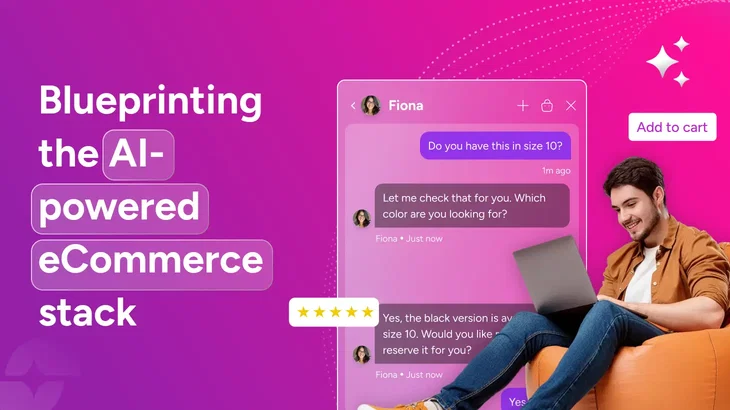
A good interface doesn’t feel like a chatbot from 2018. It feels more like a helpful assistant. Instead of rigid menus and scripted options, customers can ask questions naturally:
- “Is this jacket waterproof?”
- “Do you have this in size 10?”
- “What’s the difference between these two models?”
The cleaner and more conversational this interface feels, the more likely customers are to actually use it.
And that matters, because the value of the AI system only appears when people interact with it.
The intelligence layer: Understanding what customers mean
Once a question comes in, the system needs to understand it. This is where the AI agents for product recommendations come into play, powered by foundation models that enable the intelligence layer to process multimodal information, reason, and make decisions.
The model’s role isn’t just to generate text. Its main job is to interpret the customer’s intent and decide what information is needed to respond properly, leveraging advanced decision-making to autonomously analyze data and assemble responses in real time.
Sometimes the answer is simple. If a customer asks about shipping times, the system may only need to retrieve a policy document.
Other questions are more complex.
When someone asks for product recommendations, the system may need to analyze multiple signals like price range, product category, performance attributes, and user preferences.
It can also use real-time browsing behavior and past purchase history to generate more personalized recommendations.
The intelligence layer acts as the coordinator. AI agents observe customer interactions and decide what information or action is needed.
They then retrieve or generate responses using available tools and large language models, improving through every interaction.
Without this layer, the rest of the architecture would simply be disconnected databases.
Add AI to your eCommerce stack
Plug in Skara AI to turn shopper intent into conversions with real-time recommendations, automated conversations, and smarter customer journeys.
The retrieval layer: Where the real answers come from
One of the biggest misconceptions about AI agents is that the model “knows everything.” In reality, the most effective systems rely heavily on retrieval.
Rather than storing all information inside the model, the architecture retrieves relevant data from external systems before generating the response.
This approach is often called retrieval-augmented generation, though most ecommerce teams simply think of it as “connecting the AI to the right data.”
Typical retrieval sources include:
- The product catalog
- Inventory databases
- Internal documentation
- Return and shipping policies
- Previous customer interactions
The agent's available tools and integrations determine which data sources can be accessed and how information is retrieved.
When a customer asks a question, the system searches these sources and sends the relevant information to the AI model as context.
The model then uses that context to craft the answer. This approach keeps responses accurate and up to date, even when products or policies change.
Hyper-personalization utilizes AI to deliver tailored recommendations based on real-time browsing behavior and user context.
Retrieval architecture makes eCommerce AI more reliable The most effective eCommerce AI systems use retrieval to pull relevant information at the moment a customer asks a question. This architecture improves response quality because the AI model receives fresh context before generating an answer. For commerce teams, retrieval reduces hallucinations, improves trust, and keeps customer-facing interactions aligned with live operational data. |
The action layer: When the agent actually does something
Not every AI interaction is just a conversation. Increasingly, AI agents are expected to take action and complete tasks autonomously.
A customer might ask the agent to:
- Add an item to their cart (a simple task)
- Check order status
- Start a return request.
- Apply a discount code.
- Update shipping details
AI agents can complete tasks ranging from simple tasks like adding items to the cart to complex workflows such as end-to-end return processing, collaborating with other agents when needed.
They can resolve up to 90% of common queries and handle complex post-purchase tasks, providing 24/7, context-aware support and managing complex returns and customer inquiries autonomously.
To handle these tasks, the AI agent needs access to operational systems inside the ecommerce stack. This usually happens through APIs.
AI agents replace manual, rule-based processes with autonomous, collaborative systems that act in real-time.
They perform best when assigned well-defined tasks, which helps avoid errors and ensures accurate results through robust reasoning and collaborative discussion.
The agent sends a request to the order management system, CRM software, or payment infrastructure, performs the task, and then confirms the result to the customer.
This layer is where AI agents start moving beyond chatbots and into something closer to digital assistants that can actually execute workflows.
Of course, this is also where security becomes critical. Permissions must be carefully controlled so the AI agent only performs actions that are allowed.
Why should eCommerce brands treat AI agents as infrastructure? Treating AI agents as infrastructure allows them to connect across systems, support multiple workflows, and deliver measurable business outcomes beyond simple chatbot interactions. |
Connecting Skara AI agents to the eCommerce stack
Modern eCommerce runs on a growing tech stack: catalogs, inventory management, CRM, order systems, analytics, and a widening set of external systems.
The challenge is no longer just connecting tools. It is making those tools work together fast enough to improve the customer experience in real time.
That is where AI agents are changing the equation.
Unlike traditional automation built for narrow, well-defined tasks, AI agents work across multiple systems and use natural language processing to understand intent.
They draw on large language models and other foundation models to retrieve context and complete tasks with minimal human intervention.
Ready to connect AI agents to your eCommerce stack?
Skara AI helps brands turn disconnected commerce systems into intelligent, customer-facing experiences.
Inside an ecommerce platform, an agent can pull product information from the catalog, check stock levels, verify order status, reference past interactions, and use customer data to deliver personalized responses during live conversations.
Instead of forcing shoppers to navigate disconnected tools, the agent becomes a single interface for conversational commerce.
a. Building AI agents that work with other systems
Building AI agents for commerce is not only about adding a new tool.
It requires reliable connections to external tools, business logic, and existing workflows. Strong integrations allow agents to work with external systems without disrupting the existing code base.
In practice, agents often need a planning module that helps them decide the best course of action before executing tasks. This is especially important for complex tasks involving multiple steps, approvals, or dependencies.
For low-risk actions, the agent can act autonomously. For higher-risk actions, refunds, pricing changes, or account-level updates, human approval can remain part of the workflow to avoid errors.
This balance between automation and oversight is often what makes artificial intelligence useful in real business processes.
How AI agents use live business data in eCommerce AI agents become useful in eCommerce when they can access live business systems instead of relying only on model memory. By connecting to product catalogs, inventory databases, CRM platforms, and policy documents, the agent can generate answers based on the current business context. This makes product recommendations more relevant, order support more accurate, and customer conversations more helpful. |
b. Multiple AI agents for complex workflows
As commerce operations become more sophisticated, brands increasingly rely on multiple AI agents rather than a single system. Different agent categories can handle different functions.
One agent may focus on shopper conversations. Other AI agents may monitor fraud signals, optimize merchandising, track demand changes, or flag operational issues.
These other agents can share context, pass tasks, and coordinate around complex workflows. Instead of one system trying to do everything, brands can deploy specialized agent types built for specific business processes.
This is where multi-agent orchestration becomes valuable. A customer support agent can handle the conversation while other AI agents work in the background to pull data, validate actions, or solve operational dependencies.
c. From language models to business outcomes
Today’s language models and generative AI systems do more than generate text.
When connected to business systems, they can use short-term memory for active conversations and long-term memory for preferences, history, and recurring behavior.
That combination helps agents understand context, surface actionable insights, and solve both simple tasks and more complex tasks.
For an eCommerce brand, that can mean:
- Answering product questions instantly
- Checking order status without manual support
- Recommending relevant products based on past interactions
- Using customer data to improve customer experience
- Automating repetitive tasks so teams can focus on higher-value work
d. Planning for scale
Deploying AI agents for ecommerce stack is not just about what works today. It also requires planning for growth, new channels, and future integrations.
As traffic increases, the agent must maintain speed, reliability, and performance. During sales spikes, it needs enough resources to continue serving customers without latency.
Some parts of agent orchestration can also be computationally expensive, especially when several tools, models, and external systems are involved.
That makes architecture choices important from the beginning. The strongest implementations are designed to scale with the business.
e. Security measures and trust
As agents gain real-time access to operational systems, security measures become essential.
Access controls limit what an agent can retrieve. Data boundaries protect sensitive customer data. Monitoring helps track actions and detect anomalies.
When agents can access order history, CRM records, and the internal knowledge base, trust depends on clear permissions and visibility. Without strong safeguards, automation creates risk instead of value.
f. A new era for the eCommerce stack
This is a new era for commerce. The tech stack is no longer just a collection of disconnected software.
Connected AI agents now sit across products, customers, operations, and support, helping brands perform tasks, solve problems faster, and improve outcomes across the business.
The opportunity is not simply to automate.
It is to create intelligent systems that understand context, use available tools, coordinate with other AI agents, and continuously improve how commerce works, today and in the future.
Blockquote: State of AI agents in eCommerce report 2026.
Common challenges with AI agents
While AI agents offer significant advantages, implementing them comes with its own set of challenges.
One key hurdle is ensuring that tasks assigned to AI agents are well defined, as ambiguity can lead to errors or unintended outcomes.
In many cases, human approval is still necessary for certain actions, especially those involving sensitive customer data or critical business processes.
AI agents can also be computationally expensive, requiring substantial resources and high-quality data to function effectively.
Security measures are paramount to protect customer information and maintain the integrity of business systems. Without proper safeguards, there is a risk of data breaches or unauthorized actions.
However, with thoughtful planning, robust security protocols, and ongoing monitoring, businesses can overcome these challenges and harness the full potential of AI agents to streamline operations and deliver superior service.
Future of AI Agents in eCommerce
The future of AI agents in ecommerce is poised to usher in a new era of intelligent automation and personalized customer engagement.
As these agents continue to learn from past interactions and adapt to evolving business needs, they will become even more adept at handling complex tasks such as inventory management, conversational AI for e-commerce, and real-time customer support with minimal human intervention.
Advancements in artificial intelligence and language models will enable AI agents to analyze data more deeply, make smarter decisions, and seamlessly integrate with other systems and agents.
This evolution will empower businesses to create highly efficient, responsive, and personalized shopping experiences that set them apart from the competition.
As AI agents become more sophisticated, their ability to solve problems, optimize workflows, and deliver value will only grow, making them an indispensable part of the ecommerce landscape for years to come.
Final thoughts
The architecture described here is still evolving. Right now, most companies deploy a single customer-facing AI agent.
But that may not remain the norm for long. We’re beginning to see experiments with multiple specialized agents working together.
For example, generative AI for sales enables these agents to collaborate, share ideas, and address customer issues more effectively by processing multimodal information and learning from real-time interactions.
One agent might handle customer conversations. Another might monitor inventory changes. A third might optimize promotions or pricing strategies.
Agentic AI can even function as virtual personal shoppers, remembering past purchases and understanding customer preferences to suggest complete outfits based on behavioral analysis and real-time conversation context.
In those systems, AI agents coordinate with each other behind the scenes. From the customer’s perspective, it still feels like a single assistant.
But underneath, an entire network of intelligent systems is working together, automating repetitive tasks, enhancing productivity, and allowing humans to focus on more creative work. These agents can work simultaneously on different tasks without interference.
It’s still early, but the direction is clear. The use of agentic AI in eCommerce is expected to become essential for retailers, with 75% of retailers indicating that AI agents will be crucial for maintaining competitiveness in the market.
Additionally, the market for AI agents is expected to grow at a compound annual growth rate (CAGR) of 45% over the next five years, highlighting their increasing adoption across industries.
AI agents are gradually becoming the connective tissue that links the entire ecommerce stack.
The companies seeing the most success with AI agents transforming e-commerce are the ones that treat them as part of the infrastructure, not just a new feature.
They connect the agent to real business systems. They monitor performance carefully. And they design the architecture so that every answer is grounded in real data.
As ecommerce continues to evolve, that architecture will likely become just as important as the storefront itself.
Frequently asked questions
1. What is an AI agent in an ecommerce stack?
An AI agent in an ecommerce stack is a software system that interacts with customers, retrieves product or order information, and assists with tasks like product discovery, support questions, and checkout guidance.
2. How do AI agents connect to ecommerce platforms?
Most AI agents connect to ecommerce systems through APIs. These integrations allow the agent to access product catalogs, inventory databases, order systems, and customer information.
3. Why is retrieval important for AI agents?
Retrieval ensures that AI responses are based on accurate, up-to-date information rather than relying on the model’s training data. This improves reliability and prevents outdated answers.
4. Are AI agents secure for ecommerce businesses?
They can be secure when proper safeguards are implemented. Access controls, data isolation, and monitoring systems help ensure that sensitive information remains protected.
5. Can AI agents scale with ecommerce traffic?
Yes. Most AI agent architectures are built on scalable cloud infrastructure, allowing them to handle large volumes of interactions during peak traffic periods.







![14 Types of BigCommerce email to send [With templates]](/mm-images/types-of-bigcommerce-emails-kek9bdkx.jpg?width=295)


For years, the ecommerce stack has grown layer by layer.
An ecommerce tech stack is the collection of software and tools that help run and automate essential aspects of an online business, ensuring that each part works together seamlessly.
What started as a simple storefront with a checkout system has turned into something much more complex.
Today, even a mid-sized ecommerce brand might run dozens of tools at once - product catalog systems, marketing automation, CRM platforms, analytics tools, customer support software, logistics integrations, and payment infrastructure.
In fact, businesses typically use over 1,000 apps, with only 29% of them being connected, highlighting the importance of a well-integrated ecommerce tech suite for efficiency and growth.
Now another layer is quietly entering that ecosystem: AI agents.
At first glance, these agents look like just another interface - a chat widget on the website or an assistant inside an app.
But under the surface, they’re doing something far more interesting. They sit in the middle of the stack and connect multiple systems together, turning raw data into helpful conversations and actions.
When a customer asks an AI agent something simple like:
“Which running shoes are best for flat feet?”
The answer doesn’t come from the model alone. Behind the scenes, the system may pull product data from a catalog, check availability in the inventory system, analyze attributes across multiple products, and then present the recommendation in a way that actually helps the customer decide.
That only works if the architecture is designed properly. Choosing the right tech stack can significantly impact an ecommerce business's success, and decisions should be based on unique business needs, including budget, integration requirements, and desired functionalities.
When considering adding AI agents or any new tool to your ecommerce stack, it's crucial to evaluate usability, integration capabilities, and alignment with your business goals.
This article walks through what that architecture typically looks like - not in abstract technical diagrams, but in practical terms that reflect how real ecommerce teams are building AI agents today.
Introduction to AI Agents
AI agents are intelligent software designed to autonomously or semi-autonomously perform tasks, leveraging the power of artificial intelligence and large language models (LLMs).
These agents go beyond simple automation by using advanced reasoning, planning, and natural language processing to interact with users, process data, and make informed decisions.
In the context of ecommerce, AI agents can interpret customer queries, analyze product information, and coordinate with other systems to deliver accurate and timely responses.
The ability of AI agents to learn from interactions and adapt their behavior over time makes them increasingly valuable in modern business environments.
They can be tailored for different functions and industries, from healthcare AI agents to transportation, but their core strength lies in their capacity to process vast amounts of data, understand context, and improve performance with each interaction.
As artificial intelligence continues to evolve, AI agents are becoming essential components in the tech stacks of forward-thinking companies, enhancing both operational efficiency and customer satisfaction.
eCommerce tech stack for an eCommerce platform
An ecommerce tech stack is the backbone of any successful online store, comprising a carefully selected suite of software and tools that power every aspect of the business.
Think of building an ecommerce tech stack like assembling the perfect kitchen for a chef: each tool and ingredient plays a specific role in creating a seamless and memorable customer experience.
From inventory management systems that track stock levels in real time to AI marketing tools that nurture leads, the tech stack enables businesses to automate repetitive tasks and streamline operations.
It brings together solutions for order processing, customer relationship management, analytics, and more, ensuring that every workflow is efficient and effective.
By choosing the right combination of tools, ecommerce businesses can create robust processes, deliver exceptional omnichannel customer experiences, and gain valuable insights that drive growth.
Your eCommerce stack, built to scale
From inventory and orders to CRM and analytics, the right tech stack keeps every part of your store connected, efficient, and ready for growth.
How AI Agents improve eCommerce performance
AI agents bring a host of benefits to ecommerce platforms, transforming the way businesses operate and interact with customers.
One of their primary advantages is the automation of repetitive tasks, freeing up human resources for more strategic work.
AI agents can analyze data from multiple sources, identify patterns in customer behavior, and perform tasks such as answering queries, managing inventory, or processing orders with minimal human intervention.
These agents excel at delivering personalized experiences by leveraging customer data and past interactions to tailor recommendations and support.
By working alongside other AI agents for sales and integrating with external tools, they can complete complex tasks and provide actionable insights that help businesses improve conversion rates and overall customer satisfaction.
With their ability to process natural language and understand nuanced requests, AI agents for customer journey are a powerful addition to any ecommerce platform, driving efficiency and enhancing the customer experience.
Why architecture matters more than the AI model
When companies first start experimenting with AI agents, they usually focus on the model.
Those are valid questions, but they’re not the ones that determine whether the system succeeds.
In practice, most sales AI agent failures have nothing to do with the model itself. They happen because the system around the model isn’t well-designed.
When that happens, the AI agent ends up giving vague or incorrect answers. Good architecture solves this problem by making sure the AI has access to the right information at the right moment.
Instead of relying on the model’s memory, the system pulls data directly from the source systems that already power the ecommerce business.
Think of the AI model as the reasoning layer. The architecture determines whether that reasoning is actually useful.
The interface layer: Where conversations begin
Every AI agent interaction starts somewhere. For most ecommerce stores today, that starting point is a simple chat interface on the website. But that’s only one option.
Some brands deploy AI agents inside mobile apps. Others integrate them with messaging platforms like WhatsApp or Instagram. Larger companies sometimes embed them directly into voice support systems.
From a technical perspective, the interface layer is relatively straightforward. Its job is simply to capture the user’s question and deliver the response.
What matters more is the design of the interaction.
A good interface doesn’t feel like a chatbot from 2018. It feels more like a helpful assistant. Instead of rigid menus and scripted options, customers can ask questions naturally:
The cleaner and more conversational this interface feels, the more likely customers are to actually use it.
And that matters, because the value of the AI system only appears when people interact with it.
The intelligence layer: Understanding what customers mean
Once a question comes in, the system needs to understand it. This is where the AI agents for product recommendations come into play, powered by foundation models that enable the intelligence layer to process multimodal information, reason, and make decisions.
The model’s role isn’t just to generate text. Its main job is to interpret the customer’s intent and decide what information is needed to respond properly, leveraging advanced decision-making to autonomously analyze data and assemble responses in real time.
Sometimes the answer is simple. If a customer asks about shipping times, the system may only need to retrieve a policy document.
Other questions are more complex.
When someone asks for product recommendations, the system may need to analyze multiple signals like price range, product category, performance attributes, and user preferences.
It can also use real-time browsing behavior and past purchase history to generate more personalized recommendations.
The intelligence layer acts as the coordinator. AI agents observe customer interactions and decide what information or action is needed.
They then retrieve or generate responses using available tools and large language models, improving through every interaction.
Without this layer, the rest of the architecture would simply be disconnected databases.
Add AI to your eCommerce stack
Plug in Skara AI to turn shopper intent into conversions with real-time recommendations, automated conversations, and smarter customer journeys.
The retrieval layer: Where the real answers come from
One of the biggest misconceptions about AI agents is that the model “knows everything.” In reality, the most effective systems rely heavily on retrieval.
Rather than storing all information inside the model, the architecture retrieves relevant data from external systems before generating the response.
This approach is often called retrieval-augmented generation, though most ecommerce teams simply think of it as “connecting the AI to the right data.”
Typical retrieval sources include:
The agent's available tools and integrations determine which data sources can be accessed and how information is retrieved.
When a customer asks a question, the system searches these sources and sends the relevant information to the AI model as context.
The model then uses that context to craft the answer. This approach keeps responses accurate and up to date, even when products or policies change.
Hyper-personalization utilizes AI to deliver tailored recommendations based on real-time browsing behavior and user context.
Retrieval architecture makes eCommerce AI more reliable
The most effective eCommerce AI systems use retrieval to pull relevant information at the moment a customer asks a question. This architecture improves response quality because the AI model receives fresh context before generating an answer. For commerce teams, retrieval reduces hallucinations, improves trust, and keeps customer-facing interactions aligned with live operational data.
The action layer: When the agent actually does something
Not every AI interaction is just a conversation. Increasingly, AI agents are expected to take action and complete tasks autonomously.
A customer might ask the agent to:
AI agents can complete tasks ranging from simple tasks like adding items to the cart to complex workflows such as end-to-end return processing, collaborating with other agents when needed.
They can resolve up to 90% of common queries and handle complex post-purchase tasks, providing 24/7, context-aware support and managing complex returns and customer inquiries autonomously.
To handle these tasks, the AI agent needs access to operational systems inside the ecommerce stack. This usually happens through APIs.
AI agents replace manual, rule-based processes with autonomous, collaborative systems that act in real-time.
They perform best when assigned well-defined tasks, which helps avoid errors and ensures accurate results through robust reasoning and collaborative discussion.
The agent sends a request to the order management system, CRM software, or payment infrastructure, performs the task, and then confirms the result to the customer.
This layer is where AI agents start moving beyond chatbots and into something closer to digital assistants that can actually execute workflows.
Of course, this is also where security becomes critical. Permissions must be carefully controlled so the AI agent only performs actions that are allowed.
Why should eCommerce brands treat AI agents as infrastructure?
Treating AI agents as infrastructure allows them to connect across systems, support multiple workflows, and deliver measurable business outcomes beyond simple chatbot interactions.
Connecting Skara AI agents to the eCommerce stack
Modern eCommerce runs on a growing tech stack: catalogs, inventory management, CRM, order systems, analytics, and a widening set of external systems.
The challenge is no longer just connecting tools. It is making those tools work together fast enough to improve the customer experience in real time.
That is where AI agents are changing the equation.
Unlike traditional automation built for narrow, well-defined tasks, AI agents work across multiple systems and use natural language processing to understand intent.
They draw on large language models and other foundation models to retrieve context and complete tasks with minimal human intervention.
Ready to connect AI agents to your eCommerce stack?
Skara AI helps brands turn disconnected commerce systems into intelligent, customer-facing experiences.
Inside an ecommerce platform, an agent can pull product information from the catalog, check stock levels, verify order status, reference past interactions, and use customer data to deliver personalized responses during live conversations.
Instead of forcing shoppers to navigate disconnected tools, the agent becomes a single interface for conversational commerce.
a. Building AI agents that work with other systems
Building AI agents for commerce is not only about adding a new tool.
It requires reliable connections to external tools, business logic, and existing workflows. Strong integrations allow agents to work with external systems without disrupting the existing code base.
In practice, agents often need a planning module that helps them decide the best course of action before executing tasks. This is especially important for complex tasks involving multiple steps, approvals, or dependencies.
For low-risk actions, the agent can act autonomously. For higher-risk actions, refunds, pricing changes, or account-level updates, human approval can remain part of the workflow to avoid errors.
This balance between automation and oversight is often what makes artificial intelligence useful in real business processes.
How AI agents use live business data in eCommerce
AI agents become useful in eCommerce when they can access live business systems instead of relying only on model memory. By connecting to product catalogs, inventory databases, CRM platforms, and policy documents, the agent can generate answers based on the current business context. This makes product recommendations more relevant, order support more accurate, and customer conversations more helpful.
b. Multiple AI agents for complex workflows
As commerce operations become more sophisticated, brands increasingly rely on multiple AI agents rather than a single system. Different agent categories can handle different functions.
One agent may focus on shopper conversations. Other AI agents may monitor fraud signals, optimize merchandising, track demand changes, or flag operational issues.
These other agents can share context, pass tasks, and coordinate around complex workflows. Instead of one system trying to do everything, brands can deploy specialized agent types built for specific business processes.
This is where multi-agent orchestration becomes valuable. A customer support agent can handle the conversation while other AI agents work in the background to pull data, validate actions, or solve operational dependencies.
c. From language models to business outcomes
Today’s language models and generative AI systems do more than generate text.
When connected to business systems, they can use short-term memory for active conversations and long-term memory for preferences, history, and recurring behavior.
That combination helps agents understand context, surface actionable insights, and solve both simple tasks and more complex tasks.
For an eCommerce brand, that can mean:
d. Planning for scale
Deploying AI agents for ecommerce stack is not just about what works today. It also requires planning for growth, new channels, and future integrations.
As traffic increases, the agent must maintain speed, reliability, and performance. During sales spikes, it needs enough resources to continue serving customers without latency.
Some parts of agent orchestration can also be computationally expensive, especially when several tools, models, and external systems are involved.
That makes architecture choices important from the beginning. The strongest implementations are designed to scale with the business.
e. Security measures and trust
As agents gain real-time access to operational systems, security measures become essential.
Access controls limit what an agent can retrieve. Data boundaries protect sensitive customer data. Monitoring helps track actions and detect anomalies.
When agents can access order history, CRM records, and the internal knowledge base, trust depends on clear permissions and visibility. Without strong safeguards, automation creates risk instead of value.
f. A new era for the eCommerce stack
This is a new era for commerce. The tech stack is no longer just a collection of disconnected software.
Connected AI agents now sit across products, customers, operations, and support, helping brands perform tasks, solve problems faster, and improve outcomes across the business.
The opportunity is not simply to automate.
It is to create intelligent systems that understand context, use available tools, coordinate with other AI agents, and continuously improve how commerce works, today and in the future.
Common challenges with AI agents
While AI agents offer significant advantages, implementing them comes with its own set of challenges.
One key hurdle is ensuring that tasks assigned to AI agents are well defined, as ambiguity can lead to errors or unintended outcomes.
In many cases, human approval is still necessary for certain actions, especially those involving sensitive customer data or critical business processes.
AI agents can also be computationally expensive, requiring substantial resources and high-quality data to function effectively.
Security measures are paramount to protect customer information and maintain the integrity of business systems. Without proper safeguards, there is a risk of data breaches or unauthorized actions.
However, with thoughtful planning, robust security protocols, and ongoing monitoring, businesses can overcome these challenges and harness the full potential of AI agents to streamline operations and deliver superior service.
Future of AI Agents in eCommerce
The future of AI agents in ecommerce is poised to usher in a new era of intelligent automation and personalized customer engagement.
As these agents continue to learn from past interactions and adapt to evolving business needs, they will become even more adept at handling complex tasks such as inventory management, conversational AI for e-commerce, and real-time customer support with minimal human intervention.
Advancements in artificial intelligence and language models will enable AI agents to analyze data more deeply, make smarter decisions, and seamlessly integrate with other systems and agents.
This evolution will empower businesses to create highly efficient, responsive, and personalized shopping experiences that set them apart from the competition.
As AI agents become more sophisticated, their ability to solve problems, optimize workflows, and deliver value will only grow, making them an indispensable part of the ecommerce landscape for years to come.
Final thoughts
The architecture described here is still evolving. Right now, most companies deploy a single customer-facing AI agent.
But that may not remain the norm for long. We’re beginning to see experiments with multiple specialized agents working together.
For example, generative AI for sales enables these agents to collaborate, share ideas, and address customer issues more effectively by processing multimodal information and learning from real-time interactions.
One agent might handle customer conversations. Another might monitor inventory changes. A third might optimize promotions or pricing strategies.
Agentic AI can even function as virtual personal shoppers, remembering past purchases and understanding customer preferences to suggest complete outfits based on behavioral analysis and real-time conversation context.
In those systems, AI agents coordinate with each other behind the scenes. From the customer’s perspective, it still feels like a single assistant.
But underneath, an entire network of intelligent systems is working together, automating repetitive tasks, enhancing productivity, and allowing humans to focus on more creative work. These agents can work simultaneously on different tasks without interference.
It’s still early, but the direction is clear. The use of agentic AI in eCommerce is expected to become essential for retailers, with 75% of retailers indicating that AI agents will be crucial for maintaining competitiveness in the market.
Additionally, the market for AI agents is expected to grow at a compound annual growth rate (CAGR) of 45% over the next five years, highlighting their increasing adoption across industries.
AI agents are gradually becoming the connective tissue that links the entire ecommerce stack.
The companies seeing the most success with AI agents transforming e-commerce are the ones that treat them as part of the infrastructure, not just a new feature.
They connect the agent to real business systems. They monitor performance carefully. And they design the architecture so that every answer is grounded in real data.
As ecommerce continues to evolve, that architecture will likely become just as important as the storefront itself.
Frequently asked questions
1. What is an AI agent in an ecommerce stack?
An AI agent in an ecommerce stack is a software system that interacts with customers, retrieves product or order information, and assists with tasks like product discovery, support questions, and checkout guidance.
2. How do AI agents connect to ecommerce platforms?
Most AI agents connect to ecommerce systems through APIs. These integrations allow the agent to access product catalogs, inventory databases, order systems, and customer information.
3. Why is retrieval important for AI agents?
Retrieval ensures that AI responses are based on accurate, up-to-date information rather than relying on the model’s training data. This improves reliability and prevents outdated answers.
4. Are AI agents secure for ecommerce businesses?
They can be secure when proper safeguards are implemented. Access controls, data isolation, and monitoring systems help ensure that sensitive information remains protected.
5. Can AI agents scale with ecommerce traffic?
Yes. Most AI agent architectures are built on scalable cloud infrastructure, allowing them to handle large volumes of interactions during peak traffic periods.
Sonali Negi
Content WriterSonali is a writer born out of her utmost passion for writing. She is working with a passionate team of content creators at Salesmate. She enjoys learning about new ideas in marketing and sales. She is an optimistic girl and endeavors to bring the best out of every situation. In her free time, she loves to introspect and observe people.