Key takeaways
- eCommerce AI agents significantly improve conversion rates by guiding users in real time.
- Personalized recommendations and instant responses reduce drop-offs in the buying journey.
- AI-driven interactions increase average order value through smarter upselling and cross-selling.
- Continuous optimization and testing are key to maximizing conversion uplift.
Ecommerce teams obsess over one number more than any other: conversion rate.
You can double traffic and still struggle to grow revenue if conversions remain flat. On the other hand, even small improvements in the average eCommerce conversion rate can produce massive revenue gains.
This is why the rise of AI agents in ecommerce is generating so much attention.
Unlike traditional optimization tools that focus on individual parts of the funnel, AI agents operate across the entire shopping journey.
AI agents answer questions, improve product discovery, recommend products, and remove hesitation at critical decision points.
Over the past few years, ecommerce companies experimenting with AI agents have started reporting consistent patterns in performance improvements.
The data shows a clear trend: AI shopping assistants convert significantly better than traditional browsing experiences.
This article explores those benchmarks and explains where AI agents are creating the biggest impact.
What are eCommerce AI agents
Ecommerce AI agents are intelligent software systems that help online stores guide customers through the shopping journey using conversation, recommendations, and automated decision support.
Unlike traditional chatbots that follow scripted flows, AI agents differ from chatbots because they can understand customer questions, retrieve product information, and respond dynamically based on context, and take action across eCommerce systems.
In many ways, they behave more like digital sales associates than automated tools.
These agents typically integrate with core ecommerce systems such as:
Because they have access to real-time information, AI agents can assist customers with tasks such as product comparisons, shipping inquiries, compatibility checks, and order updates.
The goal is simple: help customers make decisions faster and reduce shopper hesitation.
Ready to turn browsing into buying?
The most effective ecommerce brands are using AI agents to remove friction, guide decisions, and convert more visitors without increasing acquisition spend.
Why conversion rate is the most important eCommerce metric
Before discussing AI benchmarks, it helps to understand why average eCommerce conversion rate improvements are so valuable.
Traffic acquisition costs have increased significantly in recent years. Paid channels like Google Ads, Meta ads, and marketplace advertising have become increasingly competitive.
This means that ecommerce growth often depends less on attracting more visitors and more on converting existing traffic effectively.
Consider a simple example.
If an online store receives 100,000 monthly visitors and converts at 2.5%, it generates 2,500 orders.
Now imagine conversion increases to 3%. Without increasing traffic, the store now produces 3,000 orders, representing a 20% increase in revenue.
This is why even small conversion improvements can have an outsized financial impact. AI agents represent a new approach to achieving these improvements.
Average eCommerce conversion rates (Baseline benchmarks)
To understand AI-driven uplift, we first need to look at baseline ecommerce performance. Across industries, typical conversion rates fall within relatively narrow ranges.
| Industry | Typical Conversion Rate |
|---|
| Apparel & fashion | 1.8% – 2.7% |
| Electronics | 1.5% – 2.5% |
| Beauty & skincare | 2.5% – 3.5% |
| Home & furniture | 2% – 3% |
| Overall ecommerce average | ~2.5% |
While strong brands sometimes achieve higher numbers, even high-performing ecommerce stores rarely exceed 4–5% average ecommerce conversion rates. This leaves significant room for optimization.
Typical conversion benchmarks for AI-assisted eCommerce
Most ecommerce stores implementing AI agents see measurable improvements in conversion performance.
While results vary depending on product category and implementation quality, several benchmarks have emerged across deployments.
Typical performance improvements include:
- 10–35% relative conversion uplift after introducing AI agents
- 2–4× higher conversion rates in AI-assisted sessions compared to normal browsing sessions
- 10–20% increase in average order value (AOV) due to contextual recommendations
- AI interactions influence 20–30% of total revenue in mature deployments
These improvements occur because AI agents engage customers during high-intent moments, when removing friction has the largest impact.
Explore: How AI lead generation boosts conversion rates?.
How AI agents improve average eCommerce conversion rates
AI agents improve average ecommerce conversion rates by reducing friction throughout the buying journey.
Traditional ecommerce experiences require customers to navigate menus, filters, and product pages before making decisions. This can create confusion and decision fatigue.
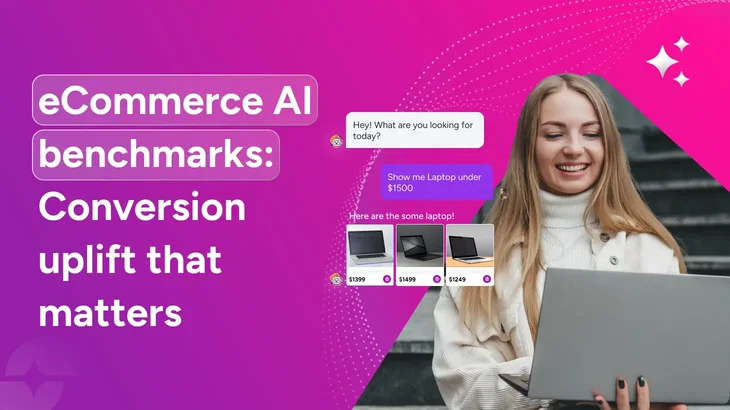
AI agents introduce a more interactive experience. Instead of forcing customers to browse manually, they can simply ask questions like:
- “Which laptop is best for video editing under $1,500?”
- “Is this skincare product suitable for sensitive skin?”
- “Will this desk fit in a small apartment?”
The AI agent interprets the question, retrieves relevant products, and explains the differences. This type of guidance helps customers move from discovery to purchase more quickly.
AI-assisted sessions convert significantly better
One of the most consistent patterns across ecommerce deployments is the difference between standard sessions and AI-assisted sessions.
In many stores:
- Standard browsing sessions convert at 2–3%
- AI-assisted sessions convert at 5–10%
This difference occurs because customers who interact with AI agents often have higher purchase intent.
They are actively seeking guidance, clarification, or reassurance before completing a purchase. By answering questions instantly, AI agents remove uncertainty and keep customers engaged in the buying process.
Why customer experience matters for conversion
A better customer experience often leads directly to better conversion outcomes. When shoppers can quickly find products, understand differences, and receive instant answers, they are more likely to make confident buying decisions. This is one reason why AI agents influence both average eCommerce conversion rates and long-term customer satisfaction. |
How AI agents fit into modern eCommerce growth strategies
AI agents are no longer experimental tools used only by large enterprises. They are increasingly becoming part of the everyday growth stack for ecommerce businesses of all sizes.
Traditional ecommerce optimization often relies on separate tools for analytics, product recommendations, support automation, and A/B testing.
AI agents bring these functions closer together by connecting customer conversations with product data, past interactions, and business processes.
Because AI agents can access external systems such as product catalogs, customer data platforms, and order management tools, they can complete tasks that previously required human intervention.
For ecommerce teams under pressure to improve conversions without endlessly increasing acquisition costs, AI agents represent a practical way to scale smarter.
How Skara helps eCommerce stores deploy AI agents
Skara AI enables online stores to deploy AI agents that can guide product discovery, answer pre-purchase questions, assist with order tracking, and automate large portions of customer support.
An AI agent builder helps ecommerce teams launch, test, and optimize these agents without heavy engineering work.
Because the agents integrate directly with ecommerce systems such as catalogs, inventory, and customer data, they can provide accurate responses and personalized product recommendations in real time.
For many ecommerce brands, this means introducing AI-assisted shopping experiences without building complex AI infrastructure internally.
The broader trend is clear: as AI agents become a core layer of ecommerce, platforms like Skara are making it easier for businesses to deploy them in practical, revenue-driving ways.
Turn AI from a concept into a conversion engine
Skara helps ecommerce brands launch AI agents that improve shopping experiences, reduce support workload, and drive more revenue - without the complexity of building AI systems from scratch.
Why product complexity often determines conversion uplift
Not every ecommerce category experiences the same level of conversion uplift.
The strongest gains often appear in categories where decision-making is more complex, and customers need more reassurance before taking the desired action.
Examples include:
- Electronics and gadgets
- Furniture and home improvement
- Skincare and beauty
- Fitness equipment
- High-consideration lifestyle products
In these categories, customers often compare specifications, compatibility, pricing, and use cases before buying.
When AI agents help users solve problems quickly and provide actionable insights at the right moment, the conversion impact tends to be significantly higher than in simple low-consideration purchases.
This is one reason why AI-assisted ecommerce sales often outperform traditional browsing experiences.
What conversion uplift can ecommerce stores expect from AI agents?
Most ecommerce businesses typically see a 10–35% relative conversion uplift after deploying AI agents effectively.
The exact impact depends on factors such as product complexity, industry, traffic quality, and how deeply the AI agent is connected to product data, inventory, and customer support systems. |
Where AI agents deliver the biggest conversion impact
AI agents tend to produce the largest gains at specific points in the ecommerce funnel.
a. Product discovery
Product discovery remains one of the most challenging parts of ecommerce. Large catalogs can overwhelm customers, especially when product differences are subtle.
AI agents simplify discovery by asking clarifying questions and recommending the most relevant products.
This guided approach dramatically reduces the time required for customers to find what they need.
b. Pre-purchase decision support
Customers frequently hesitate before purchasing because they lack key information. Common concerns include:
- Delivery timelines
- Compatibility questions
- Return policies
- Product specifications
AI agents provide instant answers to these questions, preventing customers from leaving the site to search elsewhere.
c. Cart abandonment recovery
Cart abandonment rates across ecommerce often exceed 60%. AI agents help recover some of these lost sales by engaging customers who hesitate during checkout.
They can clarify shipping costs, recommend alternatives, or answer last-minute questions. Even small improvements in cart recovery can produce meaningful revenue gains.
Explore: How AI agents recover abandoned carts in real time.
AI agents also increase Average Order Value (AOV)
The average eCommerce conversion rate is only one part of the revenue equation. AI agents often increase average order value (AOV) by suggesting complementary products during conversations.
For example, if a customer is purchasing a camera, the AI agent might recommend:
- Memory cards
- Camera bags
- Tripods
- Lens filters
Because these suggestions occur within helpful conversations rather than promotional banners, customers often perceive them as valuable advice rather than marketing.
Many ecommerce stores report 10–20% increases in average order value after deploying other AI agents.
Best practices for maximizing conversion uplift from AI agents
Deploying AI agents alone does not guarantee better performance. Results depend heavily on how well the system is designed, trained, and integrated.
Best practice recommendations include:
1. Connect AI agents to real data sources
AI systems perform best when connected to product catalogs, inventory systems, pricing data, and customer support knowledge.
2. Focus on high-intent moments
The greatest conversion uplift usually happens near decision-making points such as product discovery, comparison, checkout hesitation, and pre-purchase support.
3. Use A/B testing continuously
A/B testing helps ecommerce teams compare AI-assisted journeys against traditional browsing sessions and measure the true conversion impact.
4. Maintain human oversight where needed
For more complex workflows, human approval or human intervention may still be important. The strongest implementations combine automation with human oversight.
When businesses treat AI agents as part of a broader optimization process rather than a standalone tool, performance improves more consistently over time.
Key metrics for measuring AI agent performance
Ecommerce teams evaluating AI agents should track several performance metrics.
- AI engagement rate: The percentage of visitors who interact with the AI agent. Typical range: 10–35% of site visitors
- AI-assisted conversion rate: The average conversion rate of sessions that include AI interactions. These sessions often convert 2–4× higher than average sessions.
- AI-attributed revenue: Revenue generated from sessions influenced by AI interactions. In mature deployments, AI tools can influence 20–30% of total revenue.
- Support ticket deflection: The percentage of customer inquiries resolved by AI without human involvement. Automation rates often reach 60–80%.
Tracking these metrics helps businesses measure both revenue impact and operational efficiency.
What metrics should ecommerce teams track?
When measuring AI performance, ecommerce teams should look beyond simple engagement.
Useful metrics include:
- Conversion uplift
- AI-assisted conversion rate
- AI-attributed revenue
- Average order value
- Support ticket deflection
- Overall customer experience improvements
Tracking these metrics helps businesses connect AI activity to measurable business outcomes. |
Why AI agents are becoming essential for eCommerce growth
Customer expectations are rising faster than most ecommerce systems can adapt. Shoppers expect:
- Instant answers
- Personalized recommendations
- Faster decision-making
At the same time, marketing automation costs continue to rise. This creates pressure on ecommerce teams to extract more value from existing traffic.
AI agents address this challenge by improving multiple business metrics simultaneously. They increase:
- Average conversion rates
- Average order value
- Customer satisfaction
- Operational efficiency
For many ecommerce companies, AI agents are becoming a critical layer of growth infrastructure.
The future of AI-driven eCommerce conversions
The next phase of average conversion rate in ecommerce will likely move beyond reactive chat experiences.
Future AI agents will increasingly support:
- Proactive product recommendations based on context
- Deeper personalization using past interactions
- Automated decision-making processes across the funnel
- Better coordination across marketing, support, and sales
As large language model capabilities improve, AI agents for sales will become more capable of understanding natural language, comparing products intelligently, and guiding customers with less human intervention.
For ecommerce businesses, the long-term opportunity is not simply better automation.
It is building shopping experiences that feel more intelligent, more relevant, and more effective at converting visitors into customers.
Final thoughts
Conversion optimization used to focus heavily on interface tweaks - button colors, layout changes, and checkout experiments.
While these tactics still matter, the biggest gains are increasingly coming from decision assistance. Customers don’t abandon purchases because the button color is wrong. They abandon purchases because they are uncertain about what to buy.
Sales AI agents solve this problem by guiding customers through decisions. By simplifying discovery, answering questions, and recommending relevant products, they transform ecommerce from a static browsing experience into an interactive conversation for lead generation.
For online stores facing rising competition and acquisition costs, that shift may prove transformative.
Frequently asked questions
1. What conversion uplift can ecommerce stores expect from AI agents?
Most ecommerce stores see a 10–35% relative conversion improvement after implementing AI agents. The exact results depend on factors such as industry, product complexity, and how well the AI agent is integrated into the shopping experience.
2. Why do AI-assisted sessions convert at higher rates?
AI-assisted sessions convert better because they occur during high-intent moments. Customers interacting with AI agents are typically asking questions or seeking recommendations, and the AI removes uncertainty by providing immediate answers.
3. Do AI agents increase average order value?
Yes. AI agents frequently increase AOV by recommending complementary products during conversations. Many ecommerce stores report 10–20% increases in average order value from contextual upselling.
4. Which ecommerce industries benefit most from AI agents?
Industries with complex product decisions benefit the most. These include electronics, furniture, skincare, and home appliances, where customers often need guidance before making purchases.
5. Are AI agents replacing traditional ecommerce UX optimization?
No. AI agents complement traditional optimization strategies rather than replacing them. They work alongside UX improvements by guiding customers through product decisions and reducing friction in the buying process








Key takeaways
Ecommerce teams obsess over one number more than any other: conversion rate.
You can double traffic and still struggle to grow revenue if conversions remain flat. On the other hand, even small improvements in the average eCommerce conversion rate can produce massive revenue gains.
This is why the rise of AI agents in ecommerce is generating so much attention.
Unlike traditional optimization tools that focus on individual parts of the funnel, AI agents operate across the entire shopping journey.
AI agents answer questions, improve product discovery, recommend products, and remove hesitation at critical decision points.
Over the past few years, ecommerce companies experimenting with AI agents have started reporting consistent patterns in performance improvements.
The data shows a clear trend: AI shopping assistants convert significantly better than traditional browsing experiences.
This article explores those benchmarks and explains where AI agents are creating the biggest impact.
What are eCommerce AI agents
Ecommerce AI agents are intelligent software systems that help online stores guide customers through the shopping journey using conversation, recommendations, and automated decision support.
Unlike traditional chatbots that follow scripted flows, AI agents differ from chatbots because they can understand customer questions, retrieve product information, and respond dynamically based on context, and take action across eCommerce systems.
In many ways, they behave more like digital sales associates than automated tools.
These agents typically integrate with core ecommerce systems such as:
Because they have access to real-time information, AI agents can assist customers with tasks such as product comparisons, shipping inquiries, compatibility checks, and order updates.
The goal is simple: help customers make decisions faster and reduce shopper hesitation.
Ready to turn browsing into buying?
The most effective ecommerce brands are using AI agents to remove friction, guide decisions, and convert more visitors without increasing acquisition spend.
Why conversion rate is the most important eCommerce metric
Before discussing AI benchmarks, it helps to understand why average eCommerce conversion rate improvements are so valuable.
Traffic acquisition costs have increased significantly in recent years. Paid channels like Google Ads, Meta ads, and marketplace advertising have become increasingly competitive.
This means that ecommerce growth often depends less on attracting more visitors and more on converting existing traffic effectively.
Consider a simple example.
If an online store receives 100,000 monthly visitors and converts at 2.5%, it generates 2,500 orders.
Now imagine conversion increases to 3%. Without increasing traffic, the store now produces 3,000 orders, representing a 20% increase in revenue.
This is why even small conversion improvements can have an outsized financial impact. AI agents represent a new approach to achieving these improvements.
Average eCommerce conversion rates (Baseline benchmarks)
To understand AI-driven uplift, we first need to look at baseline ecommerce performance. Across industries, typical conversion rates fall within relatively narrow ranges.
While strong brands sometimes achieve higher numbers, even high-performing ecommerce stores rarely exceed 4–5% average ecommerce conversion rates. This leaves significant room for optimization.
Typical conversion benchmarks for AI-assisted eCommerce
Most ecommerce stores implementing AI agents see measurable improvements in conversion performance.
While results vary depending on product category and implementation quality, several benchmarks have emerged across deployments.
Typical performance improvements include:
These improvements occur because AI agents engage customers during high-intent moments, when removing friction has the largest impact.
How AI agents improve average eCommerce conversion rates
AI agents improve average ecommerce conversion rates by reducing friction throughout the buying journey.
Traditional ecommerce experiences require customers to navigate menus, filters, and product pages before making decisions. This can create confusion and decision fatigue.
AI agents introduce a more interactive experience. Instead of forcing customers to browse manually, they can simply ask questions like:
The AI agent interprets the question, retrieves relevant products, and explains the differences. This type of guidance helps customers move from discovery to purchase more quickly.
AI-assisted sessions convert significantly better
One of the most consistent patterns across ecommerce deployments is the difference between standard sessions and AI-assisted sessions.
In many stores:
This difference occurs because customers who interact with AI agents often have higher purchase intent.
They are actively seeking guidance, clarification, or reassurance before completing a purchase. By answering questions instantly, AI agents remove uncertainty and keep customers engaged in the buying process.
Why customer experience matters for conversion
A better customer experience often leads directly to better conversion outcomes. When shoppers can quickly find products, understand differences, and receive instant answers, they are more likely to make confident buying decisions. This is one reason why AI agents influence both average eCommerce conversion rates and long-term customer satisfaction.
How AI agents fit into modern eCommerce growth strategies
AI agents are no longer experimental tools used only by large enterprises. They are increasingly becoming part of the everyday growth stack for ecommerce businesses of all sizes.
Traditional ecommerce optimization often relies on separate tools for analytics, product recommendations, support automation, and A/B testing.
AI agents bring these functions closer together by connecting customer conversations with product data, past interactions, and business processes.
Because AI agents can access external systems such as product catalogs, customer data platforms, and order management tools, they can complete tasks that previously required human intervention.
For ecommerce teams under pressure to improve conversions without endlessly increasing acquisition costs, AI agents represent a practical way to scale smarter.
How Skara helps eCommerce stores deploy AI agents
Skara AI enables online stores to deploy AI agents that can guide product discovery, answer pre-purchase questions, assist with order tracking, and automate large portions of customer support.
An AI agent builder helps ecommerce teams launch, test, and optimize these agents without heavy engineering work.
Because the agents integrate directly with ecommerce systems such as catalogs, inventory, and customer data, they can provide accurate responses and personalized product recommendations in real time.
For many ecommerce brands, this means introducing AI-assisted shopping experiences without building complex AI infrastructure internally.
The broader trend is clear: as AI agents become a core layer of ecommerce, platforms like Skara are making it easier for businesses to deploy them in practical, revenue-driving ways.
Turn AI from a concept into a conversion engine
Skara helps ecommerce brands launch AI agents that improve shopping experiences, reduce support workload, and drive more revenue - without the complexity of building AI systems from scratch.
Why product complexity often determines conversion uplift
Not every ecommerce category experiences the same level of conversion uplift.
The strongest gains often appear in categories where decision-making is more complex, and customers need more reassurance before taking the desired action.
Examples include:
In these categories, customers often compare specifications, compatibility, pricing, and use cases before buying.
When AI agents help users solve problems quickly and provide actionable insights at the right moment, the conversion impact tends to be significantly higher than in simple low-consideration purchases.
This is one reason why AI-assisted ecommerce sales often outperform traditional browsing experiences.
What conversion uplift can ecommerce stores expect from AI agents?
Most ecommerce businesses typically see a 10–35% relative conversion uplift after deploying AI agents effectively.
The exact impact depends on factors such as product complexity, industry, traffic quality, and how deeply the AI agent is connected to product data, inventory, and customer support systems.
Where AI agents deliver the biggest conversion impact
AI agents tend to produce the largest gains at specific points in the ecommerce funnel.
a. Product discovery
Product discovery remains one of the most challenging parts of ecommerce. Large catalogs can overwhelm customers, especially when product differences are subtle.
AI agents simplify discovery by asking clarifying questions and recommending the most relevant products.
This guided approach dramatically reduces the time required for customers to find what they need.
b. Pre-purchase decision support
Customers frequently hesitate before purchasing because they lack key information. Common concerns include:
AI agents provide instant answers to these questions, preventing customers from leaving the site to search elsewhere.
c. Cart abandonment recovery
Cart abandonment rates across ecommerce often exceed 60%. AI agents help recover some of these lost sales by engaging customers who hesitate during checkout.
They can clarify shipping costs, recommend alternatives, or answer last-minute questions. Even small improvements in cart recovery can produce meaningful revenue gains.
AI agents also increase Average Order Value (AOV)
The average eCommerce conversion rate is only one part of the revenue equation. AI agents often increase average order value (AOV) by suggesting complementary products during conversations.
For example, if a customer is purchasing a camera, the AI agent might recommend:
Because these suggestions occur within helpful conversations rather than promotional banners, customers often perceive them as valuable advice rather than marketing.
Many ecommerce stores report 10–20% increases in average order value after deploying other AI agents.
Best practices for maximizing conversion uplift from AI agents
Deploying AI agents alone does not guarantee better performance. Results depend heavily on how well the system is designed, trained, and integrated.
Best practice recommendations include:
1. Connect AI agents to real data sources
AI systems perform best when connected to product catalogs, inventory systems, pricing data, and customer support knowledge.
2. Focus on high-intent moments
The greatest conversion uplift usually happens near decision-making points such as product discovery, comparison, checkout hesitation, and pre-purchase support.
3. Use A/B testing continuously
A/B testing helps ecommerce teams compare AI-assisted journeys against traditional browsing sessions and measure the true conversion impact.
4. Maintain human oversight where needed
For more complex workflows, human approval or human intervention may still be important. The strongest implementations combine automation with human oversight.
When businesses treat AI agents as part of a broader optimization process rather than a standalone tool, performance improves more consistently over time.
Key metrics for measuring AI agent performance
Ecommerce teams evaluating AI agents should track several performance metrics.
Tracking these metrics helps businesses measure both revenue impact and operational efficiency.
What metrics should ecommerce teams track?
When measuring AI performance, ecommerce teams should look beyond simple engagement.
Useful metrics include:
Tracking these metrics helps businesses connect AI activity to measurable business outcomes.
Why AI agents are becoming essential for eCommerce growth
Customer expectations are rising faster than most ecommerce systems can adapt. Shoppers expect:
At the same time, marketing automation costs continue to rise. This creates pressure on ecommerce teams to extract more value from existing traffic.
AI agents address this challenge by improving multiple business metrics simultaneously. They increase:
For many ecommerce companies, AI agents are becoming a critical layer of growth infrastructure.
The future of AI-driven eCommerce conversions
The next phase of average conversion rate in ecommerce will likely move beyond reactive chat experiences.
Future AI agents will increasingly support:
As large language model capabilities improve, AI agents for sales will become more capable of understanding natural language, comparing products intelligently, and guiding customers with less human intervention.
For ecommerce businesses, the long-term opportunity is not simply better automation.
It is building shopping experiences that feel more intelligent, more relevant, and more effective at converting visitors into customers.
Final thoughts
Conversion optimization used to focus heavily on interface tweaks - button colors, layout changes, and checkout experiments.
While these tactics still matter, the biggest gains are increasingly coming from decision assistance. Customers don’t abandon purchases because the button color is wrong. They abandon purchases because they are uncertain about what to buy.
Sales AI agents solve this problem by guiding customers through decisions. By simplifying discovery, answering questions, and recommending relevant products, they transform ecommerce from a static browsing experience into an interactive conversation for lead generation.
For online stores facing rising competition and acquisition costs, that shift may prove transformative.
Frequently asked questions
1. What conversion uplift can ecommerce stores expect from AI agents?
Most ecommerce stores see a 10–35% relative conversion improvement after implementing AI agents. The exact results depend on factors such as industry, product complexity, and how well the AI agent is integrated into the shopping experience.
2. Why do AI-assisted sessions convert at higher rates?
AI-assisted sessions convert better because they occur during high-intent moments. Customers interacting with AI agents are typically asking questions or seeking recommendations, and the AI removes uncertainty by providing immediate answers.
3. Do AI agents increase average order value?
Yes. AI agents frequently increase AOV by recommending complementary products during conversations. Many ecommerce stores report 10–20% increases in average order value from contextual upselling.
4. Which ecommerce industries benefit most from AI agents?
Industries with complex product decisions benefit the most. These include electronics, furniture, skincare, and home appliances, where customers often need guidance before making purchases.
5. Are AI agents replacing traditional ecommerce UX optimization?
No. AI agents complement traditional optimization strategies rather than replacing them. They work alongside UX improvements by guiding customers through product decisions and reducing friction in the buying process
Sonali Negi
Content WriterSonali is a writer born out of her utmost passion for writing. She is working with a passionate team of content creators at Salesmate. She enjoys learning about new ideas in marketing and sales. She is an optimistic girl and endeavors to bring the best out of every situation. In her free time, she loves to introspect and observe people.