It's Monday morning. Your ticket queue has tripled over the weekend.
Two human support agents called in sick.
Your SLA clock is ticking, and somewhere in that pile of 600 unread tickets are three genuinely urgent issues, buried under 400 "where's my order?" requests that are all asking the same thing.
The study found: AI agents now manage approximately 80% of routine customer inquiries, including FAQs, order tracking, and basic troubleshooting.
Contact centers using AI customer service agents are also resolving tickets 52% faster and responding 37% more quickly.
For any customer service team dealing with rising ticket volume, that shift is hard to ignore. That is why customer service automation is becoming a practical way for support teams to reduce repetitive tickets, improve response speed, and keep service quality consistent.
Same question, same answer, repeated hundreds of times a day by skilled people you hired to solve hard problems.
The fastest support teams figured this out. And they’re not solving it by hiring faster. They’re building differently with AI agents for customer support at the core of their operation.
Customer service automation allows support teams to reduce repetitive work while maintaining faster and more consistent responses.
What do AI agents actually handle in customer support?
AI agents handle the repetitive work that slows support teams down. They can understand customer requests, identify customer intent, and pull relevant information from connected support systems before taking the next step.
That next step could be checking an order status, processing a refund request, triggering a password reset, updating account details, booking an appointment, or escalating when human intervention is needed.
As autonomous agents, they can complete these steps independently, only looping in a human when a request falls outside their defined boundaries.
The key difference is betweek an AI agent and an AI chatbot is execution.
Chatbots mostly answer predefined questions from a script. AI agents can follow policies, take the next step in a system (issue a refund, update a record, book a slot), and escalate to a human when a request needs judgment.
This makes the AI layer feel less like a bot bolted onto your support stack, and more like an extension of your existing team's workflows.
In support, the most useful types of AI agents are usually task-based agents, routing agents, and assistive agents that help human reps move faster.
Four reasons fast support teams are moving to AI agents
The longer teams delay, the wider the gap grows between companies still handling repetitive tickets manually and those resolving them instantly with AI agents.
The four biggest reasons are:
- They don’t panic at volume spikes
- They’re open when your team isn’t
- They deliver consistency humans can’t match at scale
- They free your best agents from your worst work
For customer service departments, this means fewer repetitive queues, faster replies, and more time for issues that need real human judgment.
Here’s how that split works in practice:
1. They don't panic at volume spikes
Black Friday. A product launch. An unexpected outage. These moments used to mean all-hands-on-deck and support managers refreshing dashboards at midnight.
You can't hire your way out of a volume problem, the recruiting cycle alone takes weeks. AI agents scale during peak demand without adding headcount, so response time stays steady whether there are 10 tickets or 10,000.
This ability to scale AI agents during peak demand helps support teams manage sudden volume spikes without increasing staffing costs.
Forethought's 2025 AI in CX Benchmark Report found that companies using agentic AI saw, on average, 33% higher deflection rates than those using non-agentic AI, with 73% reporting their deflection rate improved over the year.
2. They're open when your team isn't
A customer in a different time zone submitting a refund request at 3 a.m. doesn't want to wait until Tuesday morning for a reply.
24/7 coverage used to mean expensive shift rotations or outsourced overnight teams with inconsistent quality.
AI agents remove the timezone problem. First response times on off-hours tickets can drop from hours to minutes, Freshworks reported that some teams cut their first response time from over six hours to under four minutes after deploying AI-powered support.
3. Consistency that humans can't match at scale
Your support quality is inconsistent, not because your agents are bad, but because they're human.
AI agents deliver consistent responses regardless of ticket volume, time of day, or how many tickets they've handled that hour.
On the 47th refund request of the day, the response is shorter and a little less on-brand than the first one. Your refund policy should apply the same way across multiple customer interactions, ticket 1 and ticket 4,700 alike.
For compliance-heavy industries, fintech, healthcare, insurance , this consistency isn't just nice to have, it's part of how you manage regulatory and audit risk.
4. Your best agents stop doing your worst work
When AI agents absorb repetitive tier-1 volume, human agents don't disappear. They move to complex tasks like escalations, nuanced complaints, high-value relationships, and problem-solving that requires real judgment and empathy.
Salesforce's State of Service report found that service reps using agentic AI spend about 20% less time on routine tasks, roughly four hours per week, and dedicate more of their time to high-complexity issues.
The same research found 71% of reps using AI say it's creating growth opportunities for them, and 86% report developing new skills as a result.
Modern agent assist capabilities also help human reps move faster with suggested replies, conversation summaries, and relevant knowledge recommendations.
The support industry has a notoriously high turnover rate, and agents stuck doing repetitive work burn out faster. Reducing handle time on routine tickets isn't just an efficiency metric; it's a retention strategy.
The goal isn't to automate customer interactions wholesale; it's to remove the repetitive layer so people can focus on what needs them."
Stop making customers wait
Build AI support agents that resolve common customer queries instantly, so your team can focus on tickets that need human attention.
8 Common AI agent use cases in customer support across industries
AI agents work best on issues that are frequent, predictable, and tied to a clear next step.
That's why they fit naturally across industries where customers ask the same operational questions every day: an eCommerce shopper checking an order, a SaaS user locked out of an account, an insurance customer asking about policy details.
1. Order status updates
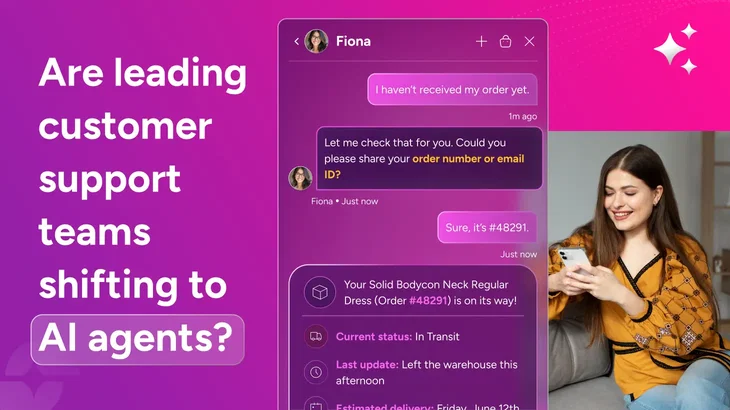
"Where is my order?" is one of the most common questions in eCommerce, retail, and logistics.
Instead of waiting for an agent to check the backend manually, an AI agent in eCommerce can pull the latest order, shipping, or tracking status and share an instant update with the customer.
For support teams, this removes a large chunk of repetitive tickets. For customers, it removes the waiting.
2. Refund and return requests
Most refund requests follow a clear policy: check the purchase date, return window, product condition, payment method, and eligibility.
AI agents can handle the straightforward cases automatically and route exceptions to a human. This applies to SaaS cancellations, travel bookings, event registrations, and subscriptions too.
3. Password resets and account access
For SaaS platforms, banking apps, learning portals, healthcare portals, and membership sites, login issues can flood the queue fast.
AI agents can guide users through recovery, trigger resets, verify basic details, and escalate when there's a security concern.
4. Shipping, delivery, and appointment updates
Many tickets are status checks, not problems: when will a package arrive, is a technician scheduled, is a booking confirmed.
AI agents can answer by pulling data from order systems, logistics tools, calendars, or booking platforms, useful for retail, travel, healthcare, and field service teams.
5. Account updates
Billing details, contact information, subscription plans, notification preferences.
AI agents can guide customers through the update or complete it directly when connected to the right system, routing sensitive changes (payment, identity, policy) to a human.
Interesting read: AI agents in action: Best use cases for businesses in 2026.
6. Product, plan, and policy questions
"What's included in this plan?" "Does my policy cover this?" AI agents can answer using approved help center content, product docs, pricing pages, and policy documents, reducing repeated answers agents would otherwise type dozens of times a day.
This helps customers get quick answers without forcing agents to repeat information already available in your knowledge base.
7. Ticket triage and routing
A lot of delay happens before problem-solving even begins: wrong queue, wrong team, repeated questions.
AI agents can read the request, detect urgency, collect missing details, and route with context attached, especially valuable for teams with multiple products, departments, or segments.
8. SLA-based escalation
A payment failure, compliance issue, VIP complaint, or enterprise escalation shouldn't sit behind routine requests. AI agents can monitor urgency, account value, customer sentiment, or SLA risk and push priority tickets to the right human before they get buried.
Resolve more tickets without hiring more agents
Use AI support agents to handle everyday inquiries, speed up replies, and improve customer satisfaction at scale.
Three common concerns about using AI agents in support
Most support leaders have one valid hesitation about customer service automation: 'We tried chatbots before, and customers hated them.'
It was rigid, scripted bots that broke the moment a question didn't fit the flow.
Concern 1: “Customers hate talking to bots.”
Customers hate poor resolutions.
If an AI agent resolves a refund in 90 seconds instead of making someone wait hours for a reply, most customers won't object to who or what handled it.
They care that the answer was fast, correct, and useful. Nobody complains that the ATM wasn't a bank teller.
Concern 2: “What if it gives the wrong answer?”
This is where AI agent governance becomes critical. Teams need clear agent operating procedures that define what the AI can do, when human approval is needed, and when conversations should be escalated.
When a request falls outside those boundaries, the agent should hand off to a human with the relevant details already captured, not leave the customer stuck.
Some AI customer service cost analyses report that top-performing AI support deployments can reduce costs by as much as 53%, but the lesson is not “automate everything.”
Teams seeing stronger results usually have clean knowledge bases, clear routing rules, and dedicated ownership for training and improving the AI.
The takeaway: guardrails and knowledge base quality matter as much as the AI itself.
Concern 3: “We don’t have the tech team to build this.”
Building AI agents doesn't mean building a model from scratch.
You also do not need to design a full AI agent framework yourself; modern platforms provide the workflow, knowledge, handoff, and governance layers already.
Most modern AI customer service platforms, including Skara AI agents, Zendesk AI, Freshdesk, Intercom, and others, are designed to let teams configure workflows without heavy engineering effort.
That's part of a broader shift to reduce support workload without adding engineering overhead.
Start with one workflow, measure it, improve it, then expand.
When should AI agents hand off to a human? The best support teams use AI for repetitive, predictable work and reserve human judgment for complex, sensitive, or emotionally charged cases. A handoff should happen when: - The customer is angry, frustrated, or emotionally distressed
- The issue involves a high-value account or VIP customer
- The request involves legal, billing, compliance, or security risk
- The customer asks for something outside standard policy
- The AI has low confidence in the answer
- The issue requires technical troubleshooting
- The customer has already tried and failed to resolve it with AI
- The conversation requires empathy, negotiation, or judgment
|
A note on data privacy and compliance
If you're deploying AI agents in fintech, healthcare, insurance, or any industry handling regulated personal data, treat data handling as a first-class design requirement, not an afterthought.
Before rollout, confirm:
- where customer data is processed and stored (and whether that meets data residency requirements)
- what's logged for audit purposes
- how the AI vendor handles data retention and model training on your data
- which actions require human sign-off under your compliance obligations (e.g., HIPAA, PCI-DSS, GDPR)
Most established vendors publish compliance documentatio, request it before you commit to a platform, not after.
Also read: How AI agents in CRM align sales, support, and RevOps.
How to start without blowing up your workflow
You don't need a complete overhaul. Here's a practical entry point for any support manager:
Step 1: Audit your ticket data
Pull your top 10 ticket categories from the last 90 days using your existing tools and support management systems.
Look for tickets that appear repeatedly, follow the same resolution path, and rarely need real human judgment.
Step 2: Flag the repetitive, low-risk ones
Order status, refund requests, password resets, shipping updates, FAQs, high-volume, low-complexity, rule-bound. These are your best starting points.
Step 3: Pilot one workflow
Don't automate everything at once. Configure one workflow, run it in parallel with your human team for two to four weeks, and compare outcomes.
Metrics to track:
- Ticket deflection rate
- CSAT on AI-handled tickets vs. human-handled
- First response time
- Average handle time on remaining human tickets
- Agent utilization rate
A meaningful deflection rate on your most common ticket type can give your team back hours per week,
A few things to watch during rollout: AI agent accuracy tends to drift as products, policies, and pricing change, schedule regular knowledge base reviews (monthly is common) rather than treating setup as one-and-done.
Top-quartile deployments in McKinsey's 2025 analysis shared a pattern of weekly knowledge base updates and using AI for routing alongside, not instead of, full resolution.
Budget for a 4–8 month payback period on implementation costs rather than expecting immediate ROI. time that goes toward complex cases, proactive support, and the work that actually builds customer loyalty.
How Skara AI agents help support teams move faster
Skara AI Agents by Salesmate is built to help support teams answer customers faster, reduce repetitive tickets, and keep conversations moving even when the team is offline.
It goes beyond basic replies, Skara can understand what a customer needs, check the relevant customer data, take the next step, and pass the conversation to a human agent when the issue needs personal attention.
For support operations, that typically means fewer repeat questions, faster responses, and better visibility into what customers ask most. Skara also includes an AI agent builder for creating, testing, and improving workflows without heavy technical setup.
A few notable capabilities:
- Answers customers naturally: uses natural language processing to understand messages and respond clearly, without the customer feeling stuck in a scripted bot flow.
- Omnichannel support: works across chat, email, voice, social media, and other channels.
- Takes action, not just replies: can book meetings, check inventory, process payments, or update customer details.
- Knowledge base-driven personalization: adjusts responses based on customer type, plan, location, account value, or prior conversation history.
- Context-aware handoffs: routes complex or sensitive issues to a human agent with full context, so customers don't repeat themselves.
- Voice support: handles calls, understands intent, and helps resolve common issues without a human picking up first.
- Performance visibility with Reports: data-driven insights into response speed, CSAT, common issue types, and your team's own performance over time.
- Role-based access controls: teams control who can create, edit, approve, or monitor AI workflows.
- Fast setup: designed to get running without a long implementation cycle.
Beyond support, the same platform can power AI sales agents for product questions, lead qualification, and meeting booking, as well as AI eCommerce agents for order tracking, returns, inventory checks, and recommendations.
Reduce support tickets without adding headcount
Let Skara AI Agents handle repetitive queries, speed up replies, and give your team more time for complex customer issues.
The bottom line
Support is no longer just a cost center; it's a competitive differentiator for customer experience, and the teams winning aren't the ones with the most headcount.
They're the ones who've figured out which problems need a human and which don't, using AI agents to handle volume while deploying their best people where judgment, empathy, and creativity matter most.
The bigger outcome is better customer service: faster replies, more consistent answers, and smoother handoffs when a customer needs human help.
Want to see how AI agents could work for your support stack? Start with your ticket data, your top 10 categories will tell you most of what you need to know.
Frequently asked questions
1. What support tickets can AI agents handle?
AI agents can handle order status, refunds, password resets, shipping updates, account changes, FAQs, appointment changes, and basic troubleshooting.
2. Will AI agents replace human support teams?
No. AI agents are best used for repetitive and low-risk tickets, while human agents handle complex, emotional, high-value, or judgment-heavy customer issues.
3. How should a support team start with AI agents?
Start by auditing your top ticket categories, choosing one repetitive workflow, piloting it with guardrails, and tracking CSAT, deflection rate, response time, and handle time.
4. What are the biggest benefits of AI agents in customer support?
The biggest benefits include faster response times, lower ticket volume, 24/7 availability, consistent service quality, reduced workload for human agents, better SLA management, and improved support scalability.
5. When should a customer service AI agent escalate to a human?
An AI agent should escalate when the customer is angry, the issue is complex, the request falls outside policy, the AI has low confidence, the case involves legal or billing risk, or the customer specifically asks for a human agent.
6. Are AI agents good for small support teams?
Yes. Small support teams can benefit from AI agents because they often have limited headcount and a high repetitive workload.
Starting with one simple workflow, such as order status or FAQs, can help small teams save time without adding more agents.
7. Are AI agents fully autonomous?
Not always. Some autonomous AI agents can complete simple tasks on their own, such as checking order status or routing a ticket. But the best support setups still use human handoff for sensitive, complex, or high-value customer issues.
8. What are the best AI agents for customer support?
The best AI agents for customer support can understand customer intent, access approved knowledge, complete simple support tasks, provide agent assist capabilities, and escalate complex issues to human agents with full context.










Key takeaways
It's Monday morning. Your ticket queue has tripled over the weekend.
Two human support agents called in sick.
Your SLA clock is ticking, and somewhere in that pile of 600 unread tickets are three genuinely urgent issues, buried under 400 "where's my order?" requests that are all asking the same thing.
The study found: AI agents now manage approximately 80% of routine customer inquiries, including FAQs, order tracking, and basic troubleshooting.
Contact centers using AI customer service agents are also resolving tickets 52% faster and responding 37% more quickly.
For any customer service team dealing with rising ticket volume, that shift is hard to ignore. That is why customer service automation is becoming a practical way for support teams to reduce repetitive tickets, improve response speed, and keep service quality consistent.
Same question, same answer, repeated hundreds of times a day by skilled people you hired to solve hard problems.
The fastest support teams figured this out. And they’re not solving it by hiring faster. They’re building differently with AI agents for customer support at the core of their operation.
Customer service automation allows support teams to reduce repetitive work while maintaining faster and more consistent responses.
What do AI agents actually handle in customer support?
AI agents handle the repetitive work that slows support teams down. They can understand customer requests, identify customer intent, and pull relevant information from connected support systems before taking the next step.
That next step could be checking an order status, processing a refund request, triggering a password reset, updating account details, booking an appointment, or escalating when human intervention is needed.
As autonomous agents, they can complete these steps independently, only looping in a human when a request falls outside their defined boundaries.
The key difference is betweek an AI agent and an AI chatbot is execution.
Chatbots mostly answer predefined questions from a script. AI agents can follow policies, take the next step in a system (issue a refund, update a record, book a slot), and escalate to a human when a request needs judgment.
This makes the AI layer feel less like a bot bolted onto your support stack, and more like an extension of your existing team's workflows.
In support, the most useful types of AI agents are usually task-based agents, routing agents, and assistive agents that help human reps move faster.
Four reasons fast support teams are moving to AI agents
The longer teams delay, the wider the gap grows between companies still handling repetitive tickets manually and those resolving them instantly with AI agents.
The four biggest reasons are:
For customer service departments, this means fewer repetitive queues, faster replies, and more time for issues that need real human judgment.
Here’s how that split works in practice:
1. They don't panic at volume spikes
Black Friday. A product launch. An unexpected outage. These moments used to mean all-hands-on-deck and support managers refreshing dashboards at midnight.
You can't hire your way out of a volume problem, the recruiting cycle alone takes weeks. AI agents scale during peak demand without adding headcount, so response time stays steady whether there are 10 tickets or 10,000.
This ability to scale AI agents during peak demand helps support teams manage sudden volume spikes without increasing staffing costs.
Forethought's 2025 AI in CX Benchmark Report found that companies using agentic AI saw, on average, 33% higher deflection rates than those using non-agentic AI, with 73% reporting their deflection rate improved over the year.
2. They're open when your team isn't
A customer in a different time zone submitting a refund request at 3 a.m. doesn't want to wait until Tuesday morning for a reply.
24/7 coverage used to mean expensive shift rotations or outsourced overnight teams with inconsistent quality.
AI agents remove the timezone problem. First response times on off-hours tickets can drop from hours to minutes, Freshworks reported that some teams cut their first response time from over six hours to under four minutes after deploying AI-powered support.
3. Consistency that humans can't match at scale
Your support quality is inconsistent, not because your agents are bad, but because they're human.
AI agents deliver consistent responses regardless of ticket volume, time of day, or how many tickets they've handled that hour.
On the 47th refund request of the day, the response is shorter and a little less on-brand than the first one. Your refund policy should apply the same way across multiple customer interactions, ticket 1 and ticket 4,700 alike.
For compliance-heavy industries, fintech, healthcare, insurance , this consistency isn't just nice to have, it's part of how you manage regulatory and audit risk.
4. Your best agents stop doing your worst work
When AI agents absorb repetitive tier-1 volume, human agents don't disappear. They move to complex tasks like escalations, nuanced complaints, high-value relationships, and problem-solving that requires real judgment and empathy.
Salesforce's State of Service report found that service reps using agentic AI spend about 20% less time on routine tasks, roughly four hours per week, and dedicate more of their time to high-complexity issues.
The same research found 71% of reps using AI say it's creating growth opportunities for them, and 86% report developing new skills as a result.
Modern agent assist capabilities also help human reps move faster with suggested replies, conversation summaries, and relevant knowledge recommendations.
The support industry has a notoriously high turnover rate, and agents stuck doing repetitive work burn out faster. Reducing handle time on routine tickets isn't just an efficiency metric; it's a retention strategy.
The goal isn't to automate customer interactions wholesale; it's to remove the repetitive layer so people can focus on what needs them."
Stop making customers wait
Build AI support agents that resolve common customer queries instantly, so your team can focus on tickets that need human attention.
8 Common AI agent use cases in customer support across industries
AI agents work best on issues that are frequent, predictable, and tied to a clear next step.
That's why they fit naturally across industries where customers ask the same operational questions every day: an eCommerce shopper checking an order, a SaaS user locked out of an account, an insurance customer asking about policy details.
1. Order status updates
"Where is my order?" is one of the most common questions in eCommerce, retail, and logistics.
Instead of waiting for an agent to check the backend manually, an AI agent in eCommerce can pull the latest order, shipping, or tracking status and share an instant update with the customer.
For support teams, this removes a large chunk of repetitive tickets. For customers, it removes the waiting.
2. Refund and return requests
Most refund requests follow a clear policy: check the purchase date, return window, product condition, payment method, and eligibility.
AI agents can handle the straightforward cases automatically and route exceptions to a human. This applies to SaaS cancellations, travel bookings, event registrations, and subscriptions too.
3. Password resets and account access
For SaaS platforms, banking apps, learning portals, healthcare portals, and membership sites, login issues can flood the queue fast.
AI agents can guide users through recovery, trigger resets, verify basic details, and escalate when there's a security concern.
4. Shipping, delivery, and appointment updates
Many tickets are status checks, not problems: when will a package arrive, is a technician scheduled, is a booking confirmed.
AI agents can answer by pulling data from order systems, logistics tools, calendars, or booking platforms, useful for retail, travel, healthcare, and field service teams.
5. Account updates
Billing details, contact information, subscription plans, notification preferences.
AI agents can guide customers through the update or complete it directly when connected to the right system, routing sensitive changes (payment, identity, policy) to a human.
6. Product, plan, and policy questions
"What's included in this plan?" "Does my policy cover this?" AI agents can answer using approved help center content, product docs, pricing pages, and policy documents, reducing repeated answers agents would otherwise type dozens of times a day.
This helps customers get quick answers without forcing agents to repeat information already available in your knowledge base.
7. Ticket triage and routing
A lot of delay happens before problem-solving even begins: wrong queue, wrong team, repeated questions.
AI agents can read the request, detect urgency, collect missing details, and route with context attached, especially valuable for teams with multiple products, departments, or segments.
8. SLA-based escalation
A payment failure, compliance issue, VIP complaint, or enterprise escalation shouldn't sit behind routine requests. AI agents can monitor urgency, account value, customer sentiment, or SLA risk and push priority tickets to the right human before they get buried.
Resolve more tickets without hiring more agents
Use AI support agents to handle everyday inquiries, speed up replies, and improve customer satisfaction at scale.
Three common concerns about using AI agents in support
Most support leaders have one valid hesitation about customer service automation: 'We tried chatbots before, and customers hated them.'
It was rigid, scripted bots that broke the moment a question didn't fit the flow.
Concern 1: “Customers hate talking to bots.”
Customers hate poor resolutions.
If an AI agent resolves a refund in 90 seconds instead of making someone wait hours for a reply, most customers won't object to who or what handled it.
They care that the answer was fast, correct, and useful. Nobody complains that the ATM wasn't a bank teller.
Concern 2: “What if it gives the wrong answer?”
This is where AI agent governance becomes critical. Teams need clear agent operating procedures that define what the AI can do, when human approval is needed, and when conversations should be escalated.
When a request falls outside those boundaries, the agent should hand off to a human with the relevant details already captured, not leave the customer stuck.
Some AI customer service cost analyses report that top-performing AI support deployments can reduce costs by as much as 53%, but the lesson is not “automate everything.”
Teams seeing stronger results usually have clean knowledge bases, clear routing rules, and dedicated ownership for training and improving the AI.
The takeaway: guardrails and knowledge base quality matter as much as the AI itself.
Concern 3: “We don’t have the tech team to build this.”
Building AI agents doesn't mean building a model from scratch.
You also do not need to design a full AI agent framework yourself; modern platforms provide the workflow, knowledge, handoff, and governance layers already.
Most modern AI customer service platforms, including Skara AI agents, Zendesk AI, Freshdesk, Intercom, and others, are designed to let teams configure workflows without heavy engineering effort.
That's part of a broader shift to reduce support workload without adding engineering overhead.
Start with one workflow, measure it, improve it, then expand.
When should AI agents hand off to a human?
The best support teams use AI for repetitive, predictable work and reserve human judgment for complex, sensitive, or emotionally charged cases. A handoff should happen when:
A note on data privacy and compliance
If you're deploying AI agents in fintech, healthcare, insurance, or any industry handling regulated personal data, treat data handling as a first-class design requirement, not an afterthought.
Before rollout, confirm:
Most established vendors publish compliance documentatio, request it before you commit to a platform, not after.
How to start without blowing up your workflow
You don't need a complete overhaul. Here's a practical entry point for any support manager:
Step 1: Audit your ticket data
Pull your top 10 ticket categories from the last 90 days using your existing tools and support management systems.
Look for tickets that appear repeatedly, follow the same resolution path, and rarely need real human judgment.
Step 2: Flag the repetitive, low-risk ones
Order status, refund requests, password resets, shipping updates, FAQs, high-volume, low-complexity, rule-bound. These are your best starting points.
Step 3: Pilot one workflow
Don't automate everything at once. Configure one workflow, run it in parallel with your human team for two to four weeks, and compare outcomes.
Metrics to track:
A meaningful deflection rate on your most common ticket type can give your team back hours per week,
A few things to watch during rollout: AI agent accuracy tends to drift as products, policies, and pricing change, schedule regular knowledge base reviews (monthly is common) rather than treating setup as one-and-done.
Top-quartile deployments in McKinsey's 2025 analysis shared a pattern of weekly knowledge base updates and using AI for routing alongside, not instead of, full resolution.
Budget for a 4–8 month payback period on implementation costs rather than expecting immediate ROI. time that goes toward complex cases, proactive support, and the work that actually builds customer loyalty.
How Skara AI agents help support teams move faster
Skara AI Agents by Salesmate is built to help support teams answer customers faster, reduce repetitive tickets, and keep conversations moving even when the team is offline.
It goes beyond basic replies, Skara can understand what a customer needs, check the relevant customer data, take the next step, and pass the conversation to a human agent when the issue needs personal attention.
For support operations, that typically means fewer repeat questions, faster responses, and better visibility into what customers ask most. Skara also includes an AI agent builder for creating, testing, and improving workflows without heavy technical setup.
A few notable capabilities:
Beyond support, the same platform can power AI sales agents for product questions, lead qualification, and meeting booking, as well as AI eCommerce agents for order tracking, returns, inventory checks, and recommendations.
Reduce support tickets without adding headcount
Let Skara AI Agents handle repetitive queries, speed up replies, and give your team more time for complex customer issues.
The bottom line
Support is no longer just a cost center; it's a competitive differentiator for customer experience, and the teams winning aren't the ones with the most headcount.
They're the ones who've figured out which problems need a human and which don't, using AI agents to handle volume while deploying their best people where judgment, empathy, and creativity matter most.
The bigger outcome is better customer service: faster replies, more consistent answers, and smoother handoffs when a customer needs human help.
Want to see how AI agents could work for your support stack? Start with your ticket data, your top 10 categories will tell you most of what you need to know.
Frequently asked questions
1. What support tickets can AI agents handle?
AI agents can handle order status, refunds, password resets, shipping updates, account changes, FAQs, appointment changes, and basic troubleshooting.
2. Will AI agents replace human support teams?
No. AI agents are best used for repetitive and low-risk tickets, while human agents handle complex, emotional, high-value, or judgment-heavy customer issues.
3. How should a support team start with AI agents?
Start by auditing your top ticket categories, choosing one repetitive workflow, piloting it with guardrails, and tracking CSAT, deflection rate, response time, and handle time.
4. What are the biggest benefits of AI agents in customer support?
The biggest benefits include faster response times, lower ticket volume, 24/7 availability, consistent service quality, reduced workload for human agents, better SLA management, and improved support scalability.
5. When should a customer service AI agent escalate to a human?
An AI agent should escalate when the customer is angry, the issue is complex, the request falls outside policy, the AI has low confidence, the case involves legal or billing risk, or the customer specifically asks for a human agent.
6. Are AI agents good for small support teams?
Yes. Small support teams can benefit from AI agents because they often have limited headcount and a high repetitive workload.
Starting with one simple workflow, such as order status or FAQs, can help small teams save time without adding more agents.
7. Are AI agents fully autonomous?
Not always. Some autonomous AI agents can complete simple tasks on their own, such as checking order status or routing a ticket. But the best support setups still use human handoff for sensitive, complex, or high-value customer issues.
8. What are the best AI agents for customer support?
The best AI agents for customer support can understand customer intent, access approved knowledge, complete simple support tasks, provide agent assist capabilities, and escalate complex issues to human agents with full context.
Shivani Tripathi
Shivani TripathiShivani is a passionate writer who found her calling in storytelling and content creation. At Salesmate, she collaborates with a dynamic team of creators to craft impactful narratives around marketing and sales. She has a keen curiosity for new ideas and trends, always eager to learn and share fresh perspectives. Known for her optimism, Shivani believes in turning challenges into opportunities. Outside of work, she enjoys introspection, observing people, and finding inspiration in everyday moments.