Artificial intelligence is evolving rapidly from simple chatbots and automation tools into intelligent systems capable of reasoning, decision-making, workflow execution, and autonomous collaboration.
Businesses are no longer experimenting with AI only for content generation or customer support.
They are now building AI agents that can coordinate operations, interact with software tools, analyze information, and execute multi-step workflows with minimal human involvement.
At the center of this transformation lies one critical component that many organizations overlook in the early stages: the AI agent framework.
AI agent frameworks are becoming the foundation of modern enterprise AI infrastructure. They determine how AI agents think, collaborate, maintain memory, interact with systems, and operate at scale.
The framework a business chooses can significantly influence the reliability, flexibility, scalability, and long-term success of its AI initiatives.
Organizations that select the wrong foundation often struggle with fragmented workflows, governance issues, inconsistent outputs, integration challenges, and rising infrastructure costs.
This shift is changing how companies think about software itself. Instead of static applications, businesses are beginning to build intelligent operational systems powered by AI agents.
Understanding AI agent frameworks
AI agent frameworks are software foundations that help businesses and developers create, manage, deploy, and orchestrate intelligent AI agents.
These frameworks support the observe-plan-act cycle, enabling AI agents to analyze information, plan actions using large language models, execute tasks toward specific goals, and improve over time through memory and past interactions.
These frameworks function similarly to web development frameworks that simplified website creation years ago.
Frameworks simplify challenges by providing reusable architecture for intelligent systems. They let systems act autonomously, perform tasks, and adapt in real time, rather than relying on constant human intervention, allowing businesses to focus on operational outcomes rather than low-level implementation complexities.
Together, these capabilities make it possible for developers to build active problem-solvers that can complete tasks rather than simple chatbots, clarifying what AI agents work toward in real business environments.
Blockquote: Cost or quality? With Skara, you get both.
Why AI agent frameworks matter for businesses
Most organizations begin their AI journey with isolated experiments such as testing chatbots, automating repetitive tasks, or integrating AI customer support systems.
AI agent frameworks help transform these early automation efforts into scalable productivity gains, allowing teams to focus more on strategic, creative, and high-value work.
But as adoption grows, businesses quickly realize that enterprise AI requires far more than a simple conversational interface.
Organizations eventually need systems that can coordinate multiple AI agents, automate workflows across departments, interact with internal platforms, maintain context, and execute tasks reliably at scale. This is where frameworks become essential.
The shift from AI assistants to autonomous systems is one of the biggest technological transitions happening across enterprises today.
Early AI adoption statistics focused largely on generating responses and assisting humans. Modern AI systems are increasingly expected to take action and deliver measurable business value.
Businesses now use AI agents for customer support workflows, lead qualification, scheduling, research automation, knowledge retrieval, sales operations, internal process management, IT coordination, and data analysis.
Modern AI agents can also analyze large volumes of data, coordinate systems, and manage complex multi-step workflows rather than simply assisting with isolated tasks.
These workflows require structured execution, memory persistence, decision-making logic, and integration with business systems.
AI agent frameworks provide the infrastructure needed to support these advanced capabilities and complex workflows.
AI agent frameworks vs traditional automation tools
Traditional automation platforms usually follow fixed rules and predefined workflows. They are effective for repetitive tasks but struggle when environments change or decisions require reasoning and contextual understanding. AI agent frameworks introduce adaptive intelligence into automation systems. They allow AI agents to analyze information, plan actions, use tools, maintain memory, and adjust workflows dynamically based on changing inputs and objectives. |
Different types of AI agents and frameworks
Artificial intelligence is rapidly evolving from simple automation tools into intelligent systems capable of reasoning, decision-making, collaboration, and autonomous execution.
Businesses are no longer using AI only for chatbots or basic task automation. They are now building AI agents that can analyze information, interact with software tools, coordinate workflows, automate operations, and execute multi-step tasks with minimal human involvement.
Categories of AI agents
- Simple reflex agents: Simple reflex agents operate using predefined rules and react only to the current environment state. They do not store memory or evaluate past actions, making them suitable for basic and repetitive tasks.
- Model-based reflex agents: Model-based reflex agents maintain an internal understanding of the environment. This allows them to make more informed decisions by considering both current conditions and previous states.
- Goal-based agents: Goal-based agents evaluate actions according to predefined objectives. They analyze different paths and choose actions that help achieve a desired outcome.
- Utility-based agents: Utility-based agents compare multiple possible outcomes and select actions that maximize efficiency, performance, or overall value. These agents are often used in more complex decision-making systems.
- Learning agents: Learning agents continuously improve through experience, feedback, and data. They adapt over time and become more effective as they interact with environments and workflows.
Ready to operationalize AI across your business?
Skara AI enables organizations to build, orchestrate, and manage intelligent AI agent workflows designed for real-world enterprise automation.
Categories of AI frameworks
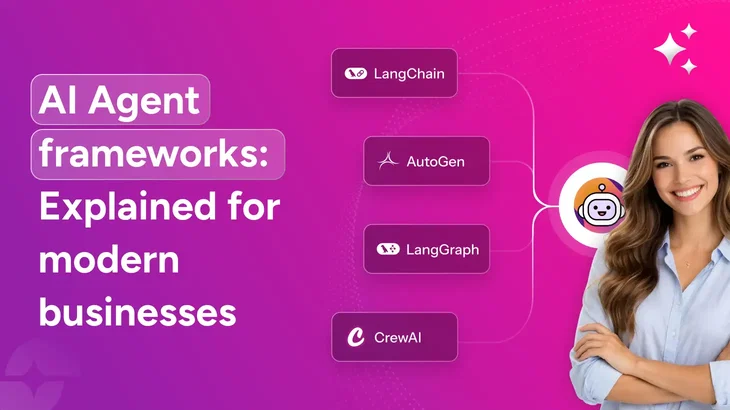
a. LangChain
LangChain is one of the most widely adopted frameworks for building AI-powered applications and autonomous agents.
It provides developers with modular components for prompt management, memory, retrieval-augmented generation (RAG), tool integrations, document processing, and multi-step agent workflows.
Businesses often choose LangChain because of its extensive ecosystem, strong community support, and compatibility with multiple large language models and vector databases.
It is especially useful for creating AI copilots, enterprise search systems, workflow automation tools, and conversational assistants.
However, as projects grow more complex, organizations may face challenges related to orchestration complexity, debugging, and maintaining large-scale agent pipelines.
b. LangGraph
LangGraph extends the LangChain ecosystem by enabling graph-based and stateful AI workflows.
Instead of relying only on linear chains, it allows businesses to build structured execution paths where agents can revisit previous states, make decisions dynamically, and maintain long-running processes, making it especially strong for complex workflows and multi-step reasoning.
This framework is particularly valuable for organizations building advanced multi-agent systems that require reliability, persistence, and workflow control.
Teams use LangGraph to create AI systems capable of planning, reasoning, retrying failed tasks, and coordinating multiple decision layers.
Its architecture is well-suited for enterprise-grade orchestration, where Pydantic-based validation helps improve reliability, transparency, and workflow governance.
Its graph-based state handling also makes it a strong fit for production environments by improving execution control, reliability, and traceability.
c. CrewAI
CrewAI is designed around collaborative multi-agent execution, with agent orchestration as its core strength.
It enables organizations to create teams of specialized AI agents, where each agent performs a dedicated role such as research, analysis, customer support, planning, or execution.
Businesses are increasingly evaluating CrewAI because it mirrors how human teams operate. Agents can delegate tasks, exchange context, and coordinate more complex workflows together.
Teams of agents can also work with other agents to tackle complex tasks.
This structure helps companies automate more sophisticated business processes that involve multiple stages and responsibilities.
CrewAI is commonly used for automated operations, research workflows, sales automation, content generation pipelines, and task coordination systems where multiple AI agents must work together efficiently.
Its structured orchestration and collaboration capabilities also make it well-suited for production environments that require reliable workflow management and coordinated execution across multiple agents.
Blockquote: 11 types of AI agents to automate complex and dynamic workflows.
d. AutoGen
AutoGen focuses on conversational multi-agent collaboration and human-in-the-loop interaction in dynamic environments.
Developed to support adaptable agent interactions and advanced AI communication patterns, it enables multiple agents to converse, negotiate, solve problems collaboratively, and interact with human users during execution.
Organizations often use AutoGen for complex automation environments where reasoning, discussion, and iterative refinement are important.
AutoGen allows for dynamic agent interactions and can adapt to various use cases, making it a flexible option for multi-step reasoning and tool calls in changing workflows.
It supports scenarios where AI agents need to coordinate dynamically, request clarification, or validate outputs before taking action.
Its conversational architecture makes it particularly effective for research automation, coding assistants, planning systems, simulation environments, and collaborative enterprise workflows.
e. Semantic Kernel
Semantic Kernel is increasingly popular among enterprises seeking structured integration between AI systems and existing business infrastructure.
Developed with enterprise architecture in mind, it emphasizes plugins, orchestration layers, memory handling, and compatibility with traditional software ecosystems.
Businesses evaluating Semantic Kernel often prioritize AI agents' governance, scalability, and interoperability with internal systems.
The framework supports integrating AI capabilities into existing applications while maintaining operational structure and security controls.
It is widely considered suitable for enterprises building production-grade AI systems that require reliable orchestration, controlled execution, and strong alignment with enterprise software environments.
What industries are using AI agent frameworks?
AI agent frameworks are being adopted across industries that require scalable automation, workflow coordination, and intelligent decision-making. Healthcare organizations use AI agents for medical data analysis, workflow support, patient communication, and administrative automation. Financial institutions apply AI agents to fraud detection, compliance workflows, reporting automation, and customer service operations. Retail and ecommerce companies use AI agents for inventory coordination, customer engagement, personalized recommendations, and operational analytics. |
Beyond frameworks: Agent SDKs and AI infrastructure
Beyond standalone frameworks, many organizations are now building directly on modern AI agent SDKs and managed infrastructure platforms.
These platforms provide hosted orchestration, tool calling, structured outputs, workflow execution, observability, AI change management, and deployment management.
Businesses are increasingly opting for managed environments because they simplify infrastructure complexity while enhancing scalability and operational reliability.
These solutions often include built-in governance controls, API integrations, monitoring systems, and enterprise-grade deployment capabilities.
As the AI ecosystem evolves, companies are moving toward platforms that combine flexibility, orchestration, security, and long-term maintainability rather than relying solely on experimental agent architectures.
Core capabilities businesses should understand
Although frameworks vary widely in architecture and design philosophy, most enterprise-grade AI agent frameworks share several foundational capabilities, and many provide pre-built structures for role and persona, memory, tools, and planning.
One of the most important is AI agent orchestration. Orchestration determines how AI agents execute workflows, coordinate tasks, and manage dependencies across systems.
This includes sequencing actions, routing tasks, handling conditional logic, triggering workflows, and managing execution states, with state management tracking what the agent has done, what it has learned, and what it needs to do next.
Modern orchestration capabilities allow businesses to automate highly complex operational processes that span multiple applications and departments.
Memory management is another critical capability. AI agents become significantly more effective when they can remember context across workflows and interactions.
Frameworks often support short-term conversational memory, long-term persistent memory, vector databases, retrieval systems, and session management.
Memory systems handle short-term context and long-term history, including learning from past interactions across connected data sources.
Memory allows AI systems to maintain continuity and make more informed decisions over time.
Tool integration is equally important. AI agents today are expected to do much more than generate text.
They must interact with APIs, databases, CRM platforms, communication tools, analytics systems, internal software, and external applications.
Frameworks make these integrations easier by providing standardized tool connectivity and execution layers.
Tools and skills let agents connect to external systems such as APIs, web search, databases, browsers, or calculators, so the model can execute searches, call services, and query records directly.
Blockquote: Top 8 AI agent orchestration tools in 2026.
AI orchestration vs. Multi-agent frameworks
Although the terms are often used interchangeably, AI orchestration and AI agent frameworks are not identical.
AI agent frameworks primarily focus on enabling intelligent behavior. They help agents reason, plan, maintain memory, collaborate, and interact with tools.
AI orchestration platforms focus more heavily on coordinating workflows, systems, tasks, and operational processes.
Their role is to manage execution, workflow automation, route tasks, move data, and coordinate systems efficiently.
However, the distinction between these categories is becoming increasingly blurred.
Modern enterprises want intelligent systems that can both reason and execute. As a result, many vendors are combining orchestration and agent capabilities into unified AI operating systems.
This convergence is reshaping how businesses approach enterprise automation.
Need AI orchestration that scales with your business?
Skara AI helps organizations automate workflows, coordinate AI agents, and manage enterprise operations through intelligent orchestration and real-time execution.
Factors businesses should evaluate before choosing a framework
Selecting an AI agent framework is not simply a technical decision. It is an operational strategy decision that affects scalability, governance, efficiency, and long-term flexibility.
Evaluation should also consider whether agents can handle Autonomous Task Execution from goal to completion.
The first step is understanding the business use cases the framework needs to support, including well-defined tasks and clear goals.
Different platforms excel in different environments. Some are optimized for developer flexibility, while others prioritize enterprise automation and governance.
The workflow typically starts with a specific goal, moves into planning and execution, and then adapts based on feedback.
Organizations should evaluate whether the framework aligns with their operational goals, technical capabilities, and deployment timelines.
Technical complexity is another major consideration. Some frameworks require advanced AI engineering expertise and custom infrastructure management. Others provide low-code environments that simplify deployment.
Scalability should also be evaluated carefully. Many AI projects perform well during pilot stages but struggle under production workloads.
Businesses should assess whether frameworks can support increasing workflow volume, high concurrency, large data environments, and enterprise-wide deployments, while also supporting governance of AI processes for compliance and operational trust.
Governance and security are becoming major evaluation criteria as AI systems gain more operational autonomy.
Organizations increasingly require access controls, audit logs, permission management, compliance capabilities, approval systems, AI agent security and privacy, and secure handling of customer data.
Observability is another critical factor. Enterprise AI systems require continuous visibility into execution flows, costs, performance, failure patterns, and user interactions.
Framework ecosystems and community support also matter significantly. Strong ecosystems accelerate innovation through integrations, templates, documentation, community resources, and third-party tooling.
Businesses should carefully evaluate long-term cost structures. AI infrastructure expenses can rise rapidly due to model usage, cloud resources, workflow execution, vector databases, and monitoring systems.
The lowest-cost framework initially may not remain cost-effective as operations scale.
How do AI agent frameworks improve enterprise automation?
AI agent frameworks help businesses move beyond isolated AI tools toward connected and intelligent automation systems. Instead of relying only on chatbots or single-purpose assistants, organizations can build AI agents capable of coordinating workflows, accessing business systems, maintaining memory, and executing multi-step tasks autonomously. |
Common implementation challenges
Despite rapid advancements, implementing AI agent frameworks still presents several operational challenges.
One of the most common issues involves context management. AI agents can lose context during long workflows or struggle with retrieval accuracy across large knowledge systems.
Workflow unpredictability is another challenge. AI systems do not always behave consistently, which creates risks around reliability and repeatability.
Frameworks with structured execution models, validation systems, and guardrails can help reduce these risks, especially when AI models and machine learning techniques introduce variability that must be controlled.
Integration complexity is also a major concern, especially in enterprises with fragmented legacy infrastructure.
Connecting AI systems across databases, APIs, communication tools, security environments, and operational systems can become highly complex, and reliable data sources are a common implementation challenge because performance depends on structured, trustworthy inputs.
Governance introduces additional challenges. Organizations must manage permissions, approvals, auditability, compliance requirements, and human oversight as AI agents gain more autonomy, and human supervision remains necessary as agents take on more responsibility.
Scaling costs remain another important issue. Large AI systems require substantial compute resources, orchestration infrastructure, monitoring tools, and model usage capacity, especially as machine learning adds more demand over time.
Efficient orchestration becomes essential for maintaining sustainable operational costs.
Best practices for building AI agents and choosing the right AI foundation
Organizations should approach AI framework adoption strategically rather than focusing solely on trends or model popularity, choosing systems that can complete tasks in active workflows rather than generate responses.
One of the most important best practices is starting with workflows instead of models.
Long-term success depends more on orchestration, integrations, reliability, and operational design than on model selection alone, so teams should target well-defined tasks first before expanding to broader automation.
Businesses should identify high-impact workflows, operational bottlenecks, repetitive tasks, and automation opportunities before evaluating frameworks.
Interoperability should also be prioritized. The AI ecosystem is evolving rapidly, and organizations should avoid rigid systems that limit flexibility.
Frameworks with modular architecture, open integrations, API flexibility, and multi-model support are better positioned for long-term adaptability.
Governance should be built early rather than added later. Businesses should establish approval systems, monitoring standards, access controls, escalation workflows, and compliance policies before scaling automation.
Observability is equally critical. Teams should continuously monitor workflow performance, agent behavior, costs, and operational reliability.
A phased deployment strategy is usually more effective than an enterprise-wide transformation from the beginning.
Organizations can start with limited workflows and controlled environments before gradually expanding adoption, using controlled rollouts before reducing human intervention in sensitive workflows.
Blockquote: What is an AI agent? Definition, architecture, types, & use cases.
Future trends shaping AI agent frameworks
The AI infrastructure landscape is evolving rapidly, and several major trends are shaping the future of agent frameworks.
One of the biggest trends is the rise of multi-agent ecosystems. Businesses are moving beyond single assistants toward networks of specialized agents that collaborate across workflows and departments.
Real-time orchestration is also becoming increasingly important. Future AI systems will operate more dynamically through event-driven execution, streaming workflows, and adaptive automation.
Many vendors are evolving toward unified enterprise AI operating systems that combine orchestration, governance, monitoring, integrations, and intelligent agents into centralized platforms.
Memory architecture improvements are another major area of innovation. Future frameworks are expected to provide stronger long-term memory, persistent context, personalized workflows, and more accurate knowledge retrieval.
Governance infrastructure will also become increasingly important as regulations evolve and businesses require greater explainability, compliance automation, and operational transparency.
Final thoughts
AI agent frameworks are rapidly becoming the operational backbone of enterprise AI. Businesses are moving far beyond isolated chatbots and simple automation tools.
They now require intelligent systems capable of coordinating workflows, integrating across software environments, maintaining context, executing tasks, and operating reliably at scale.
Choosing the right framework is not just about technology selection. It is about building the foundation for future operational intelligence.
The right framework can help organizations automate complex processes, improve efficiency, reduce operational friction, scale AI adoption, and enable real-time decision-making across teams.
As AI agents become increasingly capable, businesses that invest in scalable orchestration, governance, and intelligent workflow infrastructure today will be far better positioned for the next era of enterprise automation.
The future of enterprise AI will not depend solely on more powerful models. It will depend on the frameworks that allow businesses to operationalize intelligence effectively, reliably, and at scale.
Frequently asked questions
1. What is an AI agent framework?
An AI agent framework is a software foundation that helps businesses build, manage, and orchestrate intelligent AI agents. These frameworks provide capabilities such as memory management, workflow execution, reasoning, integrations, tool usage, monitoring, and multi-agent coordination to help agents act autonomously through observe-plan-act behavior, memory, tools, and reasoning, moving systems beyond simple chatbots into active problem-solvers.
2. Which AI agent framework is best for enterprises?
The best framework depends on the organization’s goals, technical maturity, infrastructure, and operational requirements.
- LangChain is widely used for flexible AI application development.
- LangGraph is strong for stateful and multi-agent workflows.
- CrewAI specializes in collaborative agent execution.
- AutoGen supports conversational multi-agent coordination.
- Semantic Kernel is often preferred for enterprise integrations and governance.
3. Are AI agent frameworks only for large enterprises?
No. Small teams use healthcare AI agents to automate routine tasks, analyze medical data, support diagnosis, and assist with treatment planning, while financial and retail teams use them for fraud checks and more personalized customer experiences. They’re also common in software development, where agents handle code generation and generate code faster, and in manufacturing, where they help monitor equipment and predict maintenance. While enterprises are major adopters, startups and mid-sized businesses are also using AI agent frameworks to automate workflows, improve productivity, and reduce operational overhead. Low-code and no-code platforms are making AI agent development increasingly accessible for smaller teams without large engineering resources.
4. Are AI agent frameworks open source?
Many AI agent frameworks are open source, including:
- LangChain
- CrewAI
- AutoGen
- Semantic Kernel
Open-source frameworks provide flexibility and customization, while managed enterprise platforms often offer additional governance, security, and deployment support.
5. Can businesses use multiple AI frameworks together?
Yes. Many organizations combine multiple frameworks and AI infrastructure platforms depending on operational needs, especially when multiple agents need to coordinate with external systems across departments.
For example, businesses may use:
- LangChain for application development
- LangGraph for workflow orchestration, alongside another framework for specialized agent workflows in more complex workflows
- Managed AI infrastructure platforms for deployment, observability, and scaling










Key takeaways
Artificial intelligence is evolving rapidly from simple chatbots and automation tools into intelligent systems capable of reasoning, decision-making, workflow execution, and autonomous collaboration.
Businesses are no longer experimenting with AI only for content generation or customer support.
They are now building AI agents that can coordinate operations, interact with software tools, analyze information, and execute multi-step workflows with minimal human involvement.
At the center of this transformation lies one critical component that many organizations overlook in the early stages: the AI agent framework.
AI agent frameworks are becoming the foundation of modern enterprise AI infrastructure. They determine how AI agents think, collaborate, maintain memory, interact with systems, and operate at scale.
The framework a business chooses can significantly influence the reliability, flexibility, scalability, and long-term success of its AI initiatives.
Organizations that select the wrong foundation often struggle with fragmented workflows, governance issues, inconsistent outputs, integration challenges, and rising infrastructure costs.
This shift is changing how companies think about software itself. Instead of static applications, businesses are beginning to build intelligent operational systems powered by AI agents.
Understanding AI agent frameworks
AI agent frameworks are software foundations that help businesses and developers create, manage, deploy, and orchestrate intelligent AI agents.
These frameworks support the observe-plan-act cycle, enabling AI agents to analyze information, plan actions using large language models, execute tasks toward specific goals, and improve over time through memory and past interactions.
These frameworks function similarly to web development frameworks that simplified website creation years ago.
Frameworks simplify challenges by providing reusable architecture for intelligent systems. They let systems act autonomously, perform tasks, and adapt in real time, rather than relying on constant human intervention, allowing businesses to focus on operational outcomes rather than low-level implementation complexities.
Together, these capabilities make it possible for developers to build active problem-solvers that can complete tasks rather than simple chatbots, clarifying what AI agents work toward in real business environments.
Why AI agent frameworks matter for businesses
Most organizations begin their AI journey with isolated experiments such as testing chatbots, automating repetitive tasks, or integrating AI customer support systems.
AI agent frameworks help transform these early automation efforts into scalable productivity gains, allowing teams to focus more on strategic, creative, and high-value work.
But as adoption grows, businesses quickly realize that enterprise AI requires far more than a simple conversational interface.
Organizations eventually need systems that can coordinate multiple AI agents, automate workflows across departments, interact with internal platforms, maintain context, and execute tasks reliably at scale. This is where frameworks become essential.
The shift from AI assistants to autonomous systems is one of the biggest technological transitions happening across enterprises today.
Early AI adoption statistics focused largely on generating responses and assisting humans. Modern AI systems are increasingly expected to take action and deliver measurable business value.
Businesses now use AI agents for customer support workflows, lead qualification, scheduling, research automation, knowledge retrieval, sales operations, internal process management, IT coordination, and data analysis.
Modern AI agents can also analyze large volumes of data, coordinate systems, and manage complex multi-step workflows rather than simply assisting with isolated tasks.
These workflows require structured execution, memory persistence, decision-making logic, and integration with business systems.
AI agent frameworks provide the infrastructure needed to support these advanced capabilities and complex workflows.
AI agent frameworks vs traditional automation tools
Traditional automation platforms usually follow fixed rules and predefined workflows. They are effective for repetitive tasks but struggle when environments change or decisions require reasoning and contextual understanding. AI agent frameworks introduce adaptive intelligence into automation systems. They allow AI agents to analyze information, plan actions, use tools, maintain memory, and adjust workflows dynamically based on changing inputs and objectives.
Different types of AI agents and frameworks
Artificial intelligence is rapidly evolving from simple automation tools into intelligent systems capable of reasoning, decision-making, collaboration, and autonomous execution.
Businesses are no longer using AI only for chatbots or basic task automation. They are now building AI agents that can analyze information, interact with software tools, coordinate workflows, automate operations, and execute multi-step tasks with minimal human involvement.
Categories of AI agents
Ready to operationalize AI across your business?
Skara AI enables organizations to build, orchestrate, and manage intelligent AI agent workflows designed for real-world enterprise automation.
Categories of AI frameworks
a. LangChain
LangChain is one of the most widely adopted frameworks for building AI-powered applications and autonomous agents.
It provides developers with modular components for prompt management, memory, retrieval-augmented generation (RAG), tool integrations, document processing, and multi-step agent workflows.
Businesses often choose LangChain because of its extensive ecosystem, strong community support, and compatibility with multiple large language models and vector databases.
It is especially useful for creating AI copilots, enterprise search systems, workflow automation tools, and conversational assistants.
However, as projects grow more complex, organizations may face challenges related to orchestration complexity, debugging, and maintaining large-scale agent pipelines.
b. LangGraph
LangGraph extends the LangChain ecosystem by enabling graph-based and stateful AI workflows.
Instead of relying only on linear chains, it allows businesses to build structured execution paths where agents can revisit previous states, make decisions dynamically, and maintain long-running processes, making it especially strong for complex workflows and multi-step reasoning.
This framework is particularly valuable for organizations building advanced multi-agent systems that require reliability, persistence, and workflow control.
Teams use LangGraph to create AI systems capable of planning, reasoning, retrying failed tasks, and coordinating multiple decision layers.
Its architecture is well-suited for enterprise-grade orchestration, where Pydantic-based validation helps improve reliability, transparency, and workflow governance.
Its graph-based state handling also makes it a strong fit for production environments by improving execution control, reliability, and traceability.
c. CrewAI
CrewAI is designed around collaborative multi-agent execution, with agent orchestration as its core strength.
It enables organizations to create teams of specialized AI agents, where each agent performs a dedicated role such as research, analysis, customer support, planning, or execution.
Businesses are increasingly evaluating CrewAI because it mirrors how human teams operate. Agents can delegate tasks, exchange context, and coordinate more complex workflows together.
Teams of agents can also work with other agents to tackle complex tasks.
This structure helps companies automate more sophisticated business processes that involve multiple stages and responsibilities.
CrewAI is commonly used for automated operations, research workflows, sales automation, content generation pipelines, and task coordination systems where multiple AI agents must work together efficiently.
Its structured orchestration and collaboration capabilities also make it well-suited for production environments that require reliable workflow management and coordinated execution across multiple agents.
d. AutoGen
AutoGen focuses on conversational multi-agent collaboration and human-in-the-loop interaction in dynamic environments.
Developed to support adaptable agent interactions and advanced AI communication patterns, it enables multiple agents to converse, negotiate, solve problems collaboratively, and interact with human users during execution.
Organizations often use AutoGen for complex automation environments where reasoning, discussion, and iterative refinement are important.
AutoGen allows for dynamic agent interactions and can adapt to various use cases, making it a flexible option for multi-step reasoning and tool calls in changing workflows.
It supports scenarios where AI agents need to coordinate dynamically, request clarification, or validate outputs before taking action.
Its conversational architecture makes it particularly effective for research automation, coding assistants, planning systems, simulation environments, and collaborative enterprise workflows.
e. Semantic Kernel
Semantic Kernel is increasingly popular among enterprises seeking structured integration between AI systems and existing business infrastructure.
Developed with enterprise architecture in mind, it emphasizes plugins, orchestration layers, memory handling, and compatibility with traditional software ecosystems.
Businesses evaluating Semantic Kernel often prioritize AI agents' governance, scalability, and interoperability with internal systems.
The framework supports integrating AI capabilities into existing applications while maintaining operational structure and security controls.
It is widely considered suitable for enterprises building production-grade AI systems that require reliable orchestration, controlled execution, and strong alignment with enterprise software environments.
What industries are using AI agent frameworks?
AI agent frameworks are being adopted across industries that require scalable automation, workflow coordination, and intelligent decision-making. Healthcare organizations use AI agents for medical data analysis, workflow support, patient communication, and administrative automation. Financial institutions apply AI agents to fraud detection, compliance workflows, reporting automation, and customer service operations. Retail and ecommerce companies use AI agents for inventory coordination, customer engagement, personalized recommendations, and operational analytics.
Beyond frameworks: Agent SDKs and AI infrastructure
Beyond standalone frameworks, many organizations are now building directly on modern AI agent SDKs and managed infrastructure platforms.
These platforms provide hosted orchestration, tool calling, structured outputs, workflow execution, observability, AI change management, and deployment management.
Businesses are increasingly opting for managed environments because they simplify infrastructure complexity while enhancing scalability and operational reliability.
These solutions often include built-in governance controls, API integrations, monitoring systems, and enterprise-grade deployment capabilities.
As the AI ecosystem evolves, companies are moving toward platforms that combine flexibility, orchestration, security, and long-term maintainability rather than relying solely on experimental agent architectures.
Core capabilities businesses should understand
Although frameworks vary widely in architecture and design philosophy, most enterprise-grade AI agent frameworks share several foundational capabilities, and many provide pre-built structures for role and persona, memory, tools, and planning.
One of the most important is AI agent orchestration. Orchestration determines how AI agents execute workflows, coordinate tasks, and manage dependencies across systems.
This includes sequencing actions, routing tasks, handling conditional logic, triggering workflows, and managing execution states, with state management tracking what the agent has done, what it has learned, and what it needs to do next.
Modern orchestration capabilities allow businesses to automate highly complex operational processes that span multiple applications and departments.
Memory management is another critical capability. AI agents become significantly more effective when they can remember context across workflows and interactions.
Frameworks often support short-term conversational memory, long-term persistent memory, vector databases, retrieval systems, and session management.
Memory systems handle short-term context and long-term history, including learning from past interactions across connected data sources.
Memory allows AI systems to maintain continuity and make more informed decisions over time.
Tool integration is equally important. AI agents today are expected to do much more than generate text.
They must interact with APIs, databases, CRM platforms, communication tools, analytics systems, internal software, and external applications.
Frameworks make these integrations easier by providing standardized tool connectivity and execution layers.
Tools and skills let agents connect to external systems such as APIs, web search, databases, browsers, or calculators, so the model can execute searches, call services, and query records directly.
AI orchestration vs. Multi-agent frameworks
Although the terms are often used interchangeably, AI orchestration and AI agent frameworks are not identical.
AI agent frameworks primarily focus on enabling intelligent behavior. They help agents reason, plan, maintain memory, collaborate, and interact with tools.
AI orchestration platforms focus more heavily on coordinating workflows, systems, tasks, and operational processes.
Their role is to manage execution, workflow automation, route tasks, move data, and coordinate systems efficiently.
However, the distinction between these categories is becoming increasingly blurred.
Modern enterprises want intelligent systems that can both reason and execute. As a result, many vendors are combining orchestration and agent capabilities into unified AI operating systems.
This convergence is reshaping how businesses approach enterprise automation.
Need AI orchestration that scales with your business?
Skara AI helps organizations automate workflows, coordinate AI agents, and manage enterprise operations through intelligent orchestration and real-time execution.
Factors businesses should evaluate before choosing a framework
Selecting an AI agent framework is not simply a technical decision. It is an operational strategy decision that affects scalability, governance, efficiency, and long-term flexibility.
Evaluation should also consider whether agents can handle Autonomous Task Execution from goal to completion.
The first step is understanding the business use cases the framework needs to support, including well-defined tasks and clear goals.
Different platforms excel in different environments. Some are optimized for developer flexibility, while others prioritize enterprise automation and governance.
The workflow typically starts with a specific goal, moves into planning and execution, and then adapts based on feedback.
Organizations should evaluate whether the framework aligns with their operational goals, technical capabilities, and deployment timelines.
Technical complexity is another major consideration. Some frameworks require advanced AI engineering expertise and custom infrastructure management. Others provide low-code environments that simplify deployment.
Scalability should also be evaluated carefully. Many AI projects perform well during pilot stages but struggle under production workloads.
Businesses should assess whether frameworks can support increasing workflow volume, high concurrency, large data environments, and enterprise-wide deployments, while also supporting governance of AI processes for compliance and operational trust.
Governance and security are becoming major evaluation criteria as AI systems gain more operational autonomy.
Organizations increasingly require access controls, audit logs, permission management, compliance capabilities, approval systems, AI agent security and privacy, and secure handling of customer data.
Observability is another critical factor. Enterprise AI systems require continuous visibility into execution flows, costs, performance, failure patterns, and user interactions.
Framework ecosystems and community support also matter significantly. Strong ecosystems accelerate innovation through integrations, templates, documentation, community resources, and third-party tooling.
Businesses should carefully evaluate long-term cost structures. AI infrastructure expenses can rise rapidly due to model usage, cloud resources, workflow execution, vector databases, and monitoring systems.
The lowest-cost framework initially may not remain cost-effective as operations scale.
How do AI agent frameworks improve enterprise automation?
AI agent frameworks help businesses move beyond isolated AI tools toward connected and intelligent automation systems. Instead of relying only on chatbots or single-purpose assistants, organizations can build AI agents capable of coordinating workflows, accessing business systems, maintaining memory, and executing multi-step tasks autonomously.
Common implementation challenges
Despite rapid advancements, implementing AI agent frameworks still presents several operational challenges.
One of the most common issues involves context management. AI agents can lose context during long workflows or struggle with retrieval accuracy across large knowledge systems.
Workflow unpredictability is another challenge. AI systems do not always behave consistently, which creates risks around reliability and repeatability.
Frameworks with structured execution models, validation systems, and guardrails can help reduce these risks, especially when AI models and machine learning techniques introduce variability that must be controlled.
Integration complexity is also a major concern, especially in enterprises with fragmented legacy infrastructure.
Connecting AI systems across databases, APIs, communication tools, security environments, and operational systems can become highly complex, and reliable data sources are a common implementation challenge because performance depends on structured, trustworthy inputs.
Governance introduces additional challenges. Organizations must manage permissions, approvals, auditability, compliance requirements, and human oversight as AI agents gain more autonomy, and human supervision remains necessary as agents take on more responsibility.
Scaling costs remain another important issue. Large AI systems require substantial compute resources, orchestration infrastructure, monitoring tools, and model usage capacity, especially as machine learning adds more demand over time.
Efficient orchestration becomes essential for maintaining sustainable operational costs.
Best practices for building AI agents and choosing the right AI foundation
Organizations should approach AI framework adoption strategically rather than focusing solely on trends or model popularity, choosing systems that can complete tasks in active workflows rather than generate responses.
One of the most important best practices is starting with workflows instead of models.
Long-term success depends more on orchestration, integrations, reliability, and operational design than on model selection alone, so teams should target well-defined tasks first before expanding to broader automation.
Businesses should identify high-impact workflows, operational bottlenecks, repetitive tasks, and automation opportunities before evaluating frameworks.
Interoperability should also be prioritized. The AI ecosystem is evolving rapidly, and organizations should avoid rigid systems that limit flexibility.
Frameworks with modular architecture, open integrations, API flexibility, and multi-model support are better positioned for long-term adaptability.
Governance should be built early rather than added later. Businesses should establish approval systems, monitoring standards, access controls, escalation workflows, and compliance policies before scaling automation.
Observability is equally critical. Teams should continuously monitor workflow performance, agent behavior, costs, and operational reliability.
A phased deployment strategy is usually more effective than an enterprise-wide transformation from the beginning.
Organizations can start with limited workflows and controlled environments before gradually expanding adoption, using controlled rollouts before reducing human intervention in sensitive workflows.
Future trends shaping AI agent frameworks
The AI infrastructure landscape is evolving rapidly, and several major trends are shaping the future of agent frameworks.
One of the biggest trends is the rise of multi-agent ecosystems. Businesses are moving beyond single assistants toward networks of specialized agents that collaborate across workflows and departments.
Real-time orchestration is also becoming increasingly important. Future AI systems will operate more dynamically through event-driven execution, streaming workflows, and adaptive automation.
Many vendors are evolving toward unified enterprise AI operating systems that combine orchestration, governance, monitoring, integrations, and intelligent agents into centralized platforms.
Memory architecture improvements are another major area of innovation. Future frameworks are expected to provide stronger long-term memory, persistent context, personalized workflows, and more accurate knowledge retrieval.
Governance infrastructure will also become increasingly important as regulations evolve and businesses require greater explainability, compliance automation, and operational transparency.
Final thoughts
AI agent frameworks are rapidly becoming the operational backbone of enterprise AI. Businesses are moving far beyond isolated chatbots and simple automation tools.
They now require intelligent systems capable of coordinating workflows, integrating across software environments, maintaining context, executing tasks, and operating reliably at scale.
Choosing the right framework is not just about technology selection. It is about building the foundation for future operational intelligence.
The right framework can help organizations automate complex processes, improve efficiency, reduce operational friction, scale AI adoption, and enable real-time decision-making across teams.
As AI agents become increasingly capable, businesses that invest in scalable orchestration, governance, and intelligent workflow infrastructure today will be far better positioned for the next era of enterprise automation.
The future of enterprise AI will not depend solely on more powerful models. It will depend on the frameworks that allow businesses to operationalize intelligence effectively, reliably, and at scale.
Frequently asked questions
1. What is an AI agent framework?
An AI agent framework is a software foundation that helps businesses build, manage, and orchestrate intelligent AI agents. These frameworks provide capabilities such as memory management, workflow execution, reasoning, integrations, tool usage, monitoring, and multi-agent coordination to help agents act autonomously through observe-plan-act behavior, memory, tools, and reasoning, moving systems beyond simple chatbots into active problem-solvers.
2. Which AI agent framework is best for enterprises?
The best framework depends on the organization’s goals, technical maturity, infrastructure, and operational requirements.
3. Are AI agent frameworks only for large enterprises?
No. Small teams use healthcare AI agents to automate routine tasks, analyze medical data, support diagnosis, and assist with treatment planning, while financial and retail teams use them for fraud checks and more personalized customer experiences. They’re also common in software development, where agents handle code generation and generate code faster, and in manufacturing, where they help monitor equipment and predict maintenance. While enterprises are major adopters, startups and mid-sized businesses are also using AI agent frameworks to automate workflows, improve productivity, and reduce operational overhead. Low-code and no-code platforms are making AI agent development increasingly accessible for smaller teams without large engineering resources.
4. Are AI agent frameworks open source?
Many AI agent frameworks are open source, including:
Open-source frameworks provide flexibility and customization, while managed enterprise platforms often offer additional governance, security, and deployment support.
5. Can businesses use multiple AI frameworks together?
Yes. Many organizations combine multiple frameworks and AI infrastructure platforms depending on operational needs, especially when multiple agents need to coordinate with external systems across departments.
For example, businesses may use:
Shivani Tripathi
Shivani TripathiShivani is a passionate writer who found her calling in storytelling and content creation. At Salesmate, she collaborates with a dynamic team of creators to craft impactful narratives around marketing and sales. She has a keen curiosity for new ideas and trends, always eager to learn and share fresh perspectives. Known for her optimism, Shivani believes in turning challenges into opportunities. Outside of work, she enjoys introspection, observing people, and finding inspiration in everyday moments.