Build enterprise-ready omnichannel AI agents
From AI agent orchestration to workflow automation and enterprise integrations, Skara AI helps businesses build scalable omnichannel AI agents across chat, email, voice, WhatsApp, websites, and customer support workflows.
Why AI orchestration tools matter in 2026
The rise of AI agents and multi agent architectures has dramatically increased workflow complexity.
Businesses are no longer running a single AI model. They are managing:
- AI agents
- Data orchestration tools
- Cloud orchestration systems
- Monitoring and observability tools
- Data integration platforms
- Workflow automation engines
- Governance capabilities
- Data quality systems
- Cloud infrastructure
- Existing tools and APIs
Without orchestration, these environments become fragmented. The right orchestration tool helps organizations:
1. Automate complex workflows
Modern orchestration workflows span multiple systems and often include data ingestion, AI inference, reporting, monitoring, and automated actions.
AI orchestration capabilities reduce manual coordination and improve operational efficiency.
2. Improve data quality
Reliable AI depends on reliable data.
Data orchestration platforms help data engineers transform data, validate data quality, and maintain consistent data flows across cloud environments.
3. Enable enterprise scale
Large organizations require orchestration platforms that support:
- Enterprise scale deployments
- Governance features
- Audit trails
- Role based access control
Compliance requirements such as the General Data Protection Regulation and the Health Insurance Portability standards
4. Support multi-cloud infrastructure
Many enterprises operate across AWS, Azure, and Google Cloud.
Modern orchestration platforms simplify cloud orchestration and infrastructure provisioning across multi-cloud environments.
5. Coordinate AI agents
AI agents are becoming increasingly autonomous.
Orchestration platforms provide centralized workflow management so multi-agent systems can collaborate effectively.
Start building with Skara AI
Orchestrate AI agents, workflows, and enterprise systems at scale and manage intelligent operations across cloud and hybrid environments.
Key features to look for in AI orchestration tools
Before selecting the right orchestration tool, organizations should evaluate several critical capabilities.
a. Workflow orchestration
The platform should support complex workflows, directed acyclic graphs, event-based triggers, and workflow automation.
b. Data integration
Strong integration capabilities are essential for connecting:
- Data sources
- Cloud storage
- APIs
- External systems
- Existing tools
- Data assets
c. Monitoring and observability
Monitoring and observability tools help teams track orchestration workflows, identify failures, and optimize performance.
d. Governance capabilities
Enterprise AI requires:
- Governance features
- Audit trails
- Version control
- Role based access control
- Lineage tracking
e. Cloud native architecture
Cloud native orchestration platforms provide scalability across cloud platforms and virtual private cloud environments.
f. Real-time data processing
Organizations handling streaming analytics and live AI systems need orchestration tools that support real time data processing.
g. Multi agent coordination
As AI agents become more common, orchestration platforms should support multi-agent communication and automation.
Multi-agent orchestration is shaping the future of AI
AI agents are rapidly evolving from experimental assistants into operational systems capable of executing workflows autonomously.
This creates demand for orchestration platforms that can coordinate multiple agents, manage memory, route tasks, and maintain governance across enterprise operations. |
The 10 best AI orchestration tools in 2026
AI orchestration is no longer just about connecting apps.
Modern businesses now need systems that can coordinate workflows, automate decisions, manage AI agents, and execute actions across teams in real time.
Here are the top AI orchestration platforms shaping 2026.
No-code/low-code AI automation
1. Skara AI
Skara AI focuses on autonomous business execution by connecting sales, marketing, support, and operational workflows into one orchestration layer.
Built for businesses that want AI agents without complex setup.
Helps automate workflows, coordinate AI actions, and unify customer operations across teams.
Its no-code architecture allows teams to deploy AI-powered automations without heavy engineering dependencies.
The platform supports workflow automation, AI copilots, conversational intelligence, and intelligent task execution across business systems.
It is especially useful for organizations looking to centralize AI-driven GTM operations.
Best for: B2B teams looking for autonomous workflows, AI copilots, and connected GTM operations.
Skara AI: No-code orchestration
Connect AI agents, automate decisions, and orchestrate sales, marketing, and support operations from a single no-code platform.
2. Zapier
Zapier integrates with thousands of applications, making it a strong choice for workflow automation across business tools.
One of the most accessible automation tools for connecting apps and AI workflows.
Supports AI-powered triggers, chatbots, and multi-step automations with minimal coding.
Its growing AI capabilities allow teams to automate repetitive tasks using AI-generated actions and intelligent routing.
The platform is widely adopted because of its simplicity, fast deployment, and extensive ecosystem of integrations. Businesses can quickly build operational workflows without requiring dedicated engineering resources.
Zapier provides non-technical users the ability to build safe workflows across their tech stack with thousands of app integrations.
Best for: Small businesses and teams are automating repetitive tasks quickly.
Enterprise & cloud AI orchestration
3. Amazon Bedrock
Amazon Bedrock simplifies enterprise AI deployment by providing access to multiple foundation models through a unified infrastructure layer.
A managed AI service that helps enterprises build and orchestrate generative AI applications using foundation models through the AWS ecosystem.
Organizations can orchestrate AI applications while maintaining security, scalability, and governance controls within AWS environments.
The platform supports retrieval augmented generation, enterprise AI workflows, and cloud-native orchestration use cases.
Its integration with AWS cloud infrastructure makes it highly scalable for enterprise operations.
Best for: Large-scale enterprise AI deployments and cloud-native AI systems.
4. IBM Watsonx Orchestrate
IBM Watsonx Orchestrate is designed to automate repetitive business tasks through AI-powered digital workers and orchestration workflows.
Focuses on enterprise productivity automation using AI assistants and workflow orchestration across business applications.
It helps organizations streamline operations across HR, finance, procurement, and customer support functions.
The platform emphasizes governance, enterprise security, compliance, and responsible AI operations.
IBM also provides strong integration capabilities for large enterprise environments and legacy systems.
Best for: Enterprises modernizing operations with AI-driven task automation.
Insightful read: 7 Best enterprise CRM software 2026: A practical buyer’s guide.
Data & workflow orchestration
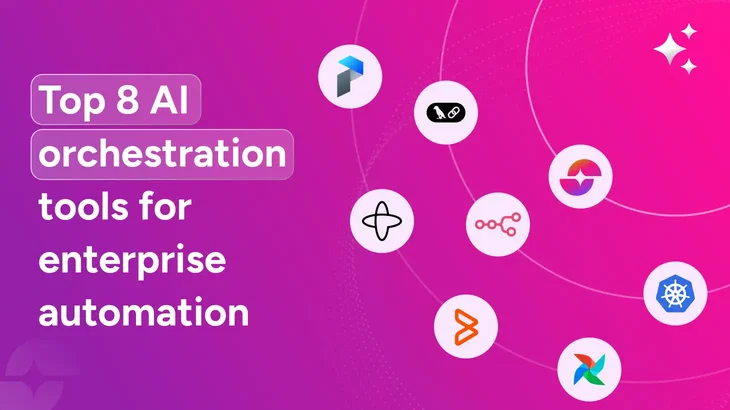
5. Apache Airflow
Apache Airflow uses directed acyclic graphs (DAGs) to define and manage workflows programmatically.
An open-source workflow orchestration platform widely used for scheduling, monitoring, and managing complex data pipelines.
Apache Airflow is the industry standard for coordinating data pipelines and machine learning tasks with clear dependencies and timelines.
It has become one of the most widely adopted orchestration tools for data engineering, ETL pipelines, and machine learning workflows.
The platform provides flexibility, scalability, and deep customization for technical teams managing large-scale workflows.
Its strong open-source ecosystem makes it highly extensible across cloud environments and data infrastructure.
Best for: Data engineering and ML workflow orchestration.
6. BMC Software Control-M
Control-M helps organizations automate and manage complex operational workflows across distributed systems and enterprise infrastructure.
Enterprise-grade orchestration platform for coordinating workflows, batch jobs, and mission-critical business processes.
It is widely used in industries where reliability, compliance, and operational continuity are critical.
The platform supports workflow scheduling, application integration, monitoring, and centralized orchestration management.
Its enterprise-focused architecture makes it suitable for large organizations operating at scale.
Best for: Large enterprises managing complex operational workflows.
Why enterprises are investing heavily in AI orchestration
Enterprise AI adoption has moved far beyond experimentation. Organizations are now building interconnected ecosystems that combine AI agents, cloud infrastructure, data pipelines, APIs, retrieval systems, and workflow automation. This enables businesses to scale AI initiatives faster while improving operational efficiency, observability, automation reliability, and governance.
|
Developer frameworks & AI agents
7. LangChain
LangChain enables developers to build advanced AI systems capable of reasoning, retrieval, memory management, and tool execution.
A popular framework for building AI applications powered by LLMs, tools, memory, and multi-agent workflows.
It has become one of the foundational frameworks for retrieval augmented generation and AI agent development.
The platform supports integrations with vector databases, APIs, external tools, and cloud AI models.
Its modular architecture allows developers to build highly customized AI workflows and autonomous systems.
Best for: Developers building advanced AI agents and reasoning systems.
8. CrewAI
CrewAI is designed specifically for multi-agent orchestration where multiple AI agents coordinate responsibilities dynamically.
A lightweight framework focused on collaborative AI agents that work together to complete tasks autonomously.
It allows organizations to build AI systems that simulate teamwork between specialized agents.
The framework supports role-based agent collaboration, task delegation, sequential workflows, and autonomous execution patterns.
Its simplicity and developer-friendly structure have made it popular for experimental and production-grade multi-agent applications.
Best for: Multi-agent AI systems and autonomous task execution.
How to choose the right AI orchestration tool
Selecting the right data orchestration tool depends heavily on organizational requirements such as deterministic process control, human-in-the-loop workflows, auditability, data sovereignty, and scalability.
A strong orchestration tool should offer version control, access management, and audit logging to maintain trust and traceability across pipelines.
The most effective platforms are those that can deliver reliable automation while providing rapid time to value, often within 30 to 60 days.
a. Consider your infrastructure
If your organization already relies heavily on cloud platforms such as AWS, Azure, or Google Cloud, native orchestration tools may provide tighter integration.
b. Evaluate data complexity
Organizations managing large data volumes and complex pipelines should prioritize:
- Data quality
- Lineage tracking
- Governance capabilities
- Monitoring tools
- configuration management
c. Assess AI requirements
If your focus is on retrieval augmented generation or multi-agent AI systems, AI-native orchestration platforms may be better suited.
d. Think about governance
Full auditability in AI orchestration tools requires logging every agent action with context, including data accessed, decisions made, and approvals, which is crucial for compliance with regulations like SOX and GDPR.
Enterprise organizations should prioritize:
- Audit trails
- Role based access control
- Version control
- Compliance support
e. Plan for scale
As data volumes grow, orchestration platforms must support:
- Enterprise scale workloads
- Multi cloud environments
- Hybrid environments
- Real-time data processing
Key features of orchestration tools include robust scheduling, retry logic, conditional branching, and built-in observability, which enhance the reliability and visibility of data workflows.
Why observability matters in AI orchestration
As orchestration workflows become more complex, organizations need visibility into how AI systems operate. Without observability, teams may struggle to identify workflow failures, latency issues, incorrect AI actions, or governance risks. Modern orchestration platforms now include monitoring dashboards, audit trails, workflow tracing, and execution analytics. |
AI agent orchestration trends in 2026
Data orchestration tools coordinate complex workflows across data stacks, ensuring that pipelines run reliably and tasks are executed in the correct sequence, which helps prevent bottlenecks from manual processes and fragmented systems.
The orchestration landscape is evolving rapidly. Several major trends are shaping orchestration tools in 2026.
a. Multi agent systems
Organizations are increasingly deploying multiple AI agents working together.
This requires orchestration platforms capable of:
- Coordinating AI agents
- Managing communication
- Monitoring workflows
- Handling distributed reasoning
b. Retrieval augmented generation
Retrieval augmented generation continues to expand across enterprise AI applications.
Orchestration platforms are integrating:
- Vector databases
- Data retrieval systems
- AI inference workflows
- Data integration pipelines
c. Cloud native expansion
Cloud native orchestration is becoming standard.
Organizations need orchestration tools that operate across:
- Cloud infrastructure
- Multi cloud platforms
- Hybrid environments
- Virtual private cloud deployments
d. Greater focus on governance
As AI regulation increases, governance features are becoming essential.
Organizations now require:
- Audit trails
- Lineage tracking
- Data governance
- General Data Protection Regulation compliance
- Security controls
e. Real-time AI operations
Businesses increasingly expect real time data processing and instant AI responses. This pushes orchestration platforms toward streaming architectures and event-driven workflows.
Insightful read: Uses of AI: How is AI revolutionizing your daily experiences.
Common challenges in AI orchestration platforms
Despite the benefits, implementing AI orchestration across enterprise systems is not always straightforward.
As workflows become more connected and AI-driven, organizations often face challenges around integrations, scalability, governance, and operational reliability.
a. Integration complexity
Modern businesses operate across multiple tools, APIs, cloud environments, and legacy systems.
Connecting all these systems into a unified orchestration layer can become highly complex.
Different platforms often use different data structures, permissions, and workflows. Without proper integration planning, orchestration systems can create operational bottlenecks instead of reducing them.
Maintaining stable integrations across constantly evolving software ecosystems also requires continuous monitoring and updates.
b. Data quality problems
AI systems are heavily dependent on the quality of the underlying data. Incomplete, inconsistent, or outdated data can negatively impact automation accuracy and AI decision-making.
Poor data synchronization across systems often creates workflow failures and unreliable outputs.
Data orchestration platforms must ensure clean ingestion, transformation, validation, and governance of data operations.
Organizations also need standardized processes to maintain data consistency as systems scale.
c. Governance gaps
As AI orchestration expands across departments, governance becomes increasingly critical.
Without clear governance frameworks, organizations risk compliance violations, security vulnerabilities, and uncontrolled AI actions.
Teams need clear policies around permissions, approvals, audit trails, and data access.
Human oversight should remain part of critical workflows where business risk is involved.
Strong governance helps organizations maintain trust, accountability, and operational control at scale.
d. Workflow failures
AI orchestration workflows often involve dependencies across distributed systems, APIs, databases, and AI agents.
Even a small failure in one component can impact the entire workflow chain.
Monitoring and observability tools are essential for identifying execution issues, latency problems, and automation failures in real time.
Organizations also need fallback mechanisms and recovery workflows to maintain operational continuity. Reliable orchestration requires continuous optimization, testing, and workflow monitoring.
e. Scaling issues
What works for small workflows may fail at enterprise scale. As data volumes, integrations, and automation workloads increase, orchestration systems become harder to manage efficiently.
Performance bottlenecks, rising infrastructure costs, and workflow complexity can slow operations over time.
Organizations need orchestration platforms that support distributed execution, scalability, and high workflow reliability.
Scalable architecture becomes essential as businesses move toward multi-agent and enterprise-wide AI operations.
Best practices for AI orchestration
Organizations implementing AI orchestration platforms should focus on systems that are scalable, reliable, and aligned with real business outcomes.
I. Start with business workflows
Don’t start with AI experimentation alone. Start with operational problems that slow teams down, create silos, or require repetitive manual work.
Identify workflows where AI can reduce response times, improve efficiency, or automate decision-making.
The best orchestration strategies begin with measurable business impact, not just technology adoption.
II. Standardize data operations
AI orchestration depends heavily on clean and connected data. Disconnected systems and inconsistent workflows often lead to unreliable automation outcomes.
Create standardized data pipelines, naming structures, and integration practices across tools and departments.
When data flows consistently, AI agents can make faster and more accurate decisions across workflows.
III. Prioritize observability
AI workflows should never operate as black boxes. Organizations need visibility into how workflows execute, where failures occur, and how agents make decisions.
Monitoring execution paths, latency, workflow health, and automation outcomes helps maintain stability at scale.
Strong observability also improves debugging, compliance, and long-term system optimization.
IV. Implement governance early
Governance becomes harder to introduce after systems scale.
Security, compliance, permissions, and approval structures should be built into orchestration workflows from the beginning.
Establish clear policies around data access, AI actions, human approvals, and audit trails.
Strong governance creates trust while reducing operational and compliance risks.
V. Build for scalability
AI orchestration should support long-term growth, not just short-term automation. As businesses expand, workflows become more complex across teams, channels, and systems.
Choose orchestration platforms that can handle increasing workloads, integrations, and multi-agent coordination.
Scalable systems make it easier to expand automation without rebuilding infrastructure later.
Final thoughts
AI orchestration is becoming the operating layer for enterprise AI.
As organizations deploy AI agents, automate workflows, manage data pipelines, and operate across cloud environments, orchestration platforms are becoming indispensable.
The best AI orchestration tools in 2026 combine:
- Workflow orchestration
- Data orchestration
- Cloud orchestration
- AI orchestration capabilities
- Governance features
- Monitoring and observability tools
- Enterprise scalability
Whether you are building retrieval augmented generation systems, managing complex workflows, automating tasks, or orchestrating enterprise AI systems, selecting the right orchestration platform is critical.
For data engineers and data scientists, orchestration tools improve reliability and operational efficiency.
For enterprise organizations, they provide governance, scalability, and automation.
And for the future of AI systems, orchestration platforms will increasingly serve as the connective layer, enabling intelligent collaboration across multiple systems, cloud platforms, and AI agents.
In 2026, organizations that invest in strong orchestration workflows will be far better positioned to scale AI successfully.
Frequently asked questions
1. What are AI orchestration tools?
AI orchestration tools coordinate AI systems, workflows, cloud services, data pipelines, and automation processes to work together efficiently.
2. What is the difference between data orchestration and AI orchestration?
Data orchestration focuses primarily on managing data flows, data movement, and transforming data operations.
AI orchestration extends beyond data workflows to coordinate AI agents, inference systems, retrieval augmented generation workflows, and intelligent automation.
3. Which orchestration tool is best for enterprises?
Apache Airflow, Dagster, Control-M, and Temporal are among the strongest enterprise orchestration platforms in 2026.
4. Which orchestration platform is best for AI agents?
LangChain is one of the most widely used AI orchestration platforms for coordinating AI agents and retrieval augmented generation systems.
5. Why is workflow orchestration important?
Workflow orchestration helps organizations automate complex workflows, improve operational efficiency, manage dependencies, and scale enterprise AI systems.








Key takeaways
AI orchestration is becoming one of the most important layers in modern enterprise technology.
As organizations adopt AI agents, retrieval augmented generation systems, automation workflows, cloud native infrastructure, and increasingly complex pipelines, orchestration platforms are emerging as the backbone connecting everything.
Tool Calling & API Integration allows LLMs to autonomously execute code, search the web, and interact with external applications.
In 2026, businesses are no longer experimenting with isolated AI tools. They are building interconnected AI systems that manage data workflows, automate operations, coordinate multiple systems, and support enterprise-scale decision making.
This shift has created massive demand for the best AI orchestration tools.
Organizations today need orchestration tools that can coordinate AI agents across multi-step workflows, manage data pipelines and data movement, and support workflow orchestration across cloud platforms.
Modern orchestration platforms must handle complex workflows across hybrid and multi-cloud environments while ensuring reliability, visibility, and operational efficiency.
They should also provide AI governance, observability, real-time processing, and seamless integrations across enterprise systems and cloud
Whether you are building a modern data stack, implementing robotic process automation, orchestrating cloud resources, or deploying retrieval augmented generation applications, choosing the right orchestration platform matters.
In this guide, we compare the best AI orchestration tools in 2026 for enterprises, startups, data engineers, data scientists, and software engineering teams.
What is AI orchestration | Explained in simple terms
AI orchestration refers to the coordination of AI systems, workflows, infrastructure, data sources, and automation tools so they can operate together efficiently.
Instead of isolated models performing single tasks, orchestration platforms connect multiple systems into intelligent workflows.
Memory & State Persistence remembers past interactions, tracks decision branches (loops and cycles), and retains context throughout a task.
For example, an AI orchestration platform may:
AI orchestration tools are now central to enterprise automation because organizations operate across:
As data volumes grow, orchestration becomes critical for reliability, scalability, and operational efficiency.
Build enterprise-ready omnichannel AI agents
From AI agent orchestration to workflow automation and enterprise integrations, Skara AI helps businesses build scalable omnichannel AI agents across chat, email, voice, WhatsApp, websites, and customer support workflows.
Why AI orchestration tools matter in 2026
The rise of AI agents and multi agent architectures has dramatically increased workflow complexity.
Businesses are no longer running a single AI model. They are managing:
Without orchestration, these environments become fragmented. The right orchestration tool helps organizations:
1. Automate complex workflows
Modern orchestration workflows span multiple systems and often include data ingestion, AI inference, reporting, monitoring, and automated actions.
AI orchestration capabilities reduce manual coordination and improve operational efficiency.
2. Improve data quality
Reliable AI depends on reliable data.
Data orchestration platforms help data engineers transform data, validate data quality, and maintain consistent data flows across cloud environments.
3. Enable enterprise scale
Large organizations require orchestration platforms that support:
Compliance requirements such as the General Data Protection Regulation and the Health Insurance Portability standards
4. Support multi-cloud infrastructure
Many enterprises operate across AWS, Azure, and Google Cloud.
Modern orchestration platforms simplify cloud orchestration and infrastructure provisioning across multi-cloud environments.
5. Coordinate AI agents
AI agents are becoming increasingly autonomous.
Orchestration platforms provide centralized workflow management so multi-agent systems can collaborate effectively.
Start building with Skara AI
Orchestrate AI agents, workflows, and enterprise systems at scale and manage intelligent operations across cloud and hybrid environments.
Key features to look for in AI orchestration tools
Before selecting the right orchestration tool, organizations should evaluate several critical capabilities.
a. Workflow orchestration
The platform should support complex workflows, directed acyclic graphs, event-based triggers, and workflow automation.
b. Data integration
Strong integration capabilities are essential for connecting:
c. Monitoring and observability
Monitoring and observability tools help teams track orchestration workflows, identify failures, and optimize performance.
d. Governance capabilities
Enterprise AI requires:
e. Cloud native architecture
Cloud native orchestration platforms provide scalability across cloud platforms and virtual private cloud environments.
f. Real-time data processing
Organizations handling streaming analytics and live AI systems need orchestration tools that support real time data processing.
g. Multi agent coordination
As AI agents become more common, orchestration platforms should support multi-agent communication and automation.
Multi-agent orchestration is shaping the future of AI
AI agents are rapidly evolving from experimental assistants into operational systems capable of executing workflows autonomously.
This creates demand for orchestration platforms that can coordinate multiple agents, manage memory, route tasks, and maintain governance across enterprise operations.
The 10 best AI orchestration tools in 2026
AI orchestration is no longer just about connecting apps.
Modern businesses now need systems that can coordinate workflows, automate decisions, manage AI agents, and execute actions across teams in real time.
Here are the top AI orchestration platforms shaping 2026.
No-code/low-code AI automation
1. Skara AI
Skara AI focuses on autonomous business execution by connecting sales, marketing, support, and operational workflows into one orchestration layer.
Built for businesses that want AI agents without complex setup.
Helps automate workflows, coordinate AI actions, and unify customer operations across teams.
Its no-code architecture allows teams to deploy AI-powered automations without heavy engineering dependencies.
The platform supports workflow automation, AI copilots, conversational intelligence, and intelligent task execution across business systems.
It is especially useful for organizations looking to centralize AI-driven GTM operations.
Best for: B2B teams looking for autonomous workflows, AI copilots, and connected GTM operations.
Skara AI: No-code orchestration
Connect AI agents, automate decisions, and orchestrate sales, marketing, and support operations from a single no-code platform.
2. Zapier
Zapier integrates with thousands of applications, making it a strong choice for workflow automation across business tools.
One of the most accessible automation tools for connecting apps and AI workflows.
Supports AI-powered triggers, chatbots, and multi-step automations with minimal coding.
Its growing AI capabilities allow teams to automate repetitive tasks using AI-generated actions and intelligent routing.
The platform is widely adopted because of its simplicity, fast deployment, and extensive ecosystem of integrations. Businesses can quickly build operational workflows without requiring dedicated engineering resources.
Zapier provides non-technical users the ability to build safe workflows across their tech stack with thousands of app integrations.
Best for: Small businesses and teams are automating repetitive tasks quickly.
Enterprise & cloud AI orchestration
3. Amazon Bedrock
Amazon Bedrock simplifies enterprise AI deployment by providing access to multiple foundation models through a unified infrastructure layer.
A managed AI service that helps enterprises build and orchestrate generative AI applications using foundation models through the AWS ecosystem.
Organizations can orchestrate AI applications while maintaining security, scalability, and governance controls within AWS environments.
The platform supports retrieval augmented generation, enterprise AI workflows, and cloud-native orchestration use cases.
Its integration with AWS cloud infrastructure makes it highly scalable for enterprise operations.
Best for: Large-scale enterprise AI deployments and cloud-native AI systems.
4. IBM Watsonx Orchestrate
IBM Watsonx Orchestrate is designed to automate repetitive business tasks through AI-powered digital workers and orchestration workflows.
Focuses on enterprise productivity automation using AI assistants and workflow orchestration across business applications.
It helps organizations streamline operations across HR, finance, procurement, and customer support functions.
The platform emphasizes governance, enterprise security, compliance, and responsible AI operations.
IBM also provides strong integration capabilities for large enterprise environments and legacy systems.
Best for: Enterprises modernizing operations with AI-driven task automation.
Data & workflow orchestration
5. Apache Airflow
Apache Airflow uses directed acyclic graphs (DAGs) to define and manage workflows programmatically.
An open-source workflow orchestration platform widely used for scheduling, monitoring, and managing complex data pipelines.
Apache Airflow is the industry standard for coordinating data pipelines and machine learning tasks with clear dependencies and timelines.
It has become one of the most widely adopted orchestration tools for data engineering, ETL pipelines, and machine learning workflows.
The platform provides flexibility, scalability, and deep customization for technical teams managing large-scale workflows.
Its strong open-source ecosystem makes it highly extensible across cloud environments and data infrastructure.
Best for: Data engineering and ML workflow orchestration.
6. BMC Software Control-M
Control-M helps organizations automate and manage complex operational workflows across distributed systems and enterprise infrastructure.
Enterprise-grade orchestration platform for coordinating workflows, batch jobs, and mission-critical business processes.
It is widely used in industries where reliability, compliance, and operational continuity are critical.
The platform supports workflow scheduling, application integration, monitoring, and centralized orchestration management.
Its enterprise-focused architecture makes it suitable for large organizations operating at scale.
Best for: Large enterprises managing complex operational workflows.
Why enterprises are investing heavily in AI orchestration
Enterprise AI adoption has moved far beyond experimentation. Organizations are now building interconnected ecosystems that combine AI agents, cloud infrastructure, data pipelines, APIs, retrieval systems, and workflow automation. This enables businesses to scale AI initiatives faster while improving operational efficiency, observability, automation reliability, and governance.
Developer frameworks & AI agents
7. LangChain
LangChain enables developers to build advanced AI systems capable of reasoning, retrieval, memory management, and tool execution.
A popular framework for building AI applications powered by LLMs, tools, memory, and multi-agent workflows.
It has become one of the foundational frameworks for retrieval augmented generation and AI agent development.
The platform supports integrations with vector databases, APIs, external tools, and cloud AI models.
Its modular architecture allows developers to build highly customized AI workflows and autonomous systems.
Best for: Developers building advanced AI agents and reasoning systems.
8. CrewAI
CrewAI is designed specifically for multi-agent orchestration where multiple AI agents coordinate responsibilities dynamically.
A lightweight framework focused on collaborative AI agents that work together to complete tasks autonomously.
It allows organizations to build AI systems that simulate teamwork between specialized agents.
The framework supports role-based agent collaboration, task delegation, sequential workflows, and autonomous execution patterns.
Its simplicity and developer-friendly structure have made it popular for experimental and production-grade multi-agent applications.
Best for: Multi-agent AI systems and autonomous task execution.
How to choose the right AI orchestration tool
Selecting the right data orchestration tool depends heavily on organizational requirements such as deterministic process control, human-in-the-loop workflows, auditability, data sovereignty, and scalability.
A strong orchestration tool should offer version control, access management, and audit logging to maintain trust and traceability across pipelines.
The most effective platforms are those that can deliver reliable automation while providing rapid time to value, often within 30 to 60 days.
a. Consider your infrastructure
If your organization already relies heavily on cloud platforms such as AWS, Azure, or Google Cloud, native orchestration tools may provide tighter integration.
b. Evaluate data complexity
Organizations managing large data volumes and complex pipelines should prioritize:
c. Assess AI requirements
If your focus is on retrieval augmented generation or multi-agent AI systems, AI-native orchestration platforms may be better suited.
d. Think about governance
Full auditability in AI orchestration tools requires logging every agent action with context, including data accessed, decisions made, and approvals, which is crucial for compliance with regulations like SOX and GDPR.
Enterprise organizations should prioritize:
e. Plan for scale
As data volumes grow, orchestration platforms must support:
Key features of orchestration tools include robust scheduling, retry logic, conditional branching, and built-in observability, which enhance the reliability and visibility of data workflows.
Why observability matters in AI orchestration
As orchestration workflows become more complex, organizations need visibility into how AI systems operate. Without observability, teams may struggle to identify workflow failures, latency issues, incorrect AI actions, or governance risks. Modern orchestration platforms now include monitoring dashboards, audit trails, workflow tracing, and execution analytics.
AI agent orchestration trends in 2026
Data orchestration tools coordinate complex workflows across data stacks, ensuring that pipelines run reliably and tasks are executed in the correct sequence, which helps prevent bottlenecks from manual processes and fragmented systems.
The orchestration landscape is evolving rapidly. Several major trends are shaping orchestration tools in 2026.
a. Multi agent systems
Organizations are increasingly deploying multiple AI agents working together.
This requires orchestration platforms capable of:
b. Retrieval augmented generation
Retrieval augmented generation continues to expand across enterprise AI applications.
Orchestration platforms are integrating:
c. Cloud native expansion
Cloud native orchestration is becoming standard.
Organizations need orchestration tools that operate across:
d. Greater focus on governance
As AI regulation increases, governance features are becoming essential.
Organizations now require:
e. Real-time AI operations
Businesses increasingly expect real time data processing and instant AI responses. This pushes orchestration platforms toward streaming architectures and event-driven workflows.
Common challenges in AI orchestration platforms
Despite the benefits, implementing AI orchestration across enterprise systems is not always straightforward.
As workflows become more connected and AI-driven, organizations often face challenges around integrations, scalability, governance, and operational reliability.
a. Integration complexity
Modern businesses operate across multiple tools, APIs, cloud environments, and legacy systems.
Connecting all these systems into a unified orchestration layer can become highly complex.
Different platforms often use different data structures, permissions, and workflows. Without proper integration planning, orchestration systems can create operational bottlenecks instead of reducing them.
Maintaining stable integrations across constantly evolving software ecosystems also requires continuous monitoring and updates.
b. Data quality problems
AI systems are heavily dependent on the quality of the underlying data. Incomplete, inconsistent, or outdated data can negatively impact automation accuracy and AI decision-making.
Poor data synchronization across systems often creates workflow failures and unreliable outputs.
Data orchestration platforms must ensure clean ingestion, transformation, validation, and governance of data operations.
Organizations also need standardized processes to maintain data consistency as systems scale.
c. Governance gaps
As AI orchestration expands across departments, governance becomes increasingly critical.
Without clear governance frameworks, organizations risk compliance violations, security vulnerabilities, and uncontrolled AI actions.
Teams need clear policies around permissions, approvals, audit trails, and data access.
Human oversight should remain part of critical workflows where business risk is involved.
Strong governance helps organizations maintain trust, accountability, and operational control at scale.
d. Workflow failures
AI orchestration workflows often involve dependencies across distributed systems, APIs, databases, and AI agents.
Even a small failure in one component can impact the entire workflow chain.
Monitoring and observability tools are essential for identifying execution issues, latency problems, and automation failures in real time.
Organizations also need fallback mechanisms and recovery workflows to maintain operational continuity. Reliable orchestration requires continuous optimization, testing, and workflow monitoring.
e. Scaling issues
What works for small workflows may fail at enterprise scale. As data volumes, integrations, and automation workloads increase, orchestration systems become harder to manage efficiently.
Performance bottlenecks, rising infrastructure costs, and workflow complexity can slow operations over time.
Organizations need orchestration platforms that support distributed execution, scalability, and high workflow reliability.
Scalable architecture becomes essential as businesses move toward multi-agent and enterprise-wide AI operations.
Best practices for AI orchestration
Organizations implementing AI orchestration platforms should focus on systems that are scalable, reliable, and aligned with real business outcomes.
I. Start with business workflows
Don’t start with AI experimentation alone. Start with operational problems that slow teams down, create silos, or require repetitive manual work.
Identify workflows where AI can reduce response times, improve efficiency, or automate decision-making.
The best orchestration strategies begin with measurable business impact, not just technology adoption.
II. Standardize data operations
AI orchestration depends heavily on clean and connected data. Disconnected systems and inconsistent workflows often lead to unreliable automation outcomes.
Create standardized data pipelines, naming structures, and integration practices across tools and departments.
When data flows consistently, AI agents can make faster and more accurate decisions across workflows.
III. Prioritize observability
AI workflows should never operate as black boxes. Organizations need visibility into how workflows execute, where failures occur, and how agents make decisions.
Monitoring execution paths, latency, workflow health, and automation outcomes helps maintain stability at scale.
Strong observability also improves debugging, compliance, and long-term system optimization.
IV. Implement governance early
Governance becomes harder to introduce after systems scale.
Security, compliance, permissions, and approval structures should be built into orchestration workflows from the beginning.
Establish clear policies around data access, AI actions, human approvals, and audit trails.
Strong governance creates trust while reducing operational and compliance risks.
V. Build for scalability
AI orchestration should support long-term growth, not just short-term automation. As businesses expand, workflows become more complex across teams, channels, and systems.
Choose orchestration platforms that can handle increasing workloads, integrations, and multi-agent coordination.
Scalable systems make it easier to expand automation without rebuilding infrastructure later.
Final thoughts
AI orchestration is becoming the operating layer for enterprise AI.
As organizations deploy AI agents, automate workflows, manage data pipelines, and operate across cloud environments, orchestration platforms are becoming indispensable.
The best AI orchestration tools in 2026 combine:
Whether you are building retrieval augmented generation systems, managing complex workflows, automating tasks, or orchestrating enterprise AI systems, selecting the right orchestration platform is critical.
For data engineers and data scientists, orchestration tools improve reliability and operational efficiency.
For enterprise organizations, they provide governance, scalability, and automation.
And for the future of AI systems, orchestration platforms will increasingly serve as the connective layer, enabling intelligent collaboration across multiple systems, cloud platforms, and AI agents.
In 2026, organizations that invest in strong orchestration workflows will be far better positioned to scale AI successfully.
Frequently asked questions
1. What are AI orchestration tools?
AI orchestration tools coordinate AI systems, workflows, cloud services, data pipelines, and automation processes to work together efficiently.
2. What is the difference between data orchestration and AI orchestration?
Data orchestration focuses primarily on managing data flows, data movement, and transforming data operations.
AI orchestration extends beyond data workflows to coordinate AI agents, inference systems, retrieval augmented generation workflows, and intelligent automation.
3. Which orchestration tool is best for enterprises?
Apache Airflow, Dagster, Control-M, and Temporal are among the strongest enterprise orchestration platforms in 2026.
4. Which orchestration platform is best for AI agents?
LangChain is one of the most widely used AI orchestration platforms for coordinating AI agents and retrieval augmented generation systems.
5. Why is workflow orchestration important?
Workflow orchestration helps organizations automate complex workflows, improve operational efficiency, manage dependencies, and scale enterprise AI systems.
Sonali Negi
Content WriterSonali is a writer born out of her utmost passion for writing. She is working with a passionate team of content creators at Salesmate. She enjoys learning about new ideas in marketing and sales. She is an optimistic girl and endeavors to bring the best out of every situation. In her free time, she loves to introspect and observe people.