A typical RAG system consists of four key stages.
Step 1: Data ingestion
Documents are collected from different data sources, including domain specific data stored in raw repositories before indexing, such as:
Step 2: Indexing
The content is converted into embeddings, transformed into numerical representations, and organized into a knowledge library inside vector databases for efficient retrieval.
Step 3: Retrieval
When a user asks a question, the retrieval model uses retrieval methods to find semantically relevant passages and documents from the indexed corpus.
Step 4: Generation
The retrieved content is provided to the LLM as contextually relevant information added from the user input, helping the model produce relevant responses and high-quality generated responses.
RAG workflow
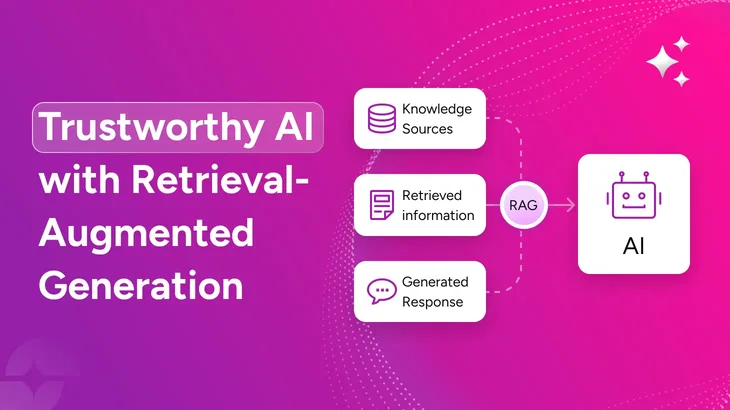
User Query → Retriever → Relevant Documents → LLM → Final Response
This architecture shows how RAG workflows help AI systems return an accurate answer based on verified sources rather than relying solely on memory.
Blockquote: 5 Types of AI Agents Explained With Examples.
Real-world applications of RAG
Organizations are using RAG to build smarter AI applications that can access up-to-date information, deliver more accurate responses, and support better decision-making.
1. Customer support AI
RAG-powered support bots retrieve relevant information from trusted knowledge sources before generating responses, helping customers receive accurate and contextual assistance.
This improves response quality, reduces resolution times, and lowers support costs.
Support bots can retrieve information from:
- Help center articles
- Product documentation
- FAQs
- Troubleshooting guides
2. Enterprise knowledge assistants
Organizations use RAG to help employees quickly access information scattered across multiple internal systems. HR AI agents reduce time spent searching for documents and improve workplace productivity.
Employees can query:
- Internal documentation
- Policies
- HR manuals
- Technical guides
3. Healthcare AI
Healthcare systems can retrieve updated medical references, treatment guidelines, and clinical documentation before generating recommendations.
Healthcare AI agents help ensure responses are based on current medical knowledge and support more informed decision-making.
4. Legal research
Law firms and legal teams can use RAG to retrieve relevant statutes, case law, contracts, and legal documents in real time. This accelerates legal research while improving the accuracy and relevance of findings.
5. Financial services
RAG enables financial institutions to access the latest regulatory information, research, and compliance resources when generating responses.
Fintech AI agents help improve accuracy while supporting risk management and regulatory compliance.
Financial institutions can access:
- Compliance guidelines
- Regulatory documents
- Investment research
6. E-commerce
RAG-powered assistants help customers discover products using real-time catalog information, inventory data, and product details.
This enables eCommerce AI agents for more personalized recommendations, improves shopping experiences, and increases conversion rates.
Core components of a RAG architecture
Behind every RAG application is a set of core components that enable information retrieval, knowledge processing, and response generation.
Each component plays a specific role in ensuring the AI delivers accurate and contextually relevant answers.
a. Document store
Stores raw documents, knowledge bases, enterprise content, and other source materials that serve as the foundation for retrieval. It acts as the primary repository from which information is prepared and indexed for search.
b. Embedding model
Converts text into numerical vector representations that capture semantic meaning rather than just keywords.
These embeddings enable the system to understand relationships, context, and similarity between different pieces of content.
c. Vector database
Stores embeddings and enables fast semantic search across large volumes of information. It helps retrieve contextually relevant content by comparing vector similarity instead of relying solely on exact keyword matches.
Popular options include:
- Pinecone
- Weaviate
- Milvus
- Chroma
- FAISS
d. Retriever
Identifies and ranks the most relevant documents based on the user's query and semantic intent.
Effective retrieval improves both response accuracy and generation speed, and strong retrieval efficiency helps supply high-quality context to the language model.
e. Large language model
Generates the final response using the retrieved context combined with its language understanding capabilities.
The RAG model synthesizes information from multiple sources to produce accurate, contextual, and natural-sounding answers.
f. Orchestration layer
Coordinates the entire workflow, including retrieval, ranking, prompt construction, and response generation. It ensures that all components work together efficiently to deliver relevant, reliable, and real-time outputs.
Benefits of Retrieval-Augmented Generation
RAG helps AI systems deliver better answers by retrieving relevant information before generating a response, improving accuracy, relevance, and trustworthiness.
a. Improved accuracy
RAG grounds responses in factual information retrieved from trusted sources, significantly reducing hallucinations and misinformation.
This helps AI generate more reliable, context-aware answers that are backed by relevant data.
b. Real-time knowledge access
Organizations can update documents and knowledge repositories without retraining models, allowing AI systems to stay current.
Real-time data retrieval ensures responses reflect the latest available information and business updates.
c. Reduced costs
Updating a knowledge base is far more cost-effective than repeatedly retraining a large language model. This approach enables organizations to improve AI performance while minimizing infrastructure, training, and maintenance expenses.
d. Better transparency
Retrieved sources can be displayed alongside responses, making it easier to verify information and understand where answers originate. This improves trust, accountability, and confidence in AI-generated outputs.
e. Domain-specific intelligence
RAG enables AI to answer questions using company-specific documents, policies, product information, and internal knowledge.
This allows organizations to deliver highly relevant, specialized responses tailored to their unique business context.
RAG vs Fine-tuning
| Feature | RAG | Fine-tuning |
|---|
| Uses External Data | Yes | No |
| Real-Time Updates | Yes | No |
| Retraining Required | No | Yes |
| Cost | Lower | Higher |
| Accuracy on Current Data | High | Limited |
| Transparency | High | Lower |
When to use RAG
Use RAG when:
- Knowledge changes frequently
- Enterprise data is involved
- Source attribution is required
- Accuracy is critical
When to use Fine-tuning
Use fine-tuning when:
- Teaching a specific writing style
- Customizing behavior
- Adapting tone and format
Many enterprises now combine both approaches.
Types of RAG systems
As Retrieval-Augmented Generation has evolved, different RAG architectures have emerged to address varying levels of complexity, accuracy, and business requirements.
Each type offers a different approach to retrieving and utilizing information during response generation.
I. Naive RAG
Naive RAG is the simplest form of Retrieval-Augmented Generation, where relevant documents are retrieved from a knowledge base and passed directly to a large language model to generate a response.
While easy to implement, it may struggle with complex queries because retrieval accuracy and document ranking capabilities are relatively limited.
This approach is relatively easy to implement and works well for basic knowledge retrieval tasks. However, it may struggle with complex queries because retrieval quality and document ranking are often limited.
II. Advanced RAG
Advanced RAG enhances the retrieval process with additional techniques that improve the relevance and quality of retrieved information before it reaches the language model, and graph RAG is another advanced approach for reasoning over relationships between entities.
Common enhancements include:
- Query expansion
- Re-ranking
- Metadata filtering
- Hybrid search
Basic keyword-driven setups in rag produce limited results for knowledge-intensive tasks, which is why more advanced retrieval techniques are used.
By refining search results and providing higher-quality context, Advanced RAG significantly improves response accuracy, reduces irrelevant information, and delivers more reliable outputs in enterprise environments.
III. Agentic RAG
Agentic RAG represents the next evolution of Retrieval-Augmented Generation, combining retrieval with autonomous AI agents capable of reasoning, planning, and taking actions.
Instead of performing a single retrieval step, AI agents can dynamically determine when information is needed, perform multiple retrieval cycles, evaluate results, and gather additional context before generating a final answer.
Recent research and real-world implementations have demonstrated substantial improvements in handling complex, multi-step tasks through agent-driven retrieval workflows.
This approach is particularly valuable for enterprise assistants, research applications, customer support automation, and other scenarios that require sophisticated reasoning and decision-making.
Blockquote: What is an AI agent? Definition, architecture, types, & use cases.
Challenges of Retrieval-Augmented Generation
While Retrieval-Augmented Generation offers significant advantages in accuracy and knowledge access, it also introduces technical and operational challenges.
Organizations must address these limitations to ensure RAG systems remain effective, secure, and scalable.
a. Retrieval quality
The effectiveness of a RAG system depends heavily on the quality of its retrieval process. If irrelevant, incomplete, or inaccurate documents are retrieved, the language model may generate poor or misleading responses.
Improving search relevance, document ranking, and indexing strategies is essential for maintaining high-quality outputs.
b. Context window limits
Large language models can only process a limited amount of information at one time. When too much content is retrieved, important details may be lost, ignored, or diluted within the available context window.
Organizations must carefully select and prioritize relevant information to maximize response quality and efficiency.
c. Data freshness
A RAG system is only as reliable as the knowledge base it accesses. Outdated documents, obsolete policies, or inaccurate information can negatively affect response accuracy.
Regular updates, content management processes, and automated synchronization mechanisms are necessary to keep knowledge sources current.
d. Security and access control
Many enterprise knowledge bases contain sensitive, confidential, or regulated information. Organizations must ensure that users and AI systems only access content they are authorized to view.
Strong authentication, role-based permissions, encryption, and governance policies are critical for protecting sensitive data.
e. Latency
Unlike traditional language models that generate responses directly, RAG systems perform additional retrieval and ranking steps before generation.
These extra processes can increase response times, especially when searching large datasets.
AI agent performance optimization, efficient vector databases, and caching strategies help reduce latency while maintaining response quality.
Text block: The growing role of RAG in AI agent development
The rise of autonomous AI agents is increasing demand for systems that can access reliable information on demand. AI agents often need to reason through complex tasks, retrieve supporting evidence, and interact with multiple knowledge sources before taking action.
Best practices for building RAG applications
Building an effective RAG application requires more than simply connecting a language model to a knowledge base.
Organizations must focus on data quality, retrieval optimization, and continuous monitoring to ensure accurate, reliable, and scalable AI performance.
a. Use high-quality data
The quality of retrieved content directly affects the quality of generated responses. Inaccurate, outdated, or poorly structured data can lead to misleading answers, even when retrieval systems function correctly.
Organizations should regularly audit, clean, and update their knowledge sources to maintain high levels of accuracy and reliability.
b. Optimize chunking
Large documents should be divided into meaningful, context-rich sections before indexing. Proper chunking helps retrieval systems locate relevant information more effectively and prevents important details from being overlooked.
Well-structured chunks improve search precision and provide the language model with clearer context for response generation.
c. Implement hybrid search
Combining multiple retrieval methods often produces better results than relying on a single approach.
Hybrid search combines:
- Semantic search
- Keyword search
This approach captures both contextual meaning and exact keyword matches, improving retrieval accuracy across a wider range of user queries.
d. Use re-ranking
Initial retrieval results are not always the most relevant. Re-ranking techniques evaluate and reorder retrieved documents based on their relevance to the user's query before sending them to the language model.
This additional step helps ensure that the highest-quality information is prioritized, leading to more accurate and useful responses.
e. Monitor performance
Continuous monitoring is essential for maintaining the effectiveness of RAG applications and identifying opportunities for improvement.
Key metrics to track include:
- Retrieval accuracy
- Hallucination rates
- User satisfaction
Regular performance evaluation helps organizations optimize retrieval strategies, improve response quality, and enhance the overall user experience.
f. Add citations
Providing citations allows users to see the sources behind AI-generated responses and verify information independently. This increases transparency, builds trust, and improves confidence in the system's outputs.
Citations are particularly valuable in industries such as healthcare, legal services, finance, and enterprise knowledge management, where accuracy and accountability are critical.
Future of Retrieval-Augmented Generation
As AI systems become more sophisticated, Retrieval-Augmented Generation is expected to play a central role in making AI more accurate, reliable, and context-aware.
Future advancements will focus on improving retrieval quality, reasoning capabilities, personalization, and real-time knowledge access.
As AI systems become more sophisticated, Retrieval-Augmented Generation is expected to play a central role in making AI more accurate, reliable, and context-aware.
Future advancements will focus on improving retrieval quality, reasoning capabilities, personalization, and real-time knowledge access.
RAG will become more deeply integrated with enterprise platforms such as CRMs, ERPs, knowledge management systems, and collaboration tools.
This will allow AI assistants to access and utilize business data seamlessly while maintaining security and compliance requirements.
Such integrations will enable more intelligent workflows and highly contextual responses.
Retrieval-Augmented Generation is rapidly evolving from a retrieval technique into the foundation of modern enterprise AI.
As retrieval methods, vector databases, and AI agents continue to advance, RAG will enable organizations to build smarter, more trustworthy, and more capable AI applications that combine powerful reasoning with access to real-world knowledge.
Conclusion
Retrieval-Augmented Generation has become one of the most important innovations in modern AI. By combining information retrieval with large language models, RAG enables businesses to build AI systems that are more accurate, transparent, and adaptable.
As enterprises move from experimentation to production AI deployments, RAG is emerging as the preferred architecture for customer support agents, enterprise search, knowledge assistants, and AI-powered decision-making systems.
Organizations looking to build trustworthy AI solutions should view Retrieval-Augmented Generation not as an optional enhancement, but as a foundational layer for the next generation of intelligent applications.









Key takeaways
Artificial intelligence has transformed how businesses access information, automate workflows, and interact with customers.
However, traditional large language models (LLMs) face a major limitation: they can only generate responses based on information available during training.
This is where Retrieval-Augmented Generation (RAG) changes the game.
RAG combines the power of large language models with external knowledge sources, enabling AI systems to retrieve relevant information in real time before generating responses. The result is more accurate, contextual, and trustworthy AI applications.
As organizations increasingly deploy AI assistants, customer support AI agents, enterprise search systems, and other AI agents, RAG has become one of the most important architectures in modern AI development.
What is Retrieval-Augmented Generation (RAG)
Retrieval-Augmented Generation (RAG) is an AI framework that enhances large language models by allowing them to retrieve information from external sources before generating a response.
Instead of relying solely on pre-trained knowledge, a RAG system can retrieve data from multiple external sources, such as relevant documents, databases, knowledge bases, or websites, and use that additional data as context for generating responses.
Simple definition
Retrieval-Augmented Generation (RAG) is a technique that combines information retrieval with a generative AI model to produce accurate responses by adding relevant data to an augmented prompt.
Why traditional LLMs need RAG
Large language models such as GPT, Claude, Gemini, and open-source models are powerful, but they have several limitations:
1. Knowledge cutoff dates
Models only know information available during training. That training data is often static, so it can miss up-to-date information. Over 60% of organizations are developing AI-powered retrieval tools to address that limitation.
2. AI hallucinations
LLMs sometimes generate incorrect or fabricated information that sounds convincing when they rely only on what they learned during training.
3. Lack of business-specific knowledge
A model may not understand unstructured text data or structured data, such as:
4. Expensive retraining
Updating an LLM with new information often requires retraining or fine-tuning.
RAG addresses these challenges by providing fresh and relevant information at inference time without retraining the model. This lets it use new data as needed instead of requiring another training cycle.
How Retrieval-Augmented Generation works
A typical RAG system consists of four key stages.
Step 1: Data ingestion
Documents are collected from different data sources, including domain specific data stored in raw repositories before indexing, such as:
Step 2: Indexing
The content is converted into embeddings, transformed into numerical representations, and organized into a knowledge library inside vector databases for efficient retrieval.
Step 3: Retrieval
When a user asks a question, the retrieval model uses retrieval methods to find semantically relevant passages and documents from the indexed corpus.
Step 4: Generation
The retrieved content is provided to the LLM as contextually relevant information added from the user input, helping the model produce relevant responses and high-quality generated responses.
RAG workflow
User Query → Retriever → Relevant Documents → LLM → Final Response
This architecture shows how RAG workflows help AI systems return an accurate answer based on verified sources rather than relying solely on memory.
Real-world applications of RAG
Organizations are using RAG to build smarter AI applications that can access up-to-date information, deliver more accurate responses, and support better decision-making.
1. Customer support AI
RAG-powered support bots retrieve relevant information from trusted knowledge sources before generating responses, helping customers receive accurate and contextual assistance.
This improves response quality, reduces resolution times, and lowers support costs.
Support bots can retrieve information from:
AI-powered customer support in practice
With Skara AI, you can automate support, improve response quality, and scale customer conversations.
2. Enterprise knowledge assistants
Organizations use RAG to help employees quickly access information scattered across multiple internal systems. HR AI agents reduce time spent searching for documents and improve workplace productivity.
Employees can query:
3. Healthcare AI
Healthcare systems can retrieve updated medical references, treatment guidelines, and clinical documentation before generating recommendations.
Healthcare AI agents help ensure responses are based on current medical knowledge and support more informed decision-making.
4. Legal research
Law firms and legal teams can use RAG to retrieve relevant statutes, case law, contracts, and legal documents in real time. This accelerates legal research while improving the accuracy and relevance of findings.
5. Financial services
RAG enables financial institutions to access the latest regulatory information, research, and compliance resources when generating responses.
Fintech AI agents help improve accuracy while supporting risk management and regulatory compliance.
Financial institutions can access:
6. E-commerce
RAG-powered assistants help customers discover products using real-time catalog information, inventory data, and product details.
This enables eCommerce AI agents for more personalized recommendations, improves shopping experiences, and increases conversion rates.
Core components of a RAG architecture
Behind every RAG application is a set of core components that enable information retrieval, knowledge processing, and response generation.
Each component plays a specific role in ensuring the AI delivers accurate and contextually relevant answers.
a. Document store
Stores raw documents, knowledge bases, enterprise content, and other source materials that serve as the foundation for retrieval. It acts as the primary repository from which information is prepared and indexed for search.
b. Embedding model
Converts text into numerical vector representations that capture semantic meaning rather than just keywords.
These embeddings enable the system to understand relationships, context, and similarity between different pieces of content.
c. Vector database
Stores embeddings and enables fast semantic search across large volumes of information. It helps retrieve contextually relevant content by comparing vector similarity instead of relying solely on exact keyword matches.
Popular options include:
d. Retriever
Identifies and ranks the most relevant documents based on the user's query and semantic intent.
Effective retrieval improves both response accuracy and generation speed, and strong retrieval efficiency helps supply high-quality context to the language model.
e. Large language model
Generates the final response using the retrieved context combined with its language understanding capabilities.
The RAG model synthesizes information from multiple sources to produce accurate, contextual, and natural-sounding answers.
f. Orchestration layer
Coordinates the entire workflow, including retrieval, ranking, prompt construction, and response generation. It ensures that all components work together efficiently to deliver relevant, reliable, and real-time outputs.
Benefits of Retrieval-Augmented Generation
RAG helps AI systems deliver better answers by retrieving relevant information before generating a response, improving accuracy, relevance, and trustworthiness.
a. Improved accuracy
RAG grounds responses in factual information retrieved from trusted sources, significantly reducing hallucinations and misinformation.
This helps AI generate more reliable, context-aware answers that are backed by relevant data.
b. Real-time knowledge access
Organizations can update documents and knowledge repositories without retraining models, allowing AI systems to stay current.
Real-time data retrieval ensures responses reflect the latest available information and business updates.
c. Reduced costs
Updating a knowledge base is far more cost-effective than repeatedly retraining a large language model. This approach enables organizations to improve AI performance while minimizing infrastructure, training, and maintenance expenses.
d. Better transparency
Retrieved sources can be displayed alongside responses, making it easier to verify information and understand where answers originate. This improves trust, accountability, and confidence in AI-generated outputs.
e. Domain-specific intelligence
RAG enables AI to answer questions using company-specific documents, policies, product information, and internal knowledge.
This allows organizations to deliver highly relevant, specialized responses tailored to their unique business context.
Why RAG is becoming the standard for enterprise AI
As organizations deploy AI across customer service, sales, operations, and knowledge management, accuracy and trust become critical requirements. Traditional AI systems often struggle to provide reliable answers when business information changes frequently.
RAG vs Fine-tuning
When to use RAG
Use RAG when:
When to use Fine-tuning
Use fine-tuning when:
Many enterprises now combine both approaches.
Types of RAG systems
As Retrieval-Augmented Generation has evolved, different RAG architectures have emerged to address varying levels of complexity, accuracy, and business requirements.
Each type offers a different approach to retrieving and utilizing information during response generation.
I. Naive RAG
Naive RAG is the simplest form of Retrieval-Augmented Generation, where relevant documents are retrieved from a knowledge base and passed directly to a large language model to generate a response.
While easy to implement, it may struggle with complex queries because retrieval accuracy and document ranking capabilities are relatively limited.
This approach is relatively easy to implement and works well for basic knowledge retrieval tasks. However, it may struggle with complex queries because retrieval quality and document ranking are often limited.
II. Advanced RAG
Advanced RAG enhances the retrieval process with additional techniques that improve the relevance and quality of retrieved information before it reaches the language model, and graph RAG is another advanced approach for reasoning over relationships between entities.
Common enhancements include:
Basic keyword-driven setups in rag produce limited results for knowledge-intensive tasks, which is why more advanced retrieval techniques are used.
By refining search results and providing higher-quality context, Advanced RAG significantly improves response accuracy, reduces irrelevant information, and delivers more reliable outputs in enterprise environments.
III. Agentic RAG
Agentic RAG represents the next evolution of Retrieval-Augmented Generation, combining retrieval with autonomous AI agents capable of reasoning, planning, and taking actions.
Instead of performing a single retrieval step, AI agents can dynamically determine when information is needed, perform multiple retrieval cycles, evaluate results, and gather additional context before generating a final answer.
Recent research and real-world implementations have demonstrated substantial improvements in handling complex, multi-step tasks through agent-driven retrieval workflows.
This approach is particularly valuable for enterprise assistants, research applications, customer support automation, and other scenarios that require sophisticated reasoning and decision-making.
Challenges of Retrieval-Augmented Generation
While Retrieval-Augmented Generation offers significant advantages in accuracy and knowledge access, it also introduces technical and operational challenges.
Organizations must address these limitations to ensure RAG systems remain effective, secure, and scalable.
a. Retrieval quality
The effectiveness of a RAG system depends heavily on the quality of its retrieval process. If irrelevant, incomplete, or inaccurate documents are retrieved, the language model may generate poor or misleading responses.
Improving search relevance, document ranking, and indexing strategies is essential for maintaining high-quality outputs.
b. Context window limits
Large language models can only process a limited amount of information at one time. When too much content is retrieved, important details may be lost, ignored, or diluted within the available context window.
Organizations must carefully select and prioritize relevant information to maximize response quality and efficiency.
c. Data freshness
A RAG system is only as reliable as the knowledge base it accesses. Outdated documents, obsolete policies, or inaccurate information can negatively affect response accuracy.
Regular updates, content management processes, and automated synchronization mechanisms are necessary to keep knowledge sources current.
d. Security and access control
Many enterprise knowledge bases contain sensitive, confidential, or regulated information. Organizations must ensure that users and AI systems only access content they are authorized to view.
Strong authentication, role-based permissions, encryption, and governance policies are critical for protecting sensitive data.
e. Latency
Unlike traditional language models that generate responses directly, RAG systems perform additional retrieval and ranking steps before generation.
These extra processes can increase response times, especially when searching large datasets.
AI agent performance optimization, efficient vector databases, and caching strategies help reduce latency while maintaining response quality.
Text block: The growing role of RAG in AI agent development
The rise of autonomous AI agents is increasing demand for systems that can access reliable information on demand. AI agents often need to reason through complex tasks, retrieve supporting evidence, and interact with multiple knowledge sources before taking action.
Best practices for building RAG applications
Building an effective RAG application requires more than simply connecting a language model to a knowledge base.
Organizations must focus on data quality, retrieval optimization, and continuous monitoring to ensure accurate, reliable, and scalable AI performance.
a. Use high-quality data
The quality of retrieved content directly affects the quality of generated responses. Inaccurate, outdated, or poorly structured data can lead to misleading answers, even when retrieval systems function correctly.
Organizations should regularly audit, clean, and update their knowledge sources to maintain high levels of accuracy and reliability.
b. Optimize chunking
Large documents should be divided into meaningful, context-rich sections before indexing. Proper chunking helps retrieval systems locate relevant information more effectively and prevents important details from being overlooked.
Well-structured chunks improve search precision and provide the language model with clearer context for response generation.
c. Implement hybrid search
Combining multiple retrieval methods often produces better results than relying on a single approach.
Hybrid search combines:
This approach captures both contextual meaning and exact keyword matches, improving retrieval accuracy across a wider range of user queries.
d. Use re-ranking
Initial retrieval results are not always the most relevant. Re-ranking techniques evaluate and reorder retrieved documents based on their relevance to the user's query before sending them to the language model.
This additional step helps ensure that the highest-quality information is prioritized, leading to more accurate and useful responses.
e. Monitor performance
Continuous monitoring is essential for maintaining the effectiveness of RAG applications and identifying opportunities for improvement.
Key metrics to track include:
Regular performance evaluation helps organizations optimize retrieval strategies, improve response quality, and enhance the overall user experience.
f. Add citations
Providing citations allows users to see the sources behind AI-generated responses and verify information independently. This increases transparency, builds trust, and improves confidence in the system's outputs.
Citations are particularly valuable in industries such as healthcare, legal services, finance, and enterprise knowledge management, where accuracy and accountability are critical.
Future of Retrieval-Augmented Generation
As AI systems become more sophisticated, Retrieval-Augmented Generation is expected to play a central role in making AI more accurate, reliable, and context-aware.
Future advancements will focus on improving retrieval quality, reasoning capabilities, personalization, and real-time knowledge access.
As AI systems become more sophisticated, Retrieval-Augmented Generation is expected to play a central role in making AI more accurate, reliable, and context-aware.
Future advancements will focus on improving retrieval quality, reasoning capabilities, personalization, and real-time knowledge access.
RAG will become more deeply integrated with enterprise platforms such as CRMs, ERPs, knowledge management systems, and collaboration tools.
This will allow AI assistants to access and utilize business data seamlessly while maintaining security and compliance requirements.
Such integrations will enable more intelligent workflows and highly contextual responses.
Retrieval-Augmented Generation is rapidly evolving from a retrieval technique into the foundation of modern enterprise AI.
As retrieval methods, vector databases, and AI agents continue to advance, RAG will enable organizations to build smarter, more trustworthy, and more capable AI applications that combine powerful reasoning with access to real-world knowledge.
Conclusion
Retrieval-Augmented Generation has become one of the most important innovations in modern AI. By combining information retrieval with large language models, RAG enables businesses to build AI systems that are more accurate, transparent, and adaptable.
As enterprises move from experimentation to production AI deployments, RAG is emerging as the preferred architecture for customer support agents, enterprise search, knowledge assistants, and AI-powered decision-making systems.
Organizations looking to build trustworthy AI solutions should view Retrieval-Augmented Generation not as an optional enhancement, but as a foundational layer for the next generation of intelligent applications.
Frequently asked questions
1. What does RAG stand for?
RAG stands for Retrieval-Augmented Generation, an AI architecture that combines information retrieval with generative AI.
2. Why is RAG important?
RAG improves AI accuracy by providing relevant external information before response generation, reducing hallucinations and enabling real-time knowledge access.
3. Is RAG better than fine-tuning?
For knowledge-intensive applications, RAG is often more cost-effective and easier to update than fine-tuning.
4. Can ChatGPT use RAG?
Yes. Many modern AI assistants use retrieval techniques to access current information and external knowledge sources, with AI models pulling in up-to-date details from external sources before answering.
5. What industries use RAG?
Industries using RAG include:
Sonali Negi
Content WriterSonali is a writer born out of her utmost passion for writing. She is working with a passionate team of content creators at Salesmate. She enjoys learning about new ideas in marketing and sales. She is an optimistic girl and endeavors to bring the best out of every situation. In her free time, she loves to introspect and observe people.