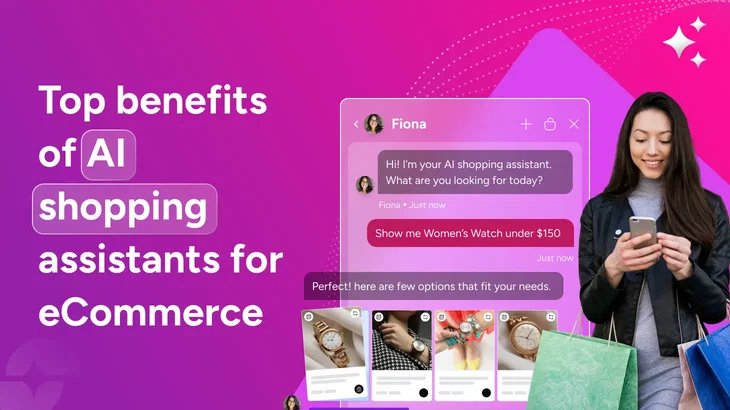
1. Improve product discovery with conversational search
A large percentage of shoppers know what they want, but not how to search for it using the exact words your catalog expects.
They search in natural language:
- Show me a blue dress for a summer wedding.
- I need running shoes for flat feet under $120
- Recommend a gift for a coffee lover.
- I want a sofa for a small apartment with pets
Conversational AI search enables customers to ask complex questions in natural language, making it easier for them to find products that match their specific needs.
Traditional ecommerce search can struggle with this type of request because the intent is rich, but the keywords are imprecise.
An AI shopping assistant helps bridge that gap. Instead of forcing customers to guess the right keywords or manually stack filters, it allows them to describe what they need naturally and then guides them toward relevant products.
For ecommerce brands, this can mean fewer dead ends, faster product discovery, and better shopper engagement.
Advanced AI shopping assistants also support multimodal search, allowing customers to interact using voice commands or by uploading images for even more intuitive product discovery.
2. Answer product questions at the moment of decision
A lot of purchase hesitation comes from uncertainty. An AI-powered shopping assistant interprets context by analyzing user queries, understanding the intent key, and reducing shopper hesitation.
Shoppers want immediate answers to customer questions like:
- Does this run true to size?
- What material is this made from?
- Is this good for sensitive skin?
- What is the difference between these two models?
- Does this work with my current setup?
- Can I return it if it does not fit?
If the answer is buried in product tabs, missing from the page, or requires a support conversation, many shoppers will delay the purchase or leave altogether.
An AI shopping assistant can answer customer questions in real time throughout the buying journey, providing more accurate answers by leveraging data and reducing eCommerce support tickets, internal documentation, and website content.
That is especially valuable on product detail pages and cart pages, where intent is already strong, and hesitation is costly.
When shoppers get clarity faster, they are more likely to continue toward checkout.
AI shopping assistants can also integrate real-time inventory and customer data to provide context-aware responses, ensuring shoppers receive the most accurate and relevant information.
Insightful read: AI agents for fit and sizing questions: How to reduce returns & improve conversions.
3. Deliver more relevant product recommendations
Most ecommerce stores already show related products, recommended items, or upsell modules.
The problem is that many of these suggestions are generic and disconnected from what the shopper is actually trying to do.
An AI shopping assistant makes recommendations more useful because it responds to the shopper’s current context.
That may include recommending:
- a better-fit alternative
- a lower-priced option
- a premium upgrade
- complementary products
- another color or style
- a substitute for an out-of-stock item
This makes the experience feel more hassle-free with guided selling agents and makes it a lot less like a static recommendation block.
For shoppers, that means less guesswork. For brands, it can optimize checkout upsells, cross-sells, and conversion opportunities.
4. Reduce cart abandonment by removing last-minute friction
Cart abandonment often happens because the shopper is close to buying but still has one or two unresolved concerns.
Those concerns may include:
- Will this arrive on time?
- Is this eligible for return?
- Can I change this later?
- Does this come in another size or color?
- Is there a better option for this need?
- Is there a bundle or offer I should know about?
These are small questions, but they appear at a critical moment.
An AI shopping assistant can help remove this friction by answering common purchase-related questions quickly and helping the shopper move forward with more confidence.
Advanced assistants can also guide customers through the final purchase steps, helping to resolve last-minute hesitations and reduce cart abandonment.
That makes it valuable not only for customer support but also for revenue and conversion.
5. Reduce repetitive eCommerce support work
Support teams often spend a large amount of time answering repeated questions, such as:
- Where is my order?
- Can I cancel this order?
- How do returns work?
- Can I change my shipping address?
- Is this item in stock?
- When will this product be back?
Order tracking and phone calls for support are common repetitive tasks that AI shopping assistants can handle, streamlining the customer journey and freeing up human agents for more complex needs.
These questions matter, but many of them do not require a human to respond manually every time.
An AI shopping assistant can automate a large portion of these repetitive interactions while still keeping the customer experience helpful and contextual.
That helps brands respond faster, reduce support burden, and reserve human agents for more complex issues.
For growing brands and high-volume stores, that efficiency can make a meaningful difference through AI bundle recommendations for better AOV.
AI shopping assistants can resolve up to 73% of customer calls independently, providing a substantial efficiency boost for businesses.
6. Support more of the customer journey in one experience
Most ecommerce tools are designed for one part of the journey.
Search helps with finding products. Live chat helps with service. Recommendation tools influence merchandising. FAQ pages answer policy questions.
But customers do not experience these as separate systems. They experience one shopping journey.
The purchase journey involves multiple touchpoints and should not be viewed as a series of individual transactions.
An AI shopping assistant can connect these moments in a way that feels more natural. It can help shoppers:
- Discover products
- Compare options
- Ask follow-up questions
- Get clarity before checkout.
- Understand returns or shipping.
- Continue into post-purchase support
That continuity helps the storefront feel more useful, more responsive, and less fragmented.
AI adoption in customer experience (CX) encompasses the cognitive, emotional, sensory, and behavioral responses of a customer during all stages of interaction with a product or service, including pre-purchase, consumption, and post-purchase.
Must-read: AI agents in customer experience: The next CX revolution.
7. Turn shopper conversations into actionable insights
Every customer conversation reveals something about your storefront. Customer feedback and operational data from shopper conversations can be leveraged to improve the overall customer experience.
Shoppers tell you:
- What they cannot find
- What is confusing
- What information is missing
- Which products need better positioning
- Where policies create friction
- What objections delay purchase
Most brands never use this feedback well because it is scattered across AI support agents, chat logs, and disconnected systems.
An AI shopping assistant can turn these interactions into a useful signal layer. The insights can help teams improve product pages, category pages, merchandising logic, FAQs, support flows, and the overall customer experience.
That makes the assistant valuable beyond customer-facing automation. It also becomes a learning loop for the business.
Multimedia support in AI shopping assistants allows for processing text, voice, and image uploads, providing richer insights for continuous improvement.
Handling complex customer queries with AI shopping assistants
AI shopping assistants are transforming how ecommerce companies address complex customer queries, delivering a new level of customer satisfaction and engagement.
Unlike traditional support tools, these AI-powered assistants go beyond basic automation.
They leverage advanced natural language processing (NLP) and machine learning to understand the context behind each question. They analyze customer behavior to uncover intent and preferences.
And they deliver accurate, personalized product recommendations throughout the entire customer journey.
For example, when a customer asks about product compatibility, nuanced differences between models, or seeks advice tailored to their unique needs, AI shopping assistants can interpret these complex requests and deliver relevant answers in real time.
This capability goes far beyond simple FAQ responses. AI shopping assistants can guide customers through the product discovery process, clarify product details, and even help with purchasing decisions, all while adapting to individual shopping intent.
Don't miss: AI onsite search for eCommerce: How AI agents help uncertain shoppers.
Seamless integration with existing systems is another key benefit. AI shopping assistants can connect with your ecommerce platform, CRM software, and inventory management tools to access up-to-date product data and operational information.
This integration enables a deeper understanding of customer needs and ensures that responses are always accurate and context-aware.
For instance, leading solutions like Skara AI empower ecommerce companies to answer questions, recommend products, and resolve support tickets efficiently, resulting in fewer abandoned carts and more revenue.
By analyzing customer data and feedback, AI shopping assistants also help businesses gain actionable insights into customer behavior and preferences.
This continuous improvement loop allows brands to refine their go-to-market strategy, optimize the product discovery experience, and stay ahead of evolving customer expectations.
AI shopping assistants not only boost conversions and reduce support workload but also drive revenue growth by delivering a superior, personalized customer experience that customers love.
Why traditional eCommerce chatbots often fall short
Many brands start by searching for an eCommerce chatbot, but what they actually need is something more capable.
Traditional ecommerce chatbots are often built around fixed scripts and limited intent handling. They can answer basic support questions, but they tend to struggle when the shopper needs help with:
- Refining what they want
- Comparing multiple options
- Understanding nuanced product differences
- Asking layered pre-purchase questions
- Moving naturally between discovery, support, and decision-making
Traditional chatbots often struggle with complex questions and cannot understand context, which limits their effectiveness in delivering personalized and nuanced assistance.
This is where the difference between a chatbot and an AI agent matters.
A chatbot usually responds to a request. A shopping assistant helps the shopper make progress.
That distinction is important for brands trying to improve product discovery, customer experience, and conversion at the same time.
AI shopping assistants can handle complex customer queries and provide personalized recommendations, whereas traditional chatbots may struggle with off-script questions.
What to look for in an AI shopping assistant
Not every AI shopping assistant is equally useful for ecommerce.
If a brand is evaluating this category, it should look for a solution that can do more than answer generic questions.
Important capabilities include:
- Strong support improves product discovery.
- Relevant recommendations.
- Clear handling of product and policy questions.
- Contextual help during cart and checkout moments.
- Post-purchase assistance.
- Sensible human escalation.
- Business guardrails and workflow control.
- Actionable insight from shopper interactions.
Key metrics such as conversion rates, average order value, and customer engagement should be used to evaluate the effectiveness of an AI shopping assistant.
The more the assistant is designed around real ecommerce journeys, the more useful it becomes.
Personalization in retail allows AI shopping assistants to use customer insights and browsing history to provide customized product recommendations.
Companies that excel in customer experience can achieve 3x returns to shareholders compared to those that do not prioritize CX.
How Skara AI agents fit here








Key takeaways
Online shoppers do not want to dig through filters, menus, product pages, and FAQ links to decide what to buy.
They want quick answers, relevant recommendations, and a faster path from interest to purchase.
That is why more brands are exploring the role of the AI shopping assistant in ecommerce.
AI shopping assistants deliver a personalized experience by leveraging artificial intelligence to tailor recommendations and interactions for each customer.
For ecommerce teams, that means more than automation. It aims to improve customer experience, reduce friction, and provide more opportunities to turn browsing into buying.
Companies using AI shopping assistants report significant improvements in customer satisfaction, loyalty, and personalization, with over a third of commerce leaders noting major enhancements in these areas.
What is an AI shopping assistant?
An AI shopping assistant is a conversational assistant powered by artificial intelligence that helps customers shop online more easily.
It understands shopper intent, responds to natural-language questions, recommends products, explains differences, and helps customers move forward when they are unsure what to buy.
In practical terms, this AI-powered assistant acts like a digital shopping guide for your storefront.
Depending on how it is implemented, an AI shopping assistant can help with:
AI shopping assistants can autonomously resolve up to 73% of customer inquiries, significantly improving operational efficiency for e-commerce businesses.
The key difference is that it supports shopping decisions, not just basic customer service interactions.
Why Ecommerce brands are investing in AI shopping assistants
Most ecommerce stores still rely on a mix of search, filters, recommendation widgets, product pages, FAQs, and support chat. All of these tools help, but they also make the shopper do too much work.
Customers often hesitate when they cannot quickly answer questions like:
AI shopping assistants drive customer engagement by providing proactive, personalized support throughout the shopping journey, helping customers feel understood and guided at every step.
Every unanswered question creates friction. Every extra click increases the chance of abandonment.
An AI shopping assistant helps reduce that friction by making the experience more conversational, more immediate, and more relevant to shopper intent.
Leading brands have adopted AI shopping assistants to boost sales and improve conversion rates, demonstrating the effectiveness of these tools in delivering personalized shopping experiences.
A comprehensive customer experience management strategy, including AI shopping assistants, can lead to a 20% improvement in customer satisfaction and a 15% boost in sales conversion rates.
Drive customer engagement with an eCommerce AI assistant
AI-powered shopping agents help reduce purchase friction by making the customer experience more intent-oriented and conversational.
1. Improve product discovery with conversational search
A large percentage of shoppers know what they want, but not how to search for it using the exact words your catalog expects.
They search in natural language:
Conversational AI search enables customers to ask complex questions in natural language, making it easier for them to find products that match their specific needs.
Traditional ecommerce search can struggle with this type of request because the intent is rich, but the keywords are imprecise.
An AI shopping assistant helps bridge that gap. Instead of forcing customers to guess the right keywords or manually stack filters, it allows them to describe what they need naturally and then guides them toward relevant products.
For ecommerce brands, this can mean fewer dead ends, faster product discovery, and better shopper engagement.
Advanced AI shopping assistants also support multimodal search, allowing customers to interact using voice commands or by uploading images for even more intuitive product discovery.
2. Answer product questions at the moment of decision
A lot of purchase hesitation comes from uncertainty. An AI-powered shopping assistant interprets context by analyzing user queries, understanding the intent key, and reducing shopper hesitation.
Shoppers want immediate answers to customer questions like:
If the answer is buried in product tabs, missing from the page, or requires a support conversation, many shoppers will delay the purchase or leave altogether.
An AI shopping assistant can answer customer questions in real time throughout the buying journey, providing more accurate answers by leveraging data and reducing eCommerce support tickets, internal documentation, and website content.
That is especially valuable on product detail pages and cart pages, where intent is already strong, and hesitation is costly.
When shoppers get clarity faster, they are more likely to continue toward checkout.
AI shopping assistants can also integrate real-time inventory and customer data to provide context-aware responses, ensuring shoppers receive the most accurate and relevant information.
3. Deliver more relevant product recommendations
Most ecommerce stores already show related products, recommended items, or upsell modules.
The problem is that many of these suggestions are generic and disconnected from what the shopper is actually trying to do.
An AI shopping assistant makes recommendations more useful because it responds to the shopper’s current context.
That may include recommending:
This makes the experience feel more hassle-free with guided selling agents and makes it a lot less like a static recommendation block.
For shoppers, that means less guesswork. For brands, it can optimize checkout upsells, cross-sells, and conversion opportunities.
4. Reduce cart abandonment by removing last-minute friction
Cart abandonment often happens because the shopper is close to buying but still has one or two unresolved concerns.
Those concerns may include:
These are small questions, but they appear at a critical moment.
An AI shopping assistant can help remove this friction by answering common purchase-related questions quickly and helping the shopper move forward with more confidence.
Advanced assistants can also guide customers through the final purchase steps, helping to resolve last-minute hesitations and reduce cart abandonment.
That makes it valuable not only for customer support but also for revenue and conversion.
5. Reduce repetitive eCommerce support work
Support teams often spend a large amount of time answering repeated questions, such as:
Order tracking and phone calls for support are common repetitive tasks that AI shopping assistants can handle, streamlining the customer journey and freeing up human agents for more complex needs.
These questions matter, but many of them do not require a human to respond manually every time.
An AI shopping assistant can automate a large portion of these repetitive interactions while still keeping the customer experience helpful and contextual.
That helps brands respond faster, reduce support burden, and reserve human agents for more complex issues.
For growing brands and high-volume stores, that efficiency can make a meaningful difference through AI bundle recommendations for better AOV.
AI shopping assistants can resolve up to 73% of customer calls independently, providing a substantial efficiency boost for businesses.
6. Support more of the customer journey in one experience
Most ecommerce tools are designed for one part of the journey.
Search helps with finding products. Live chat helps with service. Recommendation tools influence merchandising. FAQ pages answer policy questions.
But customers do not experience these as separate systems. They experience one shopping journey.
The purchase journey involves multiple touchpoints and should not be viewed as a series of individual transactions.
An AI shopping assistant can connect these moments in a way that feels more natural. It can help shoppers:
That continuity helps the storefront feel more useful, more responsive, and less fragmented.
AI adoption in customer experience (CX) encompasses the cognitive, emotional, sensory, and behavioral responses of a customer during all stages of interaction with a product or service, including pre-purchase, consumption, and post-purchase.
7. Turn shopper conversations into actionable insights
Every customer conversation reveals something about your storefront. Customer feedback and operational data from shopper conversations can be leveraged to improve the overall customer experience.
Shoppers tell you:
Most brands never use this feedback well because it is scattered across AI support agents, chat logs, and disconnected systems.
An AI shopping assistant can turn these interactions into a useful signal layer. The insights can help teams improve product pages, category pages, merchandising logic, FAQs, support flows, and the overall customer experience.
That makes the assistant valuable beyond customer-facing automation. It also becomes a learning loop for the business.
Multimedia support in AI shopping assistants allows for processing text, voice, and image uploads, providing richer insights for continuous improvement.
Handling complex customer queries with AI shopping assistants
AI shopping assistants are transforming how ecommerce companies address complex customer queries, delivering a new level of customer satisfaction and engagement.
Unlike traditional support tools, these AI-powered assistants go beyond basic automation.
They leverage advanced natural language processing (NLP) and machine learning to understand the context behind each question. They analyze customer behavior to uncover intent and preferences.
And they deliver accurate, personalized product recommendations throughout the entire customer journey.
For example, when a customer asks about product compatibility, nuanced differences between models, or seeks advice tailored to their unique needs, AI shopping assistants can interpret these complex requests and deliver relevant answers in real time.
This capability goes far beyond simple FAQ responses. AI shopping assistants can guide customers through the product discovery process, clarify product details, and even help with purchasing decisions, all while adapting to individual shopping intent.
Seamless integration with existing systems is another key benefit. AI shopping assistants can connect with your ecommerce platform, CRM software, and inventory management tools to access up-to-date product data and operational information.
This integration enables a deeper understanding of customer needs and ensures that responses are always accurate and context-aware.
For instance, leading solutions like Skara AI empower ecommerce companies to answer questions, recommend products, and resolve support tickets efficiently, resulting in fewer abandoned carts and more revenue.
By analyzing customer data and feedback, AI shopping assistants also help businesses gain actionable insights into customer behavior and preferences.
This continuous improvement loop allows brands to refine their go-to-market strategy, optimize the product discovery experience, and stay ahead of evolving customer expectations.
AI shopping assistants not only boost conversions and reduce support workload but also drive revenue growth by delivering a superior, personalized customer experience that customers love.
Why traditional eCommerce chatbots often fall short
Many brands start by searching for an eCommerce chatbot, but what they actually need is something more capable.
Traditional ecommerce chatbots are often built around fixed scripts and limited intent handling. They can answer basic support questions, but they tend to struggle when the shopper needs help with:
Traditional chatbots often struggle with complex questions and cannot understand context, which limits their effectiveness in delivering personalized and nuanced assistance.
This is where the difference between a chatbot and an AI agent matters.
A chatbot usually responds to a request. A shopping assistant helps the shopper make progress.
That distinction is important for brands trying to improve product discovery, customer experience, and conversion at the same time.
AI shopping assistants can handle complex customer queries and provide personalized recommendations, whereas traditional chatbots may struggle with off-script questions.
What to look for in an AI shopping assistant
Not every AI shopping assistant is equally useful for ecommerce.
If a brand is evaluating this category, it should look for a solution that can do more than answer generic questions.
Important capabilities include:
Key metrics such as conversion rates, average order value, and customer engagement should be used to evaluate the effectiveness of an AI shopping assistant.
The more the assistant is designed around real ecommerce journeys, the more useful it becomes.
Personalization in retail allows AI shopping assistants to use customer insights and browsing history to provide customized product recommendations.
Companies that excel in customer experience can achieve 3x returns to shareholders compared to those that do not prioritize CX.
How Skara AI agents fit here
Skara is built for ecommerce teams that want AI to support more than basic support deflection.
It is designed to help brands improve product discovery, guide shopper decisions, answer product and policy questions, reduce friction across the buying journey, and support customers after purchase.
Skara is designed to support both Shopify stores and any other e-commerce store, making it a versatile solution for a wide range of online retailers.
For brands looking for an AI shopping assistant that supports both customer experience and ecommerce outcomes, Skara is one option worth evaluating.
AI shopping assistants can automate over 80% of incoming queries, significantly improving operational efficiency in e-commerce.
See how Skara supports eCommerce shopping journeys
Help shoppers discover products, get answers faster, reduce purchase friction, and improve customer experience with an AI assistant built for ecommerce.
Final thoughts
AI shopping assistants are becoming an important part of modern ecommerce marketing automation because they help brands make online shopping feel more guided, more responsive, and less frustrating.
The best AI shopping assistants are transforming business models and setting new standards for customer experience by providing personalized, real-time support and predictive engagement across multiple touchpoints.
They can improve product discovery, answer shopper questions faster, reduce repetitive support work, and remove friction from the path to purchase.
The opportunity is not just to replace live chat or automate FAQs. It is to create a better shopping experience across the full customer journey.
For ecommerce brands evaluating this space, the real question is not whether conversational AI belongs in commerce. It is whether the experience is helpful enough to actually improve how people shop.
In 2020, the global customer experience management market was valued at $7.54 billion and is expected to grow at a CAGR of 17.5% from 2021 to 2028.
Frequently asked questions
1. What is an AI shopping assistant for ecommerce?
An AI shopping assistant for ecommerce is a conversational tool that helps shoppers discover products, ask questions, compare options, and get support across the online buying journey.
2. How is an AI shopping assistant different from an ecommerce chatbot?
An ecommerce chatbot is often rule-based and limited to simple support flows. An AI shopping assistant is usually more flexible and better suited for product discovery, recommendations, decision support, and broader shopping interactions.
3. Can AI shopping assistants help improve conversions?
Yes. They can reduce friction, answer purchase-related questions faster, and help shoppers find the right products with more confidence.
4. Are AI shopping assistants only useful for support?
No. They can also support discovery, recommendations, product comparisons, cart questions, and other high-intent parts of the buying journey.
5. What should ecommerce brands look for in an AI shopping assistant?
They should look for strong discovery support, product and policy question handling, relevant recommendations, post-purchase workflow support, human escalation, and e-commerce-specific controls.
Samir Motwani
Product HeadSamir Motwani is the Product Head & Co-founder at Salesmate, where he focuses on reinventing customer relationship management through innovative SaaS solutions that drive business efficiency and enhance user satisfaction.