1. Uncertainty about key details
Shoppers hesitate when they can’t quickly confirm delivery timelines, especially when slow delivery times create uncertainty for urgent or time-sensitive purchases.
When answers aren’t visible at the moment of decision, the safest option feels like pausing rather than guessing.
This hesitation isn’t about effort. It’s about avoiding regret.
2. Friction in the checkout flow
Long forms, forced account creation, and the absence of multiple payment options interrupt momentum at checkout.
At checkout, even small obstacles feel costly because the shopper is already close to committing.
3. Cognitive overload at the final step
Too many choices, last-minute add-ons, or unclear comparisons can introduce second thoughts.
Instead of helping shoppers decide, excess information can delay the decision entirely.
4. Trust and reassurance gaps
If policies are hard to find or payment security is not obvious, shoppers hesitate. This can happen even when the product, price, and brand are otherwise appealing.
Across all four causes, the pattern is consistent: shoppers want to complete the purchase, but something prevents them from feeling confident enough to proceed.
This is the point where abandoned cart recovery is most effective, not after shoppers leave, but when hesitation first appears at checkout.
Insightful: 15 eCommerce tasks you should hand off to AI agents right now.
The real-time decision loop behind AI cart recovery
Real-time cart recovery starts with a shift in focus. Instead of trying to bring shoppers back after they leave, the goal is to understand what is blocking progress while they are still in checkout.
Cart abandonment is rarely a single action. It unfolds through hesitation, pauses, and uncertainty before the shopper exits. Real-time recovery works because it responds during this decision process, not after it ends.
At the core of this approach is a simple decision loop that adapts to the shopper’s situation rather than following a fixed sequence.
1. Detect hesitation early
The loop begins by identifying signals that progress has stalled. These include long pauses at checkout, repeated movement between steps, or stalled payment attempts.
At this stage, the shopper is still active and intending to purchase, but something is preventing forward motion.
2. Understand context, not just behavior
Next, the system evaluates context.
What’s in the cart, which checkout step is causing friction, how the shopper has interacted so far, and relevant customer feedback from past sessions all help explain why hesitation is happening.
For example, delays on the delivery step often indicate cost or timing concerns, while repeated size changes usually point to fit uncertainty.
3. Decide what help is most relevant
Based on this context, the system selects the most appropriate response. That might be answering a question, clarifying a policy, offering guidance, or inviting assistance.
Not every hesitation needs a discount or a free shipping code, and not every situation calls for brands to offer personalized discounts.
This restraint is central to AI accountability, ensuring agents support decisions without manipulating outcomes.
4. Act without breaking checkout flow
Assistance is delivered inside the checkout experience. The shopper doesn’t need to leave the page, search for information, or restart the process.
If the issue is resolved, the loop ends with a completed purchase, effectively helping brands convert abandoned carts before they turn into lost sales.
If hesitation continues, the system adapts and responds again based on the shopper’s next signals.
This decision loop matters because it mirrors how effective in-store assistance works. A good sales associate notices hesitation, adjusts their response, and helps the customer decide.
Real-time cart recovery applies the same logic to checkout, which is why it prevents abandonment instead of reacting to it.
Real-time intervention vs post-exit recovery: a clear distinction
Real-time intervention supports decisions while they are still being made. Post-exit recovery attempts to re-engage customers after decisions have already been interrupted.
The section below breaks down the differences between real-time intervention and post-exit recovery.
Aspect | Real-time intervention | Post-exit recovery |
|---|
When it happens | While the shopper is still active in checkout | After the shopper has left the site |
Shopper state | Paused, uncertain, or blocked | Disengaged or distracted |
Before | Help the shopper complete the purchase | Bring the shopper back to restart the decision |
Problem being solved | Checkout hesitation and friction | Loss of attention and context |
Type of assistance | Answers, I clarify | Reminders, follow-ups, incentives |
Impact on momentum | Preserves checkout progress | I received the request. |
Decision status | Still in progress | Already interrupted |
This distinction matters because the effort required is fundamentally different.
Resolving a question during checkout keeps the decision moving forward.
Asking a shopper to return later requires them to remember the product, re-evaluate the message, regain motivation, and repeat steps they already abandoned.
Both approaches can coexist in a cart recovery strategy, but they serve different purposes.
Real-time intervention prevents abandonment by resolving hesitation. Post-exit recovery attempts to reverse a decision that has already paused or ended.
When real-time AI agents work for cart abandonment (and when they don’t)
AI abandoned cart recovery works best when hesitation is the problem, not when the checkout itself is broken.
AI agents add value by resolving uncertainty during decision-making, but they cannot compensate for structural issues in pricing, checkout design, or payments.
The key question is whether the problem is decision friction or structural failure.
AI agents are a strong fit when
- Shoppers pause due to unanswered questions about delivery timelines, returns, sizing, or compatibility
- Shoppers are browsing casually or behaving like window shoppers with no immediate intent to purchase
- Checkout flows are mostly stable, but drop-offs occur at specific steps
- Hesitation appears late in the journey, close to payment or confirmation
- Buyers have clear purchase intent but lack confidence to complete the final step
- Small clarifications or guidance can unblock progress without incentives
In these situations, timely in-session assistance helps shoppers complete a purchase they already intend to make.
AI agents are not the right solution when
- Pricing or shipping costs are consistently unclear or unexpected
- Checkout forms are long, error-prone, or difficult to complete
- Payment failures or limited payment options block completion
- Shoppers are browsing casually with no immediate intent to buy
The product experience itself creates confusion earlier in the journey
These issues require changes to checkout design, pricing clarity, or infrastructure. Real-time assistance cannot replace those fixes.
Understanding this boundary is essential. AI agents are most effective as a decision-support layer during checkout, not as a workaround for broken fundamentals.
What real-time cart recovery looks like during checkout
Real-time cart recovery appears at the exact moment a shopper hesitates, not after they leave. The shopper is still on the site, still interested, but something in the checkout flow has slowed them down.
This hesitation often looks subtle.
A shopper may pause on the delivery step, scroll back to product details, revisit policy information, or move between checkout steps without progressing. The intent to buy is still present, but confidence is missing.
At this point, real-time assistance focuses on removing uncertainty, not pushing reminders.
By resolving questions in-session, real-time assistance supports decision-making by allowing customers to move forward with confidence instead of pausing to search for answers elsewhere.
Instead of asking the shopper to return later, help appears directly inside the checkout flow and addresses the specific issue blocking progress.
What happens in practice
- The shopper pauses or loops between checkout steps
- A contextual prompt appears, tied to the exact step they are on
- The prompt answers a delivery, return, sizing, or payment-related question
- The shopper stays on the page and continues checkout
- The purchase is completed without restarting the decision
This is where AI agents add value. AI shopping agents are designed to observe hesitation signals during checkout and respond with relevant help based on cart contents, policies, and session context.
The response adapts to the situation rather than following a fixed script or defaulting to discounts.
The key shift is functional, not technical.
Abandoned cart recovery becomes part of checkout support, not a follow-up campaign.
Help arrives while the decision is still in progress, preserving momentum and preventing abandonment before it happens.
Also read: How AI is transforming eCommerce: A new era of possibilities.
How Skara supports real-time abandoned cart recovery
Real-time cart recovery depends on one thing above all else: acting while the shopper is still deciding.
Skara AI agents by Salesmate are designed around that moment, not around post-exit follow-ups or delayed campaigns.
Instead of treating cart abandonment as a trigger for reminders, Skara functions as a real-time checkout support layer that responds while intent is still active.
Skara supports real-time recovery by:
- Detecting hesitation before abandonment occurs, such as pauses at checkout steps, stalled payment attempts, or repeated back-and-forth navigation
- Using session context to guide responses, including what’s in the cart, where the shopper is stuck, and which policies or constraints apply
- Delivering assistance directly inside the checkout flow, so shoppers get answers or clarification without leaving the page or restarting the process
Because assistance is contextual and in-session, responses adapt to the situation rather than following a fixed script or defaulting to incentives.
The result isn’t a recovery campaign, but a smoother decision process.
Shoppers move forward because the reason for hesitation is resolved in the moment, not because they were persuaded to come back later.
This is why Skara works best as part of the checkout experience itself, complementing email or retargeting workflows rather than replacing them.
Closing thoughts
Checkout hesitation rarely comes from a lack of interest; customers abandon only when doubt, friction, or perceived risk interrupts confidence at the final step.
When recovery efforts wait until after the session ends, they miss the moment when the decision could have been completed.
Real-time cart recovery shifts the focus back to that moment. By addressing hesitation as it happens, shoppers can complete purchases without restarting the process or relying on incentives to return.
Over time, this improves conversion quality and strengthens customer retention, which platforms like Salesmate are designed to support across the full customer lifecycle.
AI agents do not replace good checkout design, pricing clarity, or trust signals.
But when those fundamentals are in place, real-time assistance becomes one of the most effective ways to reduce abandonment.
The biggest gains do not come from chasing lost carts. They come from preventing hesitation from turning into exit in the first place.
Looking ahead, AI trends in eCommerce suggest that more brands will embrace real-time assistance during checkout, moving beyond abandoned cart emails toward context-aware decision support.







Key takeaways
More than 70% of online shopping carts are abandoned globally, aligning with the average cart abandonment rate seen across eCommerce and making it one of the biggest sources of lost revenue.
For online shoppers, abandonment rarely signals lost interest. It usually reflects hesitation caused by uncertainty at the final step of checkout.
Modern checkout flows average 5.1 steps and over 11 form fields, and even small points of friction at this stage can interrupt decisions.
Customers abandon checkout when delivery timelines, return policies, sizing, or payment options are unclear.
Purchase intent is still present, but confidence weakens right before payment.
Traditional abandoned cart tactics respond after this moment has already passed, breaking the customer journey at its most critical decision point.
Real-time abandoned cart recovery works differently, powered by modern AI agents that respond inside the checkout flow instead of after it ends.
Instead of trying to pull shoppers back later, it supports decision-making inside the checkout session. AI agents detect hesitation as it happens and resolve the specific issue blocking progress.
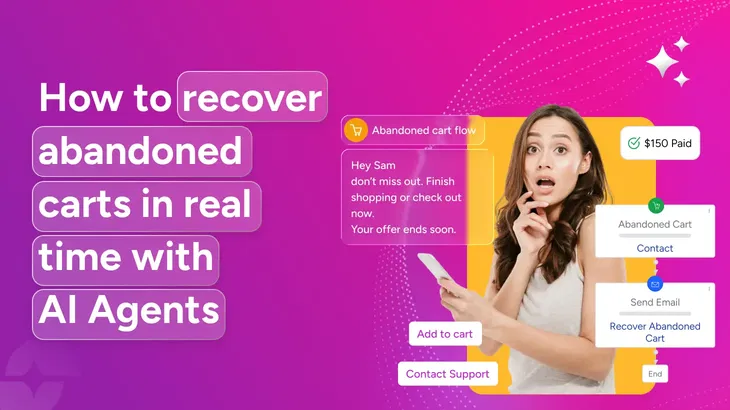
This blog explains how AI agents recover abandoned carts in real time by acting at the moment of hesitation, before shoppers exit checkout, and before intent is lost.
Why is real-time fundamentally more effective than after-the-fact recovery?
Shopping cart abandonment usually happens within a short decision window during checkout.
Shoppers reach the payment step, slow down, reread details, or pause because something feels unclear.
At this stage, purchase intent still exists, but confidence begins to drop.
This timing matters because checkout hesitation is not about memory or gentle reminders. It is about decision support.
Helping shoppers while they are still weighing the purchase preserves momentum and leads to more completed checkouts than asking them to come back after they leave.
Why do abandoned cart emails fail to convert?
Abandoned cart emails fail because they act after the buying decision has already paused.
They arrive when shoppers have left the checkout and lost context. The original hesitation remains unresolved, and the shopper must rebuild attention, intent, and momentum to return.
As a result, cart emails are better at re-engaging customers than converting hesitation into completed purchases.
Exit intent pop-ups suffer from the same limitation. They appear when shoppers are already preparing to leave, reacting to abandonment instead of preventing it at the moment hesitation begins.
What actually causes shoppers to hesitate at checkout
Treating checkout hesitation as a post-exit problem is one of the most common eCommerce mistakes brands make.
Most shoppers slow down because something introduces doubt, friction, or perceived risk at the final step.
The intent to buy is still there. What’s missing is the confidence to proceed.
1. Uncertainty about key details
Shoppers hesitate when they can’t quickly confirm delivery timelines, especially when slow delivery times create uncertainty for urgent or time-sensitive purchases.
When answers aren’t visible at the moment of decision, the safest option feels like pausing rather than guessing.
This hesitation isn’t about effort. It’s about avoiding regret.
2. Friction in the checkout flow
Long forms, forced account creation, and the absence of multiple payment options interrupt momentum at checkout.
At checkout, even small obstacles feel costly because the shopper is already close to committing.
3. Cognitive overload at the final step
Too many choices, last-minute add-ons, or unclear comparisons can introduce second thoughts.
Instead of helping shoppers decide, excess information can delay the decision entirely.
4. Trust and reassurance gaps
If policies are hard to find or payment security is not obvious, shoppers hesitate. This can happen even when the product, price, and brand are otherwise appealing.
Across all four causes, the pattern is consistent: shoppers want to complete the purchase, but something prevents them from feeling confident enough to proceed.
This is the point where abandoned cart recovery is most effective, not after shoppers leave, but when hesitation first appears at checkout.
The real-time decision loop behind AI cart recovery
Real-time cart recovery starts with a shift in focus. Instead of trying to bring shoppers back after they leave, the goal is to understand what is blocking progress while they are still in checkout.
Cart abandonment is rarely a single action. It unfolds through hesitation, pauses, and uncertainty before the shopper exits. Real-time recovery works because it responds during this decision process, not after it ends.
At the core of this approach is a simple decision loop that adapts to the shopper’s situation rather than following a fixed sequence.
1. Detect hesitation early
The loop begins by identifying signals that progress has stalled. These include long pauses at checkout, repeated movement between steps, or stalled payment attempts.
At this stage, the shopper is still active and intending to purchase, but something is preventing forward motion.
2. Understand context, not just behavior
Next, the system evaluates context.
What’s in the cart, which checkout step is causing friction, how the shopper has interacted so far, and relevant customer feedback from past sessions all help explain why hesitation is happening.
For example, delays on the delivery step often indicate cost or timing concerns, while repeated size changes usually point to fit uncertainty.
3. Decide what help is most relevant
Based on this context, the system selects the most appropriate response. That might be answering a question, clarifying a policy, offering guidance, or inviting assistance.
Not every hesitation needs a discount or a free shipping code, and not every situation calls for brands to offer personalized discounts.
This restraint is central to AI accountability, ensuring agents support decisions without manipulating outcomes.
4. Act without breaking checkout flow
Assistance is delivered inside the checkout experience. The shopper doesn’t need to leave the page, search for information, or restart the process.
If the issue is resolved, the loop ends with a completed purchase, effectively helping brands convert abandoned carts before they turn into lost sales.
If hesitation continues, the system adapts and responds again based on the shopper’s next signals.
This decision loop matters because it mirrors how effective in-store assistance works. A good sales associate notices hesitation, adjusts their response, and helps the customer decide.
Real-time cart recovery applies the same logic to checkout, which is why it prevents abandonment instead of reacting to it.
How do AI agents detect checkout hesitation in real time?
AI agents detect checkout hesitation by identifying signals that indicate stalled progress during checkout.
These signals include long pauses on checkout steps, repeated movement between steps, stalled payment attempts, and frequent revisits to delivery or policy information.
By combining these signals with session context, AI agents can intervene while the shopper is still active and deciding.
Real-time intervention vs post-exit recovery: a clear distinction
Real-time intervention supports decisions while they are still being made. Post-exit recovery attempts to re-engage customers after decisions have already been interrupted.
The section below breaks down the differences between real-time intervention and post-exit recovery.
Aspect
Real-time intervention
Post-exit recovery
When it happens
While the shopper is still active in checkout
After the shopper has left the site
Shopper state
Paused, uncertain, or blocked
Disengaged or distracted
Before
Help the shopper complete the purchase
Bring the shopper back to restart the decision
Problem being solved
Checkout hesitation and friction
Loss of attention and context
Type of assistance
Answers, I clarify
Reminders, follow-ups, incentives
Impact on momentum
Preserves checkout progress
I received the request.
Decision status
Still in progress
Already interrupted
This distinction matters because the effort required is fundamentally different.
Resolving a question during checkout keeps the decision moving forward.
Asking a shopper to return later requires them to remember the product, re-evaluate the message, regain motivation, and repeat steps they already abandoned.
Both approaches can coexist in a cart recovery strategy, but they serve different purposes.
Real-time intervention prevents abandonment by resolving hesitation. Post-exit recovery attempts to reverse a decision that has already paused or ended.
See how real-time AI agents reduce cart abandonment
Explore how Skara’s AI eCommerce agents support shoppers during checkout by resolving hesitation in real time, before carts are abandoned and intent is lost.
When real-time AI agents work for cart abandonment (and when they don’t)
AI abandoned cart recovery works best when hesitation is the problem, not when the checkout itself is broken.
AI agents add value by resolving uncertainty during decision-making, but they cannot compensate for structural issues in pricing, checkout design, or payments.
The key question is whether the problem is decision friction or structural failure.
AI agents are a strong fit when
In these situations, timely in-session assistance helps shoppers complete a purchase they already intend to make.
AI agents are not the right solution when
The product experience itself creates confusion earlier in the journey
These issues require changes to checkout design, pricing clarity, or infrastructure. Real-time assistance cannot replace those fixes.
Understanding this boundary is essential. AI agents are most effective as a decision-support layer during checkout, not as a workaround for broken fundamentals.
What real-time cart recovery looks like during checkout
Real-time cart recovery appears at the exact moment a shopper hesitates, not after they leave. The shopper is still on the site, still interested, but something in the checkout flow has slowed them down.
This hesitation often looks subtle.
A shopper may pause on the delivery step, scroll back to product details, revisit policy information, or move between checkout steps without progressing. The intent to buy is still present, but confidence is missing.
At this point, real-time assistance focuses on removing uncertainty, not pushing reminders.
By resolving questions in-session, real-time assistance supports decision-making by allowing customers to move forward with confidence instead of pausing to search for answers elsewhere.
Instead of asking the shopper to return later, help appears directly inside the checkout flow and addresses the specific issue blocking progress.
What happens in practice
This is where AI agents add value. AI shopping agents are designed to observe hesitation signals during checkout and respond with relevant help based on cart contents, policies, and session context.
The response adapts to the situation rather than following a fixed script or defaulting to discounts.
The key shift is functional, not technical.
Abandoned cart recovery becomes part of checkout support, not a follow-up campaign.
Help arrives while the decision is still in progress, preserving momentum and preventing abandonment before it happens.
How Skara supports real-time abandoned cart recovery
Real-time cart recovery depends on one thing above all else: acting while the shopper is still deciding.
Skara AI agents by Salesmate are designed around that moment, not around post-exit follow-ups or delayed campaigns.
Instead of treating cart abandonment as a trigger for reminders, Skara functions as a real-time checkout support layer that responds while intent is still active.
Skara supports real-time recovery by:
Because assistance is contextual and in-session, responses adapt to the situation rather than following a fixed script or defaulting to incentives.
The result isn’t a recovery campaign, but a smoother decision process.
Shoppers move forward because the reason for hesitation is resolved in the moment, not because they were persuaded to come back later.
This is why Skara works best as part of the checkout experience itself, complementing email or retargeting workflows rather than replacing them.
Turn checkout into a guided buying experience
Skara AI Agents answer questions, clarify policies, and unblock decisions inside checkout, before carts are abandoned.
Closing thoughts
Checkout hesitation rarely comes from a lack of interest; customers abandon only when doubt, friction, or perceived risk interrupts confidence at the final step.
When recovery efforts wait until after the session ends, they miss the moment when the decision could have been completed.
Real-time cart recovery shifts the focus back to that moment. By addressing hesitation as it happens, shoppers can complete purchases without restarting the process or relying on incentives to return.
Over time, this improves conversion quality and strengthens customer retention, which platforms like Salesmate are designed to support across the full customer lifecycle.
AI agents do not replace good checkout design, pricing clarity, or trust signals.
But when those fundamentals are in place, real-time assistance becomes one of the most effective ways to reduce abandonment.
The biggest gains do not come from chasing lost carts. They come from preventing hesitation from turning into exit in the first place.
Looking ahead, AI trends in eCommerce suggest that more brands will embrace real-time assistance during checkout, moving beyond abandoned cart emails toward context-aware decision support.
Frequently asked questions
1. What is real-time abandoned cart recovery?
Real-time abandoned cart recovery focuses on helping shoppers while they are still active in the checkout flow. Instead of waiting until a shopper leaves, it addresses hesitation as it happens by answering questions, clarifying details, or removing friction before the cart is abandoned.
2. How is real-time recovery different from abandoned cart emails?
Abandoned cart emails are sent after a shopper leaves the site and requires them to return and restart the decision. Real-time recovery happens during checkout, when intent is still present, and helps shoppers complete the purchase without leaving the flow.
3. Why do traditional abandoned cart tactics fail at the moment of decision?
Traditional tactics act too late. By the time an email or ad is delivered, the shopper has already disengaged. The original reason for hesitation remains unresolved, and the shopper must rebuild context and motivation to return.
4. Why prevention beats recovery in modern commerce?
Preventing abandonment reduces the need for follow-ups altogether. When hesitation is resolved during checkout, shoppers complete purchases with less effort, fewer incentives, and higher confidence. This improves conversion rates and customer experience at the same time.
5. Do AI agents prevent cart abandonment or just recover it?
AI agents primarily help prevent abandonment by resolving issues during checkout. They can also support recovery after exit, but their strongest impact comes from assisting shoppers before they leave, when decisions are still being made.
6. When should an AI agent intervene during checkout?
Intervention works best when a shopper shows signs of hesitation, such as long pauses, repeated navigation between steps, or stalled payment attempts. These moments indicate uncertainty rather than disinterest and are ideal for timely assistance.
7. Are AI agents better than discounts for cart recovery?
In many cases, yes. Most shoppers hesitate due to uncertainty or friction, not price alone. Answering questions or clarifying policies often removes doubt without reducing margins. Discounts can still help in specific situations, but they should not be the default response
Sonali Negi
Content WriterSonali is a writer born out of her utmost passion for writing. She is working with a passionate team of content creators at Salesmate. She enjoys learning about new ideas in marketing and sales. She is an optimistic girl and endeavors to bring the best out of every situation. In her free time, she loves to introspect and observe people.