UCP is a common language for agentic commerce. It defines building blocks that let platforms (AI agents and apps), merchants, credential providers, and payment providers work together without every integration being custom.
A useful way to think about it:
- Merchants publish what they can support (capabilities like checkout, orders, identity linking - plus extensions for things like discounts and fulfillment).
- Agents discover and negotiate those capabilities, then execute the flow the merchant allows.
- When the agent can’t finish the flow alone, UCP supports structured “handoffs” so the shopper can provide the missing input.
This matters because commerce isn’t simple - and UCP is explicitly designed to handle complexity instead of pretending checkout is one universal flow.
Why UCP matters in 2026
1) “Discovery” becomes “purchase” in the same moment
Google’s stated direction is that UCP will power a checkout experience that lets shoppers buy from eligible listings directly inside AI Mode in Search and the Gemini app - reducing the drop-off that happens when people have to click through, re-load, re-enter info, and re-decide.
2) One integration instead of a dozen surface-by-surface builds
The promise is that merchants shouldn’t have to rebuild checkout logic for every AI surface. Instead of an N×N integration matrix, UCP creates a shared contract that multiple surfaces can adopt.
3) Merchant control stays intact
A key design point: retailers remain Merchant of Record and keep control of business rules and the customer relationship.
Merchants also retain flexibility to:
- support loyalty programs and promotions,
- tailor checkout experiences,
- integrate with existing payment providers,
- and define custom fulfillment logic - all through standardized capabilities.
Google and Shopify lead the charge
Google’s introduction of UCP marks a strategic evolution from earlier standards like the Agent Payments Protocol (AP2), which focused primarily on agentic payments. UCP goes further by orchestrating the entire commerce flow, from discovery to transaction to support.
Importantly, Shopify co-developed UCP with Google, positioning its platform at the heart of this new agentic ecosystem. Shopify merchants will soon be able to:
- Sell directly inside Google’s AI Mode and Gemini app,
- Manage pricing and fulfillment from their Shopify admin,
- Participate in new AI-optimized formats like “Direct Offers,” where exclusive discounts surface during conversational interactions.
This collaboration illustrates how UCP is not just a technical protocol but a commercial infrastructure shift, enabling merchants to meet customers where consumer intent peaks, within AI-powered discovery and chat environments.
Merchant use cases enabled by the Universal Commerce Protocol
The Universal Commerce Protocol isn’t just a technical standard - it unlocks entirely new ways for merchants to sell, support, and retain customers in an agent-led world. Below are the most practical and high-impact use cases for retailers and Shopify merchants adopting UCP.
1. AI-led product discovery that converts
With UCP, merchants can expose structured product data—pricing, variants, availability, policies in a standardized way that AI agents can reliably interpret.
This enables:
- Conversational product discovery inside AI assistants
- Real-time product comparisons without page navigation
- Context-aware recommendations based on shopper intent
Instead of shoppers bouncing between search results, category pages, and FAQs, AI agents guide them directly to the most relevant product - shortening the path to purchase.
2. Checkout inside conversations (Without losing control)
One of the biggest shifts UCP enables is in-conversation checkout.
Merchants can allow AI agents to:
- Initiate checkout securely
- Apply promotions or loyalty benefits
- Select shipping options
- Complete payments
... all while the merchant remains the Merchant of Record.
This removes friction from the buying journey while preserving control over pricing, taxes, fulfillment, and compliance. For merchants, it means fewer abandoned carts and higher intent conversion moments happening directly inside AI interfaces.
3. Personalized offers at the moment of intent
UCP allows merchants to surface dynamic, merchant-defined offers through AI agents when shopper intent is highest.
Examples include:
- Limited-time discounts during comparison conversations
- Bundle recommendations when shoppers hesitate on price
- Loyalty rewards triggered by repeat-purchase signals
Because these offers are delivered contextually through AI agents - not banners or pop-ups, they feel helpful rather than promotional, improving both conversion rates and brand trust.
4. Post-purchase support without support tickets
Merchants can use UCP to power agent-led post-purchase experiences, including:
- Order tracking and delivery updates
- Exchanges and refunds
- Warranty and policy explanations
AI agents can resolve most post-purchase queries instantly by accessing standardized order and policy data, reducing support volume while improving customer satisfaction.
For merchants, this translates into:
- Lower support costs
- Faster resolutions
- Better retention and repeat purchase behavior
5. Selling across AI surfaces without rebuilding integrations
Traditionally, selling on new surfaces required custom integrations for each platform. UCP changes that.
With a single implementation, merchants can:
- Sell through search-based AI experiences
- Appear in conversational assistants
- Support future AI shopping interfaces without re-engineering
This dramatically lowers the cost and complexity of expanding into agent-driven commerce channels, future-proofing merchant infrastructure as AI adoption accelerates.
6. Better attribution between conversations and revenue
Because UCP standardizes commerce actions, merchants gain clearer visibility into how AI-led interactions contribute to revenue.
This enables:
- Attribution of sales to conversational touchpoints
- Better understanding of which questions drive conversions
- Smarter optimization of product data and offers
For the first time, merchants can treat conversational commerce as a measurable revenue channel, not a black box.
How to get started with the Universal Commerce Protocol
UCP is launching now as an open standard, with in-conversation checkout rolling out on select/eligible surfaces and merchants. Today, the two fastest and most practical ways for merchants to adopt UCP are through Google and Shopify.
Both platforms provide production-ready access to agentic commerce without requiring merchants to build or manage the protocol directly.
Getting started with Google
Google’s UCP implementation is active across Gemini and AI Mode in Search, enabling conversational discovery and in-conversation checkout.
Requirements
To participate, brands need:
- An active Google Merchant Center account
- Products eligible for checkout
- Clean, structured product data
Setup
- Verify or create your Merchant Center account
- Upload and validate your product feed
- Complete Google’s agentic commerce onboarding
- Follow Google’s UCP setup guidelines
Once approved, products can be discovered and purchased directly inside AI-powered conversations.
Getting started with Shopify
For most merchants, Shopify is the simplest path to UCP.
Shopify manages agentic commerce centrally through the Shopify Admin, allowing merchants to participate without custom builds.
For Shopify merchants
No custom UCP integration required
- Agentic commerce enabled from Admin
- Products sell inside Google AI Mode, Gemini, ChatGPT, and Microsoft Copilot
- Full control over checkout, payments, inventory, pricing, and policies
For non-Shopify brands
Through Shopify’s agentic infrastructure, non-Shopify brands can:
- Upload products to the Shopify Catalog
- Use Shopify checkout and payments
- Sell across AI shopping surfaces without migrating platforms
Bottom line for merchants
UCP adoption no longer requires protocol expertise or custom AI builds. Platforms like Google and Shopify have turned agentic commerce into infrastructure.
The merchants who benefit most will be the ones that:
- Maintain clean product data
- Enable flexible checkout logic
- Prepare for AI-led discovery and buying
Agentic shopping is no longer experimental. It’s operational.
Where Skara fits
UCP is the plumbing that makes agentic commerce interoperable. But merchants still need an agent that can:
- understand product nuance and constraints (not just keywords)
- reason across policies, inventory, and intent in real time
- guide shoppers through decisions (and recover when the path isn’t linear)
- measure what conversations convert
That’s where Skara comes in: AI Agents specially built for e-commerce - designed to turn high-intent questions into completed purchases and measurable revenue, while keeping you in control of the journey.
Explore Skara AI agents to learn more or book a demo.
What comes next?
The unveiling of the Universal Commerce Protocol marks the beginning, not the end, of agentic commerce’s evolution. Google has indicated that UCP will continue expanding, incorporating:
- loyalty and rewards integration,
- richer product discovery experiences,
- broader AI surfaces beyond Google Search and Gemini,
- ecosystem-wide support including Microsoft Copilot and others.
Major partners like Mastercard are already extending the protocol’s capabilities to enable secure, flexible AI-assisted payments.
As AI agents become more capable and ubiquitous, UCP could redefine how digital transactions happen - moving the industry toward conversational, seamless, and intelligent shopping by default.
With the Universal Commerce Protocol, Google is laying the foundation for an open, interoperable, and scalable future for shopping, where AI agents no longer just suggest products, but execute shopping tasks on behalf of users in a secure and standardized way.





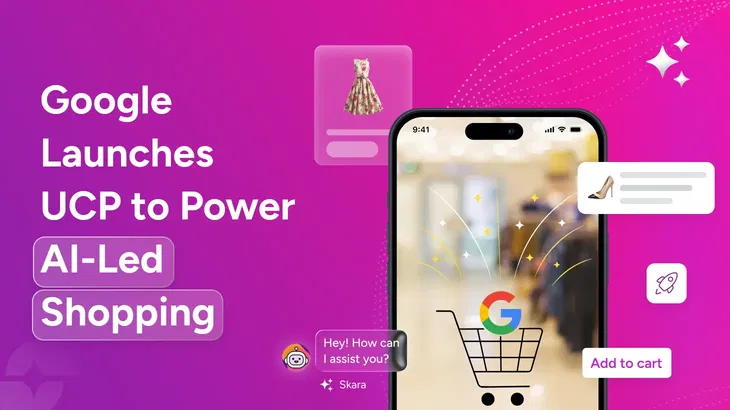


If you’ve used an AI assistant to shop, you’ve seen the gap: it can recommend a product, summarize reviews, even compare options… and then it hits a wall at checkout.
That wall exists because commerce is fragmented. Every store has its own cart rules, shipping logic, identity flow, payment methods, promotions, and post-purchase processes. So even a capable AI agent can’t reliably “complete the job” across merchants without a messy web of one-off integrations.
At NRF 2026, Google and Shopify introduced the Universal Commerce Protocol (UCP) to fix that: an open standard meant to help AI agents and commerce systems communicate through a shared set of capabilities - from discovery to purchase to post-purchase support.
The Universal Commerce Protocol is engineered to unify the full shopping journey, from product discovery and pricing to checkout, fulfillment, and post-purchase support - under a common, secure, and interoperable framework. Think of it like HTTPS for agent-led shopping: a shared, secure way for systems to talk to each other.
What Is the Universal Commerce Protocol?
UCP is a common language for agentic commerce. It defines building blocks that let platforms (AI agents and apps), merchants, credential providers, and payment providers work together without every integration being custom.
A useful way to think about it:
This matters because commerce isn’t simple - and UCP is explicitly designed to handle complexity instead of pretending checkout is one universal flow.
Why UCP matters in 2026
1) “Discovery” becomes “purchase” in the same moment
Google’s stated direction is that UCP will power a checkout experience that lets shoppers buy from eligible listings directly inside AI Mode in Search and the Gemini app - reducing the drop-off that happens when people have to click through, re-load, re-enter info, and re-decide.
2) One integration instead of a dozen surface-by-surface builds
The promise is that merchants shouldn’t have to rebuild checkout logic for every AI surface. Instead of an N×N integration matrix, UCP creates a shared contract that multiple surfaces can adopt.
3) Merchant control stays intact
A key design point: retailers remain Merchant of Record and keep control of business rules and the customer relationship.
Merchants also retain flexibility to:
Google and Shopify lead the charge
Google’s introduction of UCP marks a strategic evolution from earlier standards like the Agent Payments Protocol (AP2), which focused primarily on agentic payments. UCP goes further by orchestrating the entire commerce flow, from discovery to transaction to support.
Importantly, Shopify co-developed UCP with Google, positioning its platform at the heart of this new agentic ecosystem. Shopify merchants will soon be able to:
This collaboration illustrates how UCP is not just a technical protocol but a commercial infrastructure shift, enabling merchants to meet customers where consumer intent peaks, within AI-powered discovery and chat environments.
Merchant use cases enabled by the Universal Commerce Protocol
The Universal Commerce Protocol isn’t just a technical standard - it unlocks entirely new ways for merchants to sell, support, and retain customers in an agent-led world. Below are the most practical and high-impact use cases for retailers and Shopify merchants adopting UCP.
1. AI-led product discovery that converts
With UCP, merchants can expose structured product data—pricing, variants, availability, policies in a standardized way that AI agents can reliably interpret.
This enables:
Instead of shoppers bouncing between search results, category pages, and FAQs, AI agents guide them directly to the most relevant product - shortening the path to purchase.
2. Checkout inside conversations (Without losing control)
One of the biggest shifts UCP enables is in-conversation checkout.
Merchants can allow AI agents to:
... all while the merchant remains the Merchant of Record.
This removes friction from the buying journey while preserving control over pricing, taxes, fulfillment, and compliance. For merchants, it means fewer abandoned carts and higher intent conversion moments happening directly inside AI interfaces.
3. Personalized offers at the moment of intent
UCP allows merchants to surface dynamic, merchant-defined offers through AI agents when shopper intent is highest.
Examples include:
Because these offers are delivered contextually through AI agents - not banners or pop-ups, they feel helpful rather than promotional, improving both conversion rates and brand trust.
4. Post-purchase support without support tickets
Merchants can use UCP to power agent-led post-purchase experiences, including:
AI agents can resolve most post-purchase queries instantly by accessing standardized order and policy data, reducing support volume while improving customer satisfaction.
For merchants, this translates into:
5. Selling across AI surfaces without rebuilding integrations
Traditionally, selling on new surfaces required custom integrations for each platform. UCP changes that.
With a single implementation, merchants can:
This dramatically lowers the cost and complexity of expanding into agent-driven commerce channels, future-proofing merchant infrastructure as AI adoption accelerates.
6. Better attribution between conversations and revenue
Because UCP standardizes commerce actions, merchants gain clearer visibility into how AI-led interactions contribute to revenue.
This enables:
For the first time, merchants can treat conversational commerce as a measurable revenue channel, not a black box.
How to get started with the Universal Commerce Protocol
UCP is launching now as an open standard, with in-conversation checkout rolling out on select/eligible surfaces and merchants. Today, the two fastest and most practical ways for merchants to adopt UCP are through Google and Shopify.
Both platforms provide production-ready access to agentic commerce without requiring merchants to build or manage the protocol directly.
Getting started with Google
Google’s UCP implementation is active across Gemini and AI Mode in Search, enabling conversational discovery and in-conversation checkout.
Requirements
To participate, brands need:
Setup
Once approved, products can be discovered and purchased directly inside AI-powered conversations.
Getting started with Shopify
For most merchants, Shopify is the simplest path to UCP.
Shopify manages agentic commerce centrally through the Shopify Admin, allowing merchants to participate without custom builds.
For Shopify merchants
No custom UCP integration required
For non-Shopify brands
Through Shopify’s agentic infrastructure, non-Shopify brands can:
Bottom line for merchants
UCP adoption no longer requires protocol expertise or custom AI builds. Platforms like Google and Shopify have turned agentic commerce into infrastructure.
The merchants who benefit most will be the ones that:
Agentic shopping is no longer experimental. It’s operational.
Where Skara fits
UCP is the plumbing that makes agentic commerce interoperable. But merchants still need an agent that can:
That’s where Skara comes in: AI Agents specially built for e-commerce - designed to turn high-intent questions into completed purchases and measurable revenue, while keeping you in control of the journey.
Explore Skara AI agents to learn more or book a demo.
Explore Skara AI Agents
See how Skara turns UCP-powered conversations into real product discovery, checkout, and revenue.
What comes next?
The unveiling of the Universal Commerce Protocol marks the beginning, not the end, of agentic commerce’s evolution. Google has indicated that UCP will continue expanding, incorporating:
Major partners like Mastercard are already extending the protocol’s capabilities to enable secure, flexible AI-assisted payments.
As AI agents become more capable and ubiquitous, UCP could redefine how digital transactions happen - moving the industry toward conversational, seamless, and intelligent shopping by default.
With the Universal Commerce Protocol, Google is laying the foundation for an open, interoperable, and scalable future for shopping, where AI agents no longer just suggest products, but execute shopping tasks on behalf of users in a secure and standardized way.
Pawan Kumar
Digital Marketing ManagerMarketing Head at Salesmate | Digital Storyteller | Poll Enthusiast | 📈 Data-Driven Innovator | Building bridges between tech and people with engaging content, stories, and creative marketing strategies. Let's turn ideas into impact! 🌟