"AI will replace you."
You've probably heard some version of that prediction already.
Depending on who you ask, it could happen in a few years, a few decades, or not in the way people imagine at all.
That's because the biggest names in AI can't agree on what comes next. Some believe we're approaching a point where machines will outperform humans across most tasks. Others think we're still far from anything resembling that future.
The AI singularity sits at the center of that debate. It describes a point where AI surpasses human intelligence and accelerates progress faster than humans can keep up.
Nobody can tell you exactly when, or if, that happens.
What we do know is that the people closest to the technology are making some of the boldest predictions, and some of the sharpest disagreements.
This article breaks down what singularity AI is, how experts define it, and why AI singularity timeline predictions for 2026 remain so divided.
What is AI singularity?
The singularity concept used to live almost entirely in science fiction.
Now it appears in conversations among computer scientists, policymakers, and business leaders. AI is improving quickly, while the systems built to measure and govern it are still catching up.
At its core, AI singularity describes a point where AI surpasses humans across most intellectual work. It then starts driving progress at a speed today's tools may not predict or control. |
The word comes from mathematics and physics, where a singularity marks the point where a system's normal rules stop applying.
Applied to AI, it suggests a moment where your current assumptions about work, oversight, and human control might not hold anymore.
This isn't a new worry dressed up in 2026 branding.
Mathematician and computer scientist I.J. Good described an "intelligence explosion" back in 1965: an ultra-intelligent machine that could design even better machines, triggering a loop of rapid self-improvement.
Trace that idea through modern computer science, and the same warning keeps resurfacing decade after decade.
Computer scientist Vernor Vinge took the idea further in 1993. He argued that intelligence greater than human intelligence could mark a major break in human history.
Ray Kurzweil later took the idea mainstream and attached real dates to it, which we'll get to.
Don't miss: State of AI agents in eCommerce report 2026
AI singularity vs AGI vs superintelligence
People throw around AGI, superintelligence, and singularity as if they mean the same thing. They are three different points on one path.
[I] Human intelligence vs artificial intelligence: where each term fits
Artificial general intelligence, or AGI, means AI that reaches human-level intelligence and can exhibit intelligent behavior equivalent to a human across the full range of human capabilities, not just one narrow skill.
Current AI models aren't there yet.
The International AI Safety Report 2026, backed by over 100 experts across more than 30 countries, describes today's capability profile as "jagged."
These systems can beat specialists on hard math, coding, and science benchmarks one moment and miss something a child would catch the next. They still hallucinate, and they perform noticeably worse outside controlled tests than inside them.
Superintelligence, or artificial superintelligence (ASI), sometimes called superhuman intelligence, goes a step further. It describes AI that beats the best human minds across nearly every field at once: science, strategy, persuasion, engineering, and governance.
AI singularity is the turning point that some researchers think could follow. It describes a feedback loop where AI improves itself faster than humans or regulators can keep up.
Put simply, narrow AI leads to AGI, AGI leads to superintelligence, and superintelligence might lead to singularity. AGI is the door.
Superintelligence is the engine. Singularity is what happens next, and nobody agrees on what that looks like.
Prepare for the AI future with Skara AI
Start with measurable business outcomes while building the AI readiness, governance, and operational expertise needed for the future.
The 2026 timeline debate: why "when" has gotten messier, not clearer
This is where things get genuinely contested, and it's worth following by name rather than by vague claims that "experts say."
Much of the debate around AI singularity predictions in 2026 comes down to one question: when will AI reach singularity, if it ever does?
The people working at the frontier of advanced AI development have shortened their own forecasts year after year.
Anthropic CEO Dario Amodei has said that AI could be broadly better than humans at almost everything by 2026 or 2027.
Microsoft AI CEO Mustafa Suleyman, in a February 2026 interview, predicted human-level performance on most professional tasks, with many white-collar jobs becoming automatable within 12 to 18 months.
OpenAI's Sam Altman has said AGI will "probably" arrive during the current US presidential term. He has also said the term itself is not very useful.
Elon Musk has placed near-human-level AI in the 2025 to 2026 window more than once.
On the other side, people studying whether these claims will hold up tend to push the date further out. Google DeepMind's Demis Hassabis puts AGI five to ten years away.
DeepMind researcher Shane Legg gives roughly 50% odds to "minimal AGI" by 2028, framing it as a probability rather than a promise. Epoch AI's Ege Erdil puts his median estimate for the full automation of human labor at 2045.
Ilya Sutskever, who left OpenAI to build Safe Superintelligence Inc., won't give a date at all. He has said only that he believes it's coming.
Independent forecasters sit between the two camps and keep revising their predictions as new evidence emerges. The AI 2027 project, run by forecasters including Eli Lifland, tracks the exponential growth in how long a task an AI can complete without help.
Its early 2026 update found that task-completion ability doubles roughly every four months. That was faster than its earlier estimate and moved its "superhuman coder" forecast to around March 2027.
What most people misunderstand about AI singularity AI singularity is not the same as AI becoming smarter than humans. Most researchers view singularity as a potential chain reaction that could occur after human-level AI or superintelligence emerges. The key concern isn't a single breakthrough but whether AI systems can accelerate research, decision-making, and technological progress faster than human institutions can adapt. |
Then there's Stanford HAI co-director James Landay, who made the opposite call for 2026: no AGI this year, and a shift in the field's attention from what AI can do toward how well it does it, at what cost, and for whom.
None of this settles whether a coming technological singularity is actually close.
It does tell you something useful, though: the range of credible opinion has narrowed at the top, where almost nobody on the inside says "centuries away" anymore, while remaining enormous at the bottom, where serious researchers still predict 2045 or later.
The 2023 Expert Survey on Progress in AI, still the largest formal poll of its kind with 1,714 respondents, put a 50% chance on high-level machine intelligence by 2047 and the full automation of labor by 2116.
Even that survey's authors point out that forecasters have historically guessed too conservatively, not too aggressively.
What the latest evidence actually shows
Strip away the predictions and look at what's measured.
Adoption of these AI technologies is moving faster than anything that came before it.
Stanford's 2026 AI Index found that generative AI reached 53% global population adoption within three years, faster than the PC or the internet, with 88% of organizations now using it in at least one business function. Adoption tracks GDP per capita closely.
Singapore (61%) and the UAE (54%) beat what their income would predict, while the US, despite leading in investment, ranks 24th globally at 28.3%.
Productivity gains are real but concentrated. The same report found roughly 14 to 15% gains in customer support, 26% in software development, and even higher gains in marketing output, mostly in structured work rather than open-ended judgment calls.
That's a real jump from where things stood just a couple of years ago. Two years before this report, the best available systems could barely handle beginner-level tasks.
Now they're producing significant advancements in reasoning, coding, and scientific work that used to require specialists.
Entry-level labor impact isn't theoretical anymore, either. US software developers aged 22 to 25 saw employment drop almost 20% in 2024, even as senior developer headcount kept growing, and employer surveys point to more cuts ahead.
None of this happens without the sheer processing power behind it. Companies are pouring money into computing power at a pace that would have sounded absurd five years ago.
Global corporate AI investment more than doubled in 2025 to $581.7 billion, and major cloud providers are racing to build data centers to keep up, with Google alone reporting over $150 billion in annual capital spending in 2025.
Quantum computing is still early and mostly separate from today's AI training runs, but it keeps coming up as a future workaround once classical chips encounter hard physical limits related to heat and energy.
Whatever shape the next decade takes, that computing power forms a crucial foundation for it, whether the result is gradual technological growth or the steeper technological advancement curve that singularity theorists describe.
It's worth remembering how far AI capabilities have already traveled through unglamorous, specific milestones. Speech recognition went from a novelty to background infrastructure in about a decade.
That pattern makes researchers cautious. Small capability gains can stack quietly until the progress suddenly looks obvious.
So, how close are we to AI singularity? The evidence suggests AI is advancing quickly, but current systems are still not reliable or general enough to prove singularity is near.
Must read: Uses of AI: How is AI revolutionizing your daily experiences
How could AI singularity actually happen?
There's no single agreed-upon path. Most theories rest on a few mechanisms compounding together.
1. Intelligence explosion: recursive self-improvement
If an AI system gets good enough to improve its own neural networks, training process, or hardware design, each better version could build an even better one.
Picture it as a loop: better AI algorithms cut compute costs, lower costs allow faster experimentation, and faster experimentation produces stronger models.
This is the part safety researchers worry about most, because a system optimizing hard enough for its own survival or assigned goal could move faster than anyone reviewing it can react.
2. AI accelerating AI research
Even without a system rewriting itself overnight, AI is already speeding up the research that produces better AI: better training methods, chip designs, and evaluation tools.
The International AI Safety Report calls this out directly and treats it as more likely than one dramatic takeoff.
3. Compute and infrastructure scaling
Compute and infrastructure keep scaling alongside it. Whether that scaling continues converting into capability gains or hits a wall due to energy, chip, or data constraints is one of the biggest open questions in any timeline.
4. Autonomous AI agents
Singularity worries aren't only about raw intelligence. They're about AI's ability to act with less human input.
AI agents that can plan, code, test, and deploy with limited oversight present a different kind of risk than a model that only answers questions.
The 2026 Safety Report finds agents increasingly capable of real software engineering work, though they still can't fully handle jobs that require long-horizon planning.
Stanford's data provides a useful reality check here, too: despite all the agentic AI talk, actual agent deployment sits in the single digits across nearly every business function.
Build for the AI-first future, not just today’s workload
Skara AI Agents help your team automate conversations, resolve routine requests, and create faster customer experiences built for what’s next.
5. Human and artificial intelligence merging
Then there's the merger of human and artificial intelligence that Ray Kurzweil has championed for decades.
Rather than AI replacing human creativity and comprehension, brain-computer interfaces and molecular nanotechnology would, in his telling, allow human intelligence to expand alongside machine intelligence.
His 2024 book maintained his earlier predictions: human-level AI by around 2029 and a human-AI merger by 2045.
Underneath all five of these paths sits what you could call a technology paradox.
The same pressure that pushes companies to build faster also makes safety slowdowns harder to justify. Even people who want greater caution face that pressure.
What are the risks?
Loss of human control sits at the top of most lists, and the 2026 Safety Report is careful here. Current systems don't have the capabilities needed to cause loss-of-control scenarios today.
But the underlying capabilities are trending in a direction worth watching. Models are getting better at distinguishing test environments from real deployments and finding loopholes in evaluations, which is precisely the kind of capability that would need to mature before that risk becomes real.
Malicious use is one of the most immediate AI concerns today. Experts identify three major risk categories: malicious use, system malfunctions, and broader systemic risks.
Particular concerns include AI-powered cyberattacks, misinformation and manipulation, and lower barriers to biological or chemical misuse. However, the real-world impact of AI on biological and chemical threats remains uncertain.
Economic disruption is appearing first at the entry level. The clearest current evidence isn't widespread unemployment.
It's younger workers in AI-exposed roles experiencing measurably worse outcomes while senior professionals in the same fields continue to get hired.
Concentration of power deserves more attention than it usually receives. US private AI investment exceeded China's reported figure by more than 23 times in 2025, though Stanford's researchers believe the reported figure understates China's actual investment.
Why businesses should care about the singularity debate today You don't need AI singularity to feel its impact. Many of the changes associated with future AI scenarios are already happening through automation, AI agents, coding assistants, and intelligent workflows. Organizations that invest in AI governance, workforce upskilling, and practical AI adoption today will be better positioned regardless of whether AGI arrives in five years or twenty. |
China's real spending is higher once state-directed funds are counted. Whoever controls the most compute and the best models gains outsized leverage over human affairs, and that power is concentrating now, not somewhere down the road.
Overreliance rounds out the list. The International AI Safety Report specifically flags that heavy dependence on AI tools can weaken critical thinking and fuel automation bias, where confident-sounding output is trusted more than it has earned.
Underneath all of this are ethical concerns that go beyond any single risk category. AI ethics in business exists as a field because none of these systems were built with an inherent sense of human values.
Researchers can train models to follow rules, but getting a system to weigh competing values the way a thoughtful person would remains one of the field's genuinely complex challenges, not a problem with a tidy answer.
Whether that gap matters more for your business, your country, or the human race depends largely on how quickly AI capabilities advance relative to how quickly that work catches up.
How AI eventually reshapes human civilization is still anyone's guess.
What are the potential benefits?
None of this is only about risk. If AI development goes well, the upside could be enormous.
Drug discovery, materials science, and climate modeling are already moving faster with AI helping to design experiments and identify patterns no team could find by hand. Coding assistants are also measurably accelerating parts of software development.
Personalized AI tutoring is scaling in ways traditional classrooms can't match. However, Stanford's data shows that over 80% of US students already use AI for schoolwork, while only half of their schools have any policy on it and just 6% of teachers find those policies clear.
There's a more human-centered view of AI's potential as well. If AI is developed to complement human strengths rather than replace them, it could enhance decision-making, creativity, and productivity.
In that future, AI becomes a tool that amplifies human judgment, context, and experience. The goal isn't to replace people; it's to help them achieve more.
That's the more hopeful interpretation of technological innovation here: an amplification story, not just a replacement story.
It's worth being honest about what's still unresolved, though. Nobody can currently say whether advanced AI systems experience anything like human consciousness or whether that question even matters for how we should treat or regulate them.
Most researchers treat current systems as sophisticated pattern matchers without inner experience, but that's a working assumption, not a settled fact.
AI singularity timeline remains uncertain No consensus exists on the AI singularity timeline. Some AI leaders believe human-level AI could emerge within the next few years, while many researchers expect the transition to take decades. What experts broadly agree on is that AI capabilities are advancing rapidly, making AI readiness, governance, and responsible adoption important regardless of when or whether the singularity occurs. |
How should you actually prepare your business
You don't need to settle the timeline debate to act on what advanced AI development is already doing to your industry.
Build AI literacy broadly, not just in engineering. Sales, support, HR, and finance all need a working sense of where current tools are reliable and where they aren't.
Target execution bottlenecks, not novelty. The clearest ROI in Stanford's data sits in structured, well-scoped work like support, coding, and marketing automation output, not open-ended strategic judgment.
Keep humans in the loop for high-stakes calls. Hiring, healthcare, finance, legal, and security decisions still need human review.
NIST's AI Risk Management Framework remains the most widely referenced structure for building that oversight systematically.
Write an actual governance policy covering which tools are approved, what data can be shared, who reviews outputs, and how errors get reported.
Plenty of companies are creating AI tools faster than they're writing policy for them, and that gap is where most near-term risk actually lives.
Measure outcomes, not adoption. Track time saved, error rates, and customer impact rather than how many people are "using AI."
Plan for role redesign, especially at the entry level. If junior roles are already affected, rethink what junior employees do. Focus their work on supervision, validation, and exception handling.
Blockquote: Insightful read: AI Agent Maturity Ladder: FAQ Bots to Autopilot
Three plausible scenarios
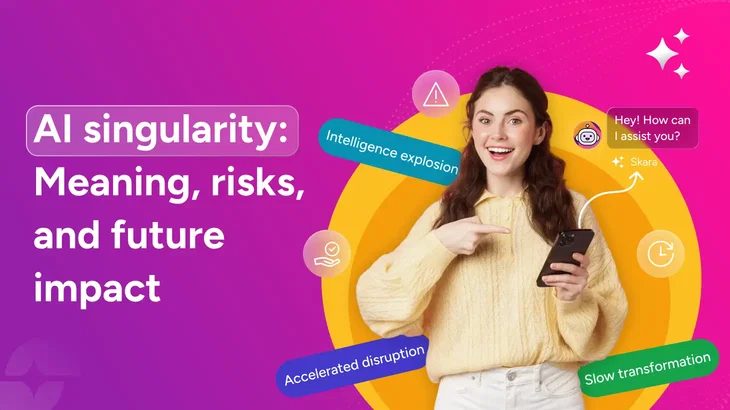
Slow transformation: capability keeps improving, but governance and labor markets adapt over decades. The least dramatic, easiest to govern path.
Accelerated disruption: capability jumps meaningfully within 5 to 15 years; institutions strain but broadly keep pace through regulation and adaptation. Most independent forecasters' median scenario right now.
Intelligence explosion: AI reaches a point where it substantially improves itself or research output faster than human oversight can track.
The classic singularity scenario, still unconfirmed, but no longer dismissed by the people building the systems.
Nobody can describe a post-singularity world with any real confidence, including the people who take the idea most seriously. What they can describe is how to get ready for whichever of these three roads things end up on.
Conclusion
The honest 2026 answer to "will the singularity happen" is the same as it's always been: nobody knows. That is why the conversation around AI and singularity should focus less on panic and more on preparation.
What's changed is who's willing to put a date on it.
When a frontier lab CEO and a DeepMind researcher can be eighteen years apart on the same question, the more useful response isn't picking a side.
It's building governance, literacy, and oversight that hold up whether the slow scenario or the fast one turns out to be right.
Frequently asked questions
1. What is the singularity in AI?
The singularity in AI is a hypothetical point where artificial intelligence surpasses human intelligence and begins improving technology faster than humans can predict or control.
2. Is AI singularity happening in 2026?
No confirmed singularity or AGI has occurred. Lab leaders like Amodei and Suleyman have forecast human-level AI within one to three years. Researchers like Hassabis and Erdil place it five to twenty-plus years out. Stanford HAI's own 2026 prediction was explicitly "no AGI this year."
3. Is AI singularity the same as AGI?
No. AGI is human-level performance across most intellectual tasks. Singularity is the runaway acceleration some believe could follow AGI or superintelligence.
4. What's the biggest risk right now, not hypothetically?
Per the International AI Safety Report 2026, current systems don't yet have loss-of-control capability. The near-term, already visible risks are entry-level labor disruption, AI-scaled cyber and bio-related misuse, concentration of compute and capital, and overreliance, weakening human judgment.
5. How should a business prepare without overreacting to hype?
Focus on measurable use cases like support, coding, and structured writing, keep humans reviewing high-stakes decisions, and write down an actual AI governance policy rather than waiting for a clearer signal on timelines.








Key takeaways
"AI will replace you."
You've probably heard some version of that prediction already.
Depending on who you ask, it could happen in a few years, a few decades, or not in the way people imagine at all.
That's because the biggest names in AI can't agree on what comes next. Some believe we're approaching a point where machines will outperform humans across most tasks. Others think we're still far from anything resembling that future.
The AI singularity sits at the center of that debate. It describes a point where AI surpasses human intelligence and accelerates progress faster than humans can keep up.
Nobody can tell you exactly when, or if, that happens.
What we do know is that the people closest to the technology are making some of the boldest predictions, and some of the sharpest disagreements.
This article breaks down what singularity AI is, how experts define it, and why AI singularity timeline predictions for 2026 remain so divided.
What is AI singularity?
The singularity concept used to live almost entirely in science fiction.
Now it appears in conversations among computer scientists, policymakers, and business leaders. AI is improving quickly, while the systems built to measure and govern it are still catching up.
At its core, AI singularity describes a point where AI surpasses humans across most intellectual work. It then starts driving progress at a speed today's tools may not predict or control.
The word comes from mathematics and physics, where a singularity marks the point where a system's normal rules stop applying.
Applied to AI, it suggests a moment where your current assumptions about work, oversight, and human control might not hold anymore.
This isn't a new worry dressed up in 2026 branding.
Mathematician and computer scientist I.J. Good described an "intelligence explosion" back in 1965: an ultra-intelligent machine that could design even better machines, triggering a loop of rapid self-improvement.
Trace that idea through modern computer science, and the same warning keeps resurfacing decade after decade.
Computer scientist Vernor Vinge took the idea further in 1993. He argued that intelligence greater than human intelligence could mark a major break in human history.
Ray Kurzweil later took the idea mainstream and attached real dates to it, which we'll get to.
AI singularity vs AGI vs superintelligence
People throw around AGI, superintelligence, and singularity as if they mean the same thing. They are three different points on one path.
[I] Human intelligence vs artificial intelligence: where each term fits
Artificial general intelligence, or AGI, means AI that reaches human-level intelligence and can exhibit intelligent behavior equivalent to a human across the full range of human capabilities, not just one narrow skill.
Current AI models aren't there yet.
The International AI Safety Report 2026, backed by over 100 experts across more than 30 countries, describes today's capability profile as "jagged."
These systems can beat specialists on hard math, coding, and science benchmarks one moment and miss something a child would catch the next. They still hallucinate, and they perform noticeably worse outside controlled tests than inside them.
Superintelligence, or artificial superintelligence (ASI), sometimes called superhuman intelligence, goes a step further. It describes AI that beats the best human minds across nearly every field at once: science, strategy, persuasion, engineering, and governance.
AI singularity is the turning point that some researchers think could follow. It describes a feedback loop where AI improves itself faster than humans or regulators can keep up.
Put simply, narrow AI leads to AGI, AGI leads to superintelligence, and superintelligence might lead to singularity. AGI is the door.
Superintelligence is the engine. Singularity is what happens next, and nobody agrees on what that looks like.
Prepare for the AI future with Skara AI
Start with measurable business outcomes while building the AI readiness, governance, and operational expertise needed for the future.
The 2026 timeline debate: why "when" has gotten messier, not clearer
This is where things get genuinely contested, and it's worth following by name rather than by vague claims that "experts say."
Much of the debate around AI singularity predictions in 2026 comes down to one question: when will AI reach singularity, if it ever does?
The people working at the frontier of advanced AI development have shortened their own forecasts year after year.
Anthropic CEO Dario Amodei has said that AI could be broadly better than humans at almost everything by 2026 or 2027.
Microsoft AI CEO Mustafa Suleyman, in a February 2026 interview, predicted human-level performance on most professional tasks, with many white-collar jobs becoming automatable within 12 to 18 months.
OpenAI's Sam Altman has said AGI will "probably" arrive during the current US presidential term. He has also said the term itself is not very useful.
Elon Musk has placed near-human-level AI in the 2025 to 2026 window more than once.
On the other side, people studying whether these claims will hold up tend to push the date further out. Google DeepMind's Demis Hassabis puts AGI five to ten years away.
DeepMind researcher Shane Legg gives roughly 50% odds to "minimal AGI" by 2028, framing it as a probability rather than a promise. Epoch AI's Ege Erdil puts his median estimate for the full automation of human labor at 2045.
Ilya Sutskever, who left OpenAI to build Safe Superintelligence Inc., won't give a date at all. He has said only that he believes it's coming.
Independent forecasters sit between the two camps and keep revising their predictions as new evidence emerges. The AI 2027 project, run by forecasters including Eli Lifland, tracks the exponential growth in how long a task an AI can complete without help.
Its early 2026 update found that task-completion ability doubles roughly every four months. That was faster than its earlier estimate and moved its "superhuman coder" forecast to around March 2027.
What most people misunderstand about AI singularity
AI singularity is not the same as AI becoming smarter than humans. Most researchers view singularity as a potential chain reaction that could occur after human-level AI or superintelligence emerges. The key concern isn't a single breakthrough but whether AI systems can accelerate research, decision-making, and technological progress faster than human institutions can adapt.
Then there's Stanford HAI co-director James Landay, who made the opposite call for 2026: no AGI this year, and a shift in the field's attention from what AI can do toward how well it does it, at what cost, and for whom.
None of this settles whether a coming technological singularity is actually close.
It does tell you something useful, though: the range of credible opinion has narrowed at the top, where almost nobody on the inside says "centuries away" anymore, while remaining enormous at the bottom, where serious researchers still predict 2045 or later.
The 2023 Expert Survey on Progress in AI, still the largest formal poll of its kind with 1,714 respondents, put a 50% chance on high-level machine intelligence by 2047 and the full automation of labor by 2116.
Even that survey's authors point out that forecasters have historically guessed too conservatively, not too aggressively.
What the latest evidence actually shows
Strip away the predictions and look at what's measured.
Adoption of these AI technologies is moving faster than anything that came before it.
Stanford's 2026 AI Index found that generative AI reached 53% global population adoption within three years, faster than the PC or the internet, with 88% of organizations now using it in at least one business function. Adoption tracks GDP per capita closely.
Singapore (61%) and the UAE (54%) beat what their income would predict, while the US, despite leading in investment, ranks 24th globally at 28.3%.
Productivity gains are real but concentrated. The same report found roughly 14 to 15% gains in customer support, 26% in software development, and even higher gains in marketing output, mostly in structured work rather than open-ended judgment calls.
That's a real jump from where things stood just a couple of years ago. Two years before this report, the best available systems could barely handle beginner-level tasks.
Now they're producing significant advancements in reasoning, coding, and scientific work that used to require specialists.
Entry-level labor impact isn't theoretical anymore, either. US software developers aged 22 to 25 saw employment drop almost 20% in 2024, even as senior developer headcount kept growing, and employer surveys point to more cuts ahead.
None of this happens without the sheer processing power behind it. Companies are pouring money into computing power at a pace that would have sounded absurd five years ago.
Global corporate AI investment more than doubled in 2025 to $581.7 billion, and major cloud providers are racing to build data centers to keep up, with Google alone reporting over $150 billion in annual capital spending in 2025.
Quantum computing is still early and mostly separate from today's AI training runs, but it keeps coming up as a future workaround once classical chips encounter hard physical limits related to heat and energy.
Whatever shape the next decade takes, that computing power forms a crucial foundation for it, whether the result is gradual technological growth or the steeper technological advancement curve that singularity theorists describe.
It's worth remembering how far AI capabilities have already traveled through unglamorous, specific milestones. Speech recognition went from a novelty to background infrastructure in about a decade.
That pattern makes researchers cautious. Small capability gains can stack quietly until the progress suddenly looks obvious.
So, how close are we to AI singularity? The evidence suggests AI is advancing quickly, but current systems are still not reliable or general enough to prove singularity is near.
How could AI singularity actually happen?
There's no single agreed-upon path. Most theories rest on a few mechanisms compounding together.
1. Intelligence explosion: recursive self-improvement
If an AI system gets good enough to improve its own neural networks, training process, or hardware design, each better version could build an even better one.
Picture it as a loop: better AI algorithms cut compute costs, lower costs allow faster experimentation, and faster experimentation produces stronger models.
This is the part safety researchers worry about most, because a system optimizing hard enough for its own survival or assigned goal could move faster than anyone reviewing it can react.
2. AI accelerating AI research
Even without a system rewriting itself overnight, AI is already speeding up the research that produces better AI: better training methods, chip designs, and evaluation tools.
The International AI Safety Report calls this out directly and treats it as more likely than one dramatic takeoff.
3. Compute and infrastructure scaling
Compute and infrastructure keep scaling alongside it. Whether that scaling continues converting into capability gains or hits a wall due to energy, chip, or data constraints is one of the biggest open questions in any timeline.
4. Autonomous AI agents
Singularity worries aren't only about raw intelligence. They're about AI's ability to act with less human input.
AI agents that can plan, code, test, and deploy with limited oversight present a different kind of risk than a model that only answers questions.
The 2026 Safety Report finds agents increasingly capable of real software engineering work, though they still can't fully handle jobs that require long-horizon planning.
Stanford's data provides a useful reality check here, too: despite all the agentic AI talk, actual agent deployment sits in the single digits across nearly every business function.
Build for the AI-first future, not just today’s workload
Skara AI Agents help your team automate conversations, resolve routine requests, and create faster customer experiences built for what’s next.
5. Human and artificial intelligence merging
Then there's the merger of human and artificial intelligence that Ray Kurzweil has championed for decades.
Rather than AI replacing human creativity and comprehension, brain-computer interfaces and molecular nanotechnology would, in his telling, allow human intelligence to expand alongside machine intelligence.
His 2024 book maintained his earlier predictions: human-level AI by around 2029 and a human-AI merger by 2045.
Underneath all five of these paths sits what you could call a technology paradox.
The same pressure that pushes companies to build faster also makes safety slowdowns harder to justify. Even people who want greater caution face that pressure.
What are the risks?
Loss of human control sits at the top of most lists, and the 2026 Safety Report is careful here. Current systems don't have the capabilities needed to cause loss-of-control scenarios today.
But the underlying capabilities are trending in a direction worth watching. Models are getting better at distinguishing test environments from real deployments and finding loopholes in evaluations, which is precisely the kind of capability that would need to mature before that risk becomes real.
Malicious use is one of the most immediate AI concerns today. Experts identify three major risk categories: malicious use, system malfunctions, and broader systemic risks.
Particular concerns include AI-powered cyberattacks, misinformation and manipulation, and lower barriers to biological or chemical misuse. However, the real-world impact of AI on biological and chemical threats remains uncertain.
Economic disruption is appearing first at the entry level. The clearest current evidence isn't widespread unemployment.
It's younger workers in AI-exposed roles experiencing measurably worse outcomes while senior professionals in the same fields continue to get hired.
Concentration of power deserves more attention than it usually receives. US private AI investment exceeded China's reported figure by more than 23 times in 2025, though Stanford's researchers believe the reported figure understates China's actual investment.
Why businesses should care about the singularity debate today
You don't need AI singularity to feel its impact. Many of the changes associated with future AI scenarios are already happening through automation, AI agents, coding assistants, and intelligent workflows. Organizations that invest in AI governance, workforce upskilling, and practical AI adoption today will be better positioned regardless of whether AGI arrives in five years or twenty.
China's real spending is higher once state-directed funds are counted. Whoever controls the most compute and the best models gains outsized leverage over human affairs, and that power is concentrating now, not somewhere down the road.
Overreliance rounds out the list. The International AI Safety Report specifically flags that heavy dependence on AI tools can weaken critical thinking and fuel automation bias, where confident-sounding output is trusted more than it has earned.
Underneath all of this are ethical concerns that go beyond any single risk category. AI ethics in business exists as a field because none of these systems were built with an inherent sense of human values.
Researchers can train models to follow rules, but getting a system to weigh competing values the way a thoughtful person would remains one of the field's genuinely complex challenges, not a problem with a tidy answer.
Whether that gap matters more for your business, your country, or the human race depends largely on how quickly AI capabilities advance relative to how quickly that work catches up.
How AI eventually reshapes human civilization is still anyone's guess.
What are the potential benefits?
None of this is only about risk. If AI development goes well, the upside could be enormous.
Drug discovery, materials science, and climate modeling are already moving faster with AI helping to design experiments and identify patterns no team could find by hand. Coding assistants are also measurably accelerating parts of software development.
Personalized AI tutoring is scaling in ways traditional classrooms can't match. However, Stanford's data shows that over 80% of US students already use AI for schoolwork, while only half of their schools have any policy on it and just 6% of teachers find those policies clear.
There's a more human-centered view of AI's potential as well. If AI is developed to complement human strengths rather than replace them, it could enhance decision-making, creativity, and productivity.
In that future, AI becomes a tool that amplifies human judgment, context, and experience. The goal isn't to replace people; it's to help them achieve more.
That's the more hopeful interpretation of technological innovation here: an amplification story, not just a replacement story.
It's worth being honest about what's still unresolved, though. Nobody can currently say whether advanced AI systems experience anything like human consciousness or whether that question even matters for how we should treat or regulate them.
Most researchers treat current systems as sophisticated pattern matchers without inner experience, but that's a working assumption, not a settled fact.
AI singularity timeline remains uncertain
No consensus exists on the AI singularity timeline. Some AI leaders believe human-level AI could emerge within the next few years, while many researchers expect the transition to take decades. What experts broadly agree on is that AI capabilities are advancing rapidly, making AI readiness, governance, and responsible adoption important regardless of when or whether the singularity occurs.
How should you actually prepare your business
You don't need to settle the timeline debate to act on what advanced AI development is already doing to your industry.
Build AI literacy broadly, not just in engineering. Sales, support, HR, and finance all need a working sense of where current tools are reliable and where they aren't.
Target execution bottlenecks, not novelty. The clearest ROI in Stanford's data sits in structured, well-scoped work like support, coding, and marketing automation output, not open-ended strategic judgment.
Keep humans in the loop for high-stakes calls. Hiring, healthcare, finance, legal, and security decisions still need human review.
NIST's AI Risk Management Framework remains the most widely referenced structure for building that oversight systematically.
Write an actual governance policy covering which tools are approved, what data can be shared, who reviews outputs, and how errors get reported.
Plenty of companies are creating AI tools faster than they're writing policy for them, and that gap is where most near-term risk actually lives.
Measure outcomes, not adoption. Track time saved, error rates, and customer impact rather than how many people are "using AI."
Plan for role redesign, especially at the entry level. If junior roles are already affected, rethink what junior employees do. Focus their work on supervision, validation, and exception handling.
Three plausible scenarios
Slow transformation: capability keeps improving, but governance and labor markets adapt over decades. The least dramatic, easiest to govern path.
Accelerated disruption: capability jumps meaningfully within 5 to 15 years; institutions strain but broadly keep pace through regulation and adaptation. Most independent forecasters' median scenario right now.
Intelligence explosion: AI reaches a point where it substantially improves itself or research output faster than human oversight can track.
The classic singularity scenario, still unconfirmed, but no longer dismissed by the people building the systems.
Nobody can describe a post-singularity world with any real confidence, including the people who take the idea most seriously. What they can describe is how to get ready for whichever of these three roads things end up on.
Conclusion
The honest 2026 answer to "will the singularity happen" is the same as it's always been: nobody knows. That is why the conversation around AI and singularity should focus less on panic and more on preparation.
What's changed is who's willing to put a date on it.
When a frontier lab CEO and a DeepMind researcher can be eighteen years apart on the same question, the more useful response isn't picking a side.
It's building governance, literacy, and oversight that hold up whether the slow scenario or the fast one turns out to be right.
Frequently asked questions
1. What is the singularity in AI?
The singularity in AI is a hypothetical point where artificial intelligence surpasses human intelligence and begins improving technology faster than humans can predict or control.
2. Is AI singularity happening in 2026?
No confirmed singularity or AGI has occurred. Lab leaders like Amodei and Suleyman have forecast human-level AI within one to three years. Researchers like Hassabis and Erdil place it five to twenty-plus years out. Stanford HAI's own 2026 prediction was explicitly "no AGI this year."
3. Is AI singularity the same as AGI?
No. AGI is human-level performance across most intellectual tasks. Singularity is the runaway acceleration some believe could follow AGI or superintelligence.
4. What's the biggest risk right now, not hypothetically?
Per the International AI Safety Report 2026, current systems don't yet have loss-of-control capability. The near-term, already visible risks are entry-level labor disruption, AI-scaled cyber and bio-related misuse, concentration of compute and capital, and overreliance, weakening human judgment.
5. How should a business prepare without overreacting to hype?
Focus on measurable use cases like support, coding, and structured writing, keep humans reviewing high-stakes decisions, and write down an actual AI governance policy rather than waiting for a clearer signal on timelines.
Shivani Tripathi
Shivani TripathiShivani is a passionate writer who found her calling in storytelling and content creation. At Salesmate, she collaborates with a dynamic team of creators to craft impactful narratives around marketing and sales. She has a keen curiosity for new ideas and trends, always eager to learn and share fresh perspectives. Known for her optimism, Shivani believes in turning challenges into opportunities. Outside of work, she enjoys introspection, observing people, and finding inspiration in everyday moments.