4. Journey-stage awareness
Recommendation strategies adapt as shoppers move through the buying journey.
- Discovery stages favor bundles that expand product understanding.
- Evaluation stages emphasize comparisons that support decision confidence.
- Checkout stages prioritize minimal, low-friction add-ons.
In some cases, intelligent recommendations can also support abandoned cart recovery by reminding shoppers of complementary products that complete the purchase.
This dynamic adjustment ensures recommendations match the shopper’s intent as it evolves.
5. Incremental value optimization
Instead of maximizing cart size, AI agents estimate whether a recommendation improves purchase probability.
If an upsell risks disrupting the purchase, it is suppressed. This approach prioritizes sustainable revenue growth and customer trust over short-term gains.
Interesting read: 15 eCommerce tasks you should hand off to AI agents right now.
Examples of natural AI bundle and add-on recommendations in action
Across these examples, the most successful recommendation strategies rely on timing, context, and relevance rather than aggressive promotion.
AI systems evaluate customer signals and introduce bundles only when they support decision-making.
1. Consumer electronics: Amazon
On Amazon, shoppers frequently see AI-driven suggestions, such as accessories or compatible products, after viewing or configuring a device.
For example, when a customer selects a laptop or camera, the platform recommends items like memory cards, cases, or adapters only after the shopper shows clear purchase intent.
These recommendations are powered by behavioral signals such as browsing activity, past purchases, and time spent evaluating products.
Amazon has also been experimenting with AI-driven product discovery tools that allow shoppers to describe what they want in natural language and receive personalized product suggestions.
The system uses this data to personalize suggestions across product pages, carts, and checkout flows.
Because the recommendations appear after core product decisions are made, they feel helpful rather than interruptive, improving attach rates and increasing average order value.
2. Apparel retail: Nike
Brands like Nike use AI-driven personalization to recommend complete outfits or complementary apparel during the browsing phase.
When a shopper views a specific product, such as a pair of running shoes, the platform may suggest matching apparel like performance socks, shorts, or jackets.
These recommendations rely on machine learning models that analyze customer behavior and preferences to predict what items are most likely to complement the selected product.
Importantly, these suggestions typically appear during discovery rather than checkout, allowing customers to explore styling combinations without slowing down the purchase process.
3. Beauty eCommerce: Sephora
Beauty retailer Sephora uses AI to personalize product recommendations based on customer preferences, purchase history, and profile data such as skin tone or beauty routines.
Its recommendation systems suggest complementary skincare or makeup products after analyzing customer data and engagement patterns. For example, returning customers may receive bundled skincare routines tailored to their previous purchases and beauty preferences.
Because the recommendations adapt to customer familiarity and experience level, new shoppers receive simpler guidance while experienced customers see more advanced bundles.
When recommendations align with real decision moments, brands improve conversion rates and average order value while maintaining a smooth shopping experience.
How to implement helpful bundle and add-on recommendations
Effective bundle and add-on recommendations require more than accurate product matching. They depend on structured decision logic, clear behavioral signals, and disciplined performance measurement.
The goal is to build a system where recommendations appear only when they improve the customer experience, support shopper intent, and drive measurable business outcomes across the customer journey.
1. Capture intent signals continuously
AI agents rely on behavioral signals rather than assumptions. Every meaningful interaction helps determine whether a recommendation will be relevant.
Real-time data collection allows recommendation systems to adapt instantly to shopper behavior and deliver relevant content and product suggestions during the session.
Instead of relying only on product relationships, modern systems analyze signals such as product views, comparisons, cart activity, and checkout progress.
These interactions reveal whether a shopper is still exploring products, validating a decision, or preparing to complete a purchase.
Most recommendation systems combine several types of signals to interpret shopper intent:
- Behavioral signals, such as page views, search queries, product comparisons, and cart changes
- Contextual signals like device type, traffic source, or entry page
- Historical signals, including past purchases, interaction history, and long-term preferences
- Real-time signals, such as navigation changes during a session
By continuously analyzing these signals, AI systems adjust recommendations dynamically instead of relying on fixed rules.
2. Establish suppression guardrails early
Many recommendation strategies fail because exposure grows faster than control mechanisms.
Before launching recommendations at scale, teams should define guardrails that prevent overexposure.
These often include confidence thresholds that determine when suggestions appear, cooldown periods after ignored recommendations, and limits on how frequently offers are displayed.
Such controls are also part of AI agent governance, ensuring recommendation systems operate within clear rules that protect customer experience and prevent excessive or irrelevant suggestions.
These controls help ensure that recommendations remain helpful rather than repetitive.
3. Prioritize relevance over quantity
A common mistake in eCommerce merchandising is showing too many suggestions at once. Large recommendation sets increase cognitive load and slow decision-making.
In addition to increasing order value, intelligent bundling can help retailers manage inventory by pairing slower-moving products with high-demand items.
AI-driven bundling helps retailers balance inventory by pairing slower-moving products with bestsellers in ways that still feel relevant to the shopper.
In practice, the most effective implementations typically present two or three complementary items. Smaller sets keep the experience focused and allow shoppers to evaluate options quickly.
In recommendation systems, relevance consistently outperforms quantity.
4. Optimize placement across journey stages
Product pages are often highly effective for bundles that help shoppers understand product combinations. Cart pages are more effective for quick add-ons that complete the purchase.
After checkout, personalized recommendations often shift toward accessories, refills, or complementary products that extend product value.
Testing these placements across the customer journey helps identify where recommendations provide genuine assistance rather than distraction.
5. Measure incremental business impact
Recommendation systems should be evaluated for their measurable impact on business outcomes. Clicks alone rarely indicate success.
Instead, teams should monitor changes in conversion rate, attach rate, revenue per session, and overall average order value.
Comparing results against a control experience helps confirm whether recommendations truly improve both revenue and customer satisfaction.
Learn: Best AI agent use cases for businesses in 2026.
How Skara AI agents recommend bundles naturally
Skara AI agents introduce intent-aware product guidance into everyday eCommerce interactions and help reduce support tickets.
Rather than pushing offers continuously, Skara AI Agents evaluate signals such as product questions, browsing behavior, and cart activity to identify moments when additional products or bundles can simplify the shopper’s decision.
When integrated with a product knowledge base, AI agents can also reference product specifications, compatibility rules, and product descriptions to recommend bundles more accurately.
Recommendations appear as part of the interaction, not as separate promotional prompts. They can guide shoppers and recommend complementary products at any time of day, ensuring that contextual upselling opportunities are not missed even outside normal business hours.
Skara AI Agents help businesses deliver contextual recommendations by:
- Intent detection: Identifying buying signals during conversations or browsing behavior.
- Product compatibility matching: Recommending compatible products, bundles, or accessories in real time.
- Recommendation suppression: Automatically preventing repetitive suggestions to reduce recommendation fatigue.
- Omnichannel coordination: Recommendations remain consistent across chat, website, and messaging channels.
- Action execution: Triggering actions such as adding recommended products directly to the cart.
Because Skara operates within CRM-connected workflows, recommendations remain consistent across the entire customer journey.
Shoppers can receive the same guidance while browsing the website, interacting with AI chatbots, or engaging through messaging channels.
This approach allows product recommendations to appear across multiple touchpoints, including website browsing, chat conversations, and post-purchase support interactions.
This approach transforms product recommendations from static widgets into guided shopping assistance.
By understanding intent and acting at the right moment, Skara AI Agents help eCommerce brands improve average order value while maintaining a smooth and natural buying experience.
Wrap up
Bundles and add-ons are not intrusive by nature. The problem is poor timing and generic recommendation logic.
AI agents change this by introducing decision intelligence into recommendation systems.
Instead of relying on static rules, AI systems evaluate behavioral signals to deliver relevant suggestions based on shopper context.
When recommendations appear at the right moment and remain relevant to the shopper’s goal, they reduce friction rather than increase cognitive load. This leads to stronger conversions, higher average order value, better customer experiences, and stronger customer loyalty over time.
In the long run, AI-powered merchandising shifts the focus from maximizing exposure to delivering meaningful assistance throughout the customer journey.








Key takeaways
Many eCommerce stores rely on product recommendations to increase average order value (AOV).
Bundles and add-ons can improve average order value significantly, but poorly timed or irrelevant suggestions often interrupt the digital experiences shoppers expect.
When recommendations appear repeatedly or surface during checkout, they start to feel promotional rather than helpful.
Studies from PwC have shown that customers are willing to pay more for better experiences, which makes thoughtful recommendation strategies a direct driver of revenue growth.
Traditional merchandising systems rely on static rules such as “frequently bought together” widgets or fixed cross-sell placements.
These rules cannot distinguish whether a shopper is exploring products, comparing options, or preparing to purchase, so the same suggestions appear regardless of context.
Instead of automatically displaying offers, AI agents analyze real-time shopper behavior and determine whether a recommendation will actually help the customer in that moment.
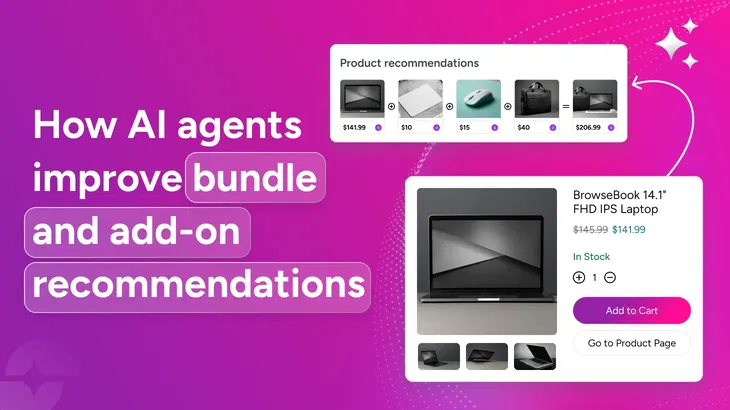
This article explains how AI agents recommend bundles and add-ons in ways that improve order value while maintaining a smooth and natural shopping experience.
How AI bundle recommendations increase average order value
Artificial intelligence (AI) improves recommendation systems by replacing static product rules with adaptive systems that evaluate shopper intent in real time.
This approach reflects intent-based personalization, where recommendations adapt to a customer’s in-the-moment goals instead of relying on static segmentation.
Intent-based personalization focuses on delivering the most relevant experience based on the customer’s immediate goals and decision context.
Traditional recommendation engines rely on fixed relationships, such as “frequently bought together” products or category similarity.
Many traditional systems rely on rules-based personalization, which uses simple if/then logic to show related products. While these rules can work at scale, they cannot adapt to changing shopper intent in real time.
While these rules can surface relevant items, they cannot interpret browsing context or understand what a shopper is trying to accomplish.
AI systems solve this by analyzing behavioral and historical data to understand shopper intent and underlying search intent.
AI-powered recommendation engines rely on inputs such as past purchases, browsing history, and user feedback to generate personalized suggestions.
Instead of showing the same suggestions to every visitor, the system evaluates behavioral signals to deliver recommendations that match shoppers' context and create personalized experiences.
These signals help systems understand user intent and identify whether a shopper is exploring options, validating a decision, or preparing to complete a purchase.
Turn product bundles into revenue engines
AI agents analyze shopper intent and automatically recommend the most relevant bundles at the right moment, boosting AOV without interrupting the buying journey.
What are AI agents for recommendation systems?
AI agents are autonomous systems that manage product recommendations across the customer journey and operate within real workflows such as browsing sessions and cart activity.
This reflects the rise of agentic AI, where systems can interpret signals, make decisions, and act without relying on rigid rules or manual workflows.
Unlike traditional recommendation engines that rely on predefined rules or similarity models, AI agents decide whether a recommendation should appear, when it should appear, and which products will be most helpful in that moment.
Instead of functioning as static widgets, they continuously analyze shopper behavior such as browsing patterns, product comparisons, and cart activity.
Based on these signals, AI agents evaluate three key decisions:
Because AI agents operate across multiple channels, recommendations remain consistent across product pages, AI assistants, and messaging interactions.
This transforms recommendation systems from simple product-matching tools into intelligent assistants that guide shopper decisions, functioning much like AI shopping assistants that help customers discover relevant products.
Five ways AI agents improve customer experience with smarter recommendations
AI product bundling allows systems to dynamically combine products based on individual customer behavior instead of relying on pre-defined bundle sets.
1. Context-aware timing
Recommendations appear when they match customer expectations and provide assistance rather than interruption. Timing often shapes perception more than the product itself.
Research from Accenture shows that many customers expect companies to respond quickly to changing needs, making timing and relevance critical in digital commerce experiences.
AI agents identify decision moments along the customer journey and introduce suggestions only when they support purchase progress.
By aligning recommendations with the shopper’s decision stage, AI agents keep suggestions helpful instead of disruptive.
2. Compatibility filtering
AI agents evaluate functional relationships between products using catalog data, product descriptions, and historical purchase patterns.
Suggestions must logically complement the primary item. Irrelevant options are filtered before display, so shoppers see only relevant additions instead of unnecessary choices.
3. Frequency caps and cooldown periods
AI agents monitor how often recommendations appear across sessions and interactions.
If a shopper ignores a suggestion, similar offers are temporarily paused. This prevents repetition, protects customer attention, and reduces recommendation fatigue.
Why do upsell recommendations sometimes feel intrusive?
Upsell recommendations feel intrusive when they appear without considering shopper context or when they interrupt key decision moments. Poor timing, repeated exposure, and irrelevant product suggestions are the most common causes. When recommendations are triggered without understanding what the customer is trying to accomplish, they can slow the purchase process instead of helping it.
4. Journey-stage awareness
Recommendation strategies adapt as shoppers move through the buying journey.
In some cases, intelligent recommendations can also support abandoned cart recovery by reminding shoppers of complementary products that complete the purchase.
This dynamic adjustment ensures recommendations match the shopper’s intent as it evolves.
5. Incremental value optimization
Instead of maximizing cart size, AI agents estimate whether a recommendation improves purchase probability.
If an upsell risks disrupting the purchase, it is suppressed. This approach prioritizes sustainable revenue growth and customer trust over short-term gains.
Examples of natural AI bundle and add-on recommendations in action
Across these examples, the most successful recommendation strategies rely on timing, context, and relevance rather than aggressive promotion.
AI systems evaluate customer signals and introduce bundles only when they support decision-making.
1. Consumer electronics: Amazon
On Amazon, shoppers frequently see AI-driven suggestions, such as accessories or compatible products, after viewing or configuring a device.
For example, when a customer selects a laptop or camera, the platform recommends items like memory cards, cases, or adapters only after the shopper shows clear purchase intent.
These recommendations are powered by behavioral signals such as browsing activity, past purchases, and time spent evaluating products.
Amazon has also been experimenting with AI-driven product discovery tools that allow shoppers to describe what they want in natural language and receive personalized product suggestions.
The system uses this data to personalize suggestions across product pages, carts, and checkout flows.
Because the recommendations appear after core product decisions are made, they feel helpful rather than interruptive, improving attach rates and increasing average order value.
2. Apparel retail: Nike
Brands like Nike use AI-driven personalization to recommend complete outfits or complementary apparel during the browsing phase.
When a shopper views a specific product, such as a pair of running shoes, the platform may suggest matching apparel like performance socks, shorts, or jackets.
These recommendations rely on machine learning models that analyze customer behavior and preferences to predict what items are most likely to complement the selected product.
Importantly, these suggestions typically appear during discovery rather than checkout, allowing customers to explore styling combinations without slowing down the purchase process.
3. Beauty eCommerce: Sephora
Beauty retailer Sephora uses AI to personalize product recommendations based on customer preferences, purchase history, and profile data such as skin tone or beauty routines.
Its recommendation systems suggest complementary skincare or makeup products after analyzing customer data and engagement patterns. For example, returning customers may receive bundled skincare routines tailored to their previous purchases and beauty preferences.
Because the recommendations adapt to customer familiarity and experience level, new shoppers receive simpler guidance while experienced customers see more advanced bundles.
When recommendations align with real decision moments, brands improve conversion rates and average order value while maintaining a smooth shopping experience.
Convert more shoppers without adding staff
Deploy an AI agent that recommends products, builds carts during conversations, and recovers abandoned checkouts across chat, SMS, and WhatsApp.
How to implement helpful bundle and add-on recommendations
Effective bundle and add-on recommendations require more than accurate product matching. They depend on structured decision logic, clear behavioral signals, and disciplined performance measurement.
The goal is to build a system where recommendations appear only when they improve the customer experience, support shopper intent, and drive measurable business outcomes across the customer journey.
1. Capture intent signals continuously
AI agents rely on behavioral signals rather than assumptions. Every meaningful interaction helps determine whether a recommendation will be relevant.
Real-time data collection allows recommendation systems to adapt instantly to shopper behavior and deliver relevant content and product suggestions during the session.
Instead of relying only on product relationships, modern systems analyze signals such as product views, comparisons, cart activity, and checkout progress.
These interactions reveal whether a shopper is still exploring products, validating a decision, or preparing to complete a purchase.
Most recommendation systems combine several types of signals to interpret shopper intent:
By continuously analyzing these signals, AI systems adjust recommendations dynamically instead of relying on fixed rules.
2. Establish suppression guardrails early
Many recommendation strategies fail because exposure grows faster than control mechanisms.
Before launching recommendations at scale, teams should define guardrails that prevent overexposure.
These often include confidence thresholds that determine when suggestions appear, cooldown periods after ignored recommendations, and limits on how frequently offers are displayed.
Such controls are also part of AI agent governance, ensuring recommendation systems operate within clear rules that protect customer experience and prevent excessive or irrelevant suggestions.
These controls help ensure that recommendations remain helpful rather than repetitive.
3. Prioritize relevance over quantity
A common mistake in eCommerce merchandising is showing too many suggestions at once. Large recommendation sets increase cognitive load and slow decision-making.
In addition to increasing order value, intelligent bundling can help retailers manage inventory by pairing slower-moving products with high-demand items.
AI-driven bundling helps retailers balance inventory by pairing slower-moving products with bestsellers in ways that still feel relevant to the shopper.
In practice, the most effective implementations typically present two or three complementary items. Smaller sets keep the experience focused and allow shoppers to evaluate options quickly.
In recommendation systems, relevance consistently outperforms quantity.
4. Optimize placement across journey stages
Product pages are often highly effective for bundles that help shoppers understand product combinations. Cart pages are more effective for quick add-ons that complete the purchase.
After checkout, personalized recommendations often shift toward accessories, refills, or complementary products that extend product value.
Testing these placements across the customer journey helps identify where recommendations provide genuine assistance rather than distraction.
5. Measure incremental business impact
Recommendation systems should be evaluated for their measurable impact on business outcomes. Clicks alone rarely indicate success.
Instead, teams should monitor changes in conversion rate, attach rate, revenue per session, and overall average order value.
Comparing results against a control experience helps confirm whether recommendations truly improve both revenue and customer satisfaction.
How Skara AI agents recommend bundles naturally
Skara AI agents introduce intent-aware product guidance into everyday eCommerce interactions and help reduce support tickets.
Rather than pushing offers continuously, Skara AI Agents evaluate signals such as product questions, browsing behavior, and cart activity to identify moments when additional products or bundles can simplify the shopper’s decision.
When integrated with a product knowledge base, AI agents can also reference product specifications, compatibility rules, and product descriptions to recommend bundles more accurately.
Recommendations appear as part of the interaction, not as separate promotional prompts. They can guide shoppers and recommend complementary products at any time of day, ensuring that contextual upselling opportunities are not missed even outside normal business hours.
Skara AI Agents help businesses deliver contextual recommendations by:
Because Skara operates within CRM-connected workflows, recommendations remain consistent across the entire customer journey.
Shoppers can receive the same guidance while browsing the website, interacting with AI chatbots, or engaging through messaging channels.
This approach allows product recommendations to appear across multiple touchpoints, including website browsing, chat conversations, and post-purchase support interactions.
This approach transforms product recommendations from static widgets into guided shopping assistance.
By understanding intent and acting at the right moment, Skara AI Agents help eCommerce brands improve average order value while maintaining a smooth and natural buying experience.
Never miss a sales opportunity again
Skara AI Agents engage shoppers instantly, recommend the right products or bundles, and move every conversation closer to checkout.
Wrap up
Bundles and add-ons are not intrusive by nature. The problem is poor timing and generic recommendation logic.
AI agents change this by introducing decision intelligence into recommendation systems.
Instead of relying on static rules, AI systems evaluate behavioral signals to deliver relevant suggestions based on shopper context.
When recommendations appear at the right moment and remain relevant to the shopper’s goal, they reduce friction rather than increase cognitive load. This leads to stronger conversions, higher average order value, better customer experiences, and stronger customer loyalty over time.
In the long run, AI-powered merchandising shifts the focus from maximizing exposure to delivering meaningful assistance throughout the customer journey.
Frequently asked questions
1. How many recommendations should an eCommerce store display?
Most eCommerce stores see better results by showing two or three highly relevant recommendations rather than long product lists. Smaller sets reduce decision friction, keep the experience focused, and make it easier for customers to evaluate complementary products.
2. When should bundles appear during the customer journey?
Bundles typically perform best during the exploration stage, when customers are evaluating products and benefit from guided combinations. Smaller add-ons are more effective closer to checkout, where customers prefer quick suggestions that help complete the purchase.
3. Can AI recommendations reduce conversion rates?
Yes. Poorly implemented recommendation systems can reduce conversion rates if they introduce too many suggestions or interrupt the purchase flow. AI agents reduce this risk by evaluating shopper intent, controlling when recommendations appear, and suppressing suggestions that may disrupt the experience.
4. Can AI systems learn from ignored recommendations?
Yes. Modern AI-powered recommendation systems treat ignored suggestions as feedback signals. By analyzing customer interactions and engagement patterns, the system continuously adjusts how recommendations are ranked and displayed to improve future relevance.
Sonali Negi
Content WriterSonali is a writer born out of her utmost passion for writing. She is working with a passionate team of content creators at Salesmate. She enjoys learning about new ideas in marketing and sales. She is an optimistic girl and endeavors to bring the best out of every situation. In her free time, she loves to introspect and observe people.