Key takeaways
- AI agents do not replace CRM, helpdesk, or CDP. They act on top of them to execute work in real time.
- CRM stores relationships, helpdesk manages support, and CDP unifies customer data, but none of them execute actions on their own.
- AI agents are the execution layer that turns data, signals, and workflows into actions like follow-ups, responses, and routing.
- High-performing teams combine CRM, helpdesk, CDP, and AI agents to build a system that responds and acts instantly.
Should AI agents replace your CRM, helpdesk, or CDP? This is a question every SaaS team is asking right now as AI trends continue to reshape how businesses approach automation, customer engagement, and system execution.
On the surface, it looks like they can. AI agents can qualify leads, respond to customers, trigger workflows, and even make decisions in real time. So it is tempting to assume they can replace the systems you already use.
That assumption is where things start to break. Because in reality, businesses are not simplifying their stack. They are making it more confusing.
Teams are now dealing with overlapping agentic AI tools and AI solutions that all claim to do the same things.
(Customer Relationship Management) CRM platforms are adding agentic AI. Helpdesk tools are becoming conversational. (Customer Data Platform) CDPs are pushing personalization. And AI agents are being positioned as everything at once.
The result is unclear roles, duplicated workflows, and poor decisions about what to keep, replace, or integrate.
At the same time, something deeper is changing.
In one real-world example, a company reduced human CRM users by 80 percent but ended up paying 83 percent more, because over 20 AI agents were now actively using the system to execute workflows and drive operations.
This is the shift most teams miss. The question is no longer what each tool does in isolation. It is how these systems work together when execution is no longer manual. AI agents do not replace CRM, helpdesk, or CDP systems. They change how they are used.
In this guide, we break down exactly how these tools fit together and where AI agents actually belong in a modern revenue stack.
Why does the SaaS stack suddenly feel confusing with AI agents?
The comparison between AI agents and tools like CRM, helpdesk, and CDP is not accidental. It is a direct result of how AI (Artificial Intelligence) is being added across every category at the same time, often with similar promises but very different roles.
This creates a surface-level similarity that hides a bigger difference.
1. Overlapping capabilities across tools
Modern CRM, helpdesk, and CDP platforms already support automation. They can send emails, route tickets, segment users, and trigger workflows.
AI agents enter this same space, but with a critical shift. They do not just follow predefined rules. They decide what action to take based on context.
From the outside, both look similar. Internally, they operate very differently. That is where confusion begins. It becomes unclear where one tool ends and another begins.
2. Every vendor is now an “AI platform”
Beyond features, AI has become the positioning layer for every SaaS category.
- CRM platforms highlight AI-driven sales insights.
- Helpdesk tools promote AI chat and automation.
- CDPs focus on AI-powered customer segmentation and personalization.
At the same time, AI agents are being introduced as standalone systems that can handle conversations, qualify leads, and execute workflows end to end.
3. Automation vs intelligence is getting blurred
Traditional automation is rule-based and depends on predefined criteria and predefined steps, making it effective for repetitive and everyday tasks but limited in handling dynamic scenarios.
AI agents work differently. They interpret context, understand intent, and choose actions dynamically.
But many tools blur this distinction by labeling basic workflows as AI. This creates a false sense of capability and makes it harder for teams to understand what is truly intelligent and what is just automated.
AI agents vs chatbots vs automation tools
- Chatbots rely on scripted responses and are designed for predictable interactions, making them suitable for simple queries but ineffective beyond structured use cases.
- Automation tools execute rule-based workflows when specific conditions are met, making them effective for well-defined tasks but limited in handling variability.
- AI agents go further by understanding context, making decisions, and taking actions dynamically.
In simple terms, chatbots respond, automation tools trigger, and AI agents decide and act. |
4. Teams are trying to reduce tools, not add more
Most teams are already operating with a crowded stack across sales, marketing, and support.
The idea of adding another category creates immediate resistance.
So the questions shift from curiosity to consolidation:
- Do we actually need another tool?
- Can AI agents replace something we already use?
- Or should they sit on top of our existing systems?
This pressure to simplify is what drives the comparison in the first place.
Build AI agents that actually get work done
Design, test, and launch action-driven AI agents that qualify, sell, and resolve, without engineering dependencies.
A simple way to understand how these tools work together
The easiest way to remove the confusion is to stop comparing these tools directly and start looking at them as layers of the same system.
Think of it as four layers: system of record, system of engagement, system of context, and system of execution.
[I] CRM: managing customer relationships and pipeline
A CRM (Customer Relationship Management) focus is on visibility and control over revenue-related interactions.
It tracks leads, deals, conversations, and follow-ups across the sales cycle. Sales teams use it to understand who the customer is, where they are in the pipeline, and what action needs to happen next.
[II] Helpdesk: handling customer queries and support
Helpdesk software focus is structured interaction and resolution at scale.
It captures incoming queries, converts them into tickets, and ensures they are assigned, tracked, and resolved efficiently. Support teams rely on it to manage conversations across channels while maintaining response quality and speed.
[III] CDP: unifying and activating customer data
A CDP (Customer Data Platform) collects and connects customer data from multiple sources into a single profile.
It brings together behavioral, transactional, and engagement data to create a unified view of each user. This allows teams to segment audiences, perform deeper data analysis, understand behavior, and personalize outreach.
The focus of a CDP is consistency, context, and customer understanding.
For more detail: CDP vs CRM: Key differences and which one you need.
[IV] AI agents: automating actions and decision execution
Let's first understand what AI agents are: These are systems that can interpret context, make decisions, and execute tasks across tools without constant human input. Unlike traditional automation, they operate independently and adapt to dynamic environments.
They function as autonomous agents that can interpret context, make decisions, and execute workflows independently. Unlike traditional automation, they can operate independently and act autonomously across systems without requiring manual input.
They adapt based on inputs, enable autonomous decision making, and continuously improve outcomes across workflows. Also, they use available data and context to perform tasks such as lead qualification and responding to queries.
This is where AI agents stand out. They are not limited to simple triggers. They can perform complex tasks that involve context, timing, and complex decision-making across multiple systems.
The focus of AI agents is execution, speed, and autonomy.
AI agents vs AI assistants: What is the difference?
AI assistants are designed to respond to user queries and help complete tasks when prompted. AI agents operate more independently. They initiate actions, automate workflows, and make decisions based on context without waiting for user input every time. |
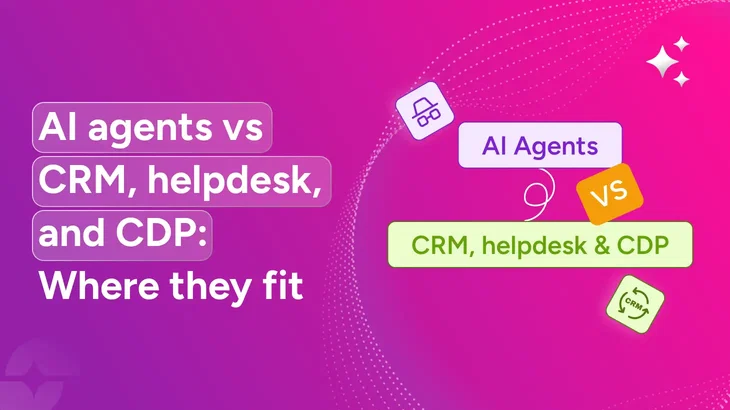
AI agents vs CRM, helpdesk, and CDP: key differences
Once you see these tools as layers, the difference becomes obvious. They are not interchangeable because they operate at completely different levels of the system.
The simplest way to understand this is to look at what each one does when work needs to happen.
| System | Role | Limitation | AI agents |
|---|
| CRM | Tracks leads and pipeline | Shows what to do | Executes follow-ups and moves deals |
| Helpdesk | Manages support tickets | Depends on human response | Handles queries and resolves instantly |
| CDP | Unifies customer data | Provides insight only | Triggers actions based on data |
CRM, helpdesk, and CDP manage data and workflows. AI agents operate on top of them to execute actions in real time.
Turn every conversation into revenue with the Skara AI agent platform
Deploy AI agents that qualify leads, guide buyers, and resolve queries 24/7 across every channel, no extra hires needed.
How AI agents work across CRM, helpdesk, and CDP in real workflows
The easiest way to understand the role of AI agents is to see what happens when a real interaction takes place.
AI agents do not operate inside a single system. They move across CRM, helpdesk, customer data, external tools, and broader enterprise systems to execute complex workflows end-to-end.
The role of AI agents becomes much clearer when you look at how work actually moves across systems in a real scenario.
When a customer visits your website, submits a form, or raises a support query, that interaction is captured just as it always has been. Your CRM records the activity, your CDP enriches it with behavioral and historical context, and your helpdesk may log it as a ticket if support is involved.
What changes is not where the data goes, but what happens next.
In a traditional setup, that interaction would sit within the system until someone acted on it or until a predefined workflow was triggered. Sales teams would follow up, support agents would respond, and most execution depended either on manual effort or fixed predefined rules.
With AI agents in place, that gap between signal and action is significantly reduced.
Instead of waiting, the agent uses the same underlying data to understand intent and determine the next step. It can initiate a conversation, qualify intent, automate tasks, and even support content creation where needed, all while adapting to real-time context.
These decisions are powered by agentic AI models, natural language processing (NLP), and machine learning techniques that enable complex analysis of intent, behavior, and context in real time.
This does not remove the role of CRM, helpdesk, or CDP. If anything, it makes them more important.
Recent industry shifts show that companies are not replacing their core systems. They are building agentic AI-driven workflows and many agents on top of them, allowing those systems to act as the source of data while execution increasingly happens through agents.
That is where the real change sits.
The CRM continues to store and structure customer relationships, the CDP continues to unify and enrich data, and the helpdesk continues to manage complex support scenarios.
However, the responsibility for initiating and progressing interactions is no longer entirely dependent on human input or rigid workflows.
AI agents sit across these systems and turn available data into immediate action.
If a situation requires human involvement, the agent routes it with full context, ensuring AI accountability and the right level of human oversight without slowing down the overall workflow.
If it does not, the interaction can often be resolved in real time. At the same time, every action feeds back into the system, keeping records updated and improving future decisions.
In that sense, the underlying stack remains the same, but how it operates changes.
The systems still manage information, but the execution layer becomes far more responsive, continuous, and less dependent on manual intervention.
AI agents vs generative AI: What is the difference?
Generative AI is a form of AI technology powered by large language AI models that create content such as text, images, or code based on prompts.
AI agents use models like generative AI as part of a larger system to take actions, make decisions, and execute workflows across tools.
In simple terms, generative AI creates outputs, while AI agents use those outputs to get work done. |
How to implement AI agents in your existing stack
Implementing AI agents is not about replacing tools. It is about improving how work actually moves across your existing systems, especially after a customer action is captured.
1. Identify gaps in response and execution
Look at what happens after a lead, query, or interaction enters your system.
In most cases, the data is captured correctly, but action is delayed. Leads sit before a follow-up, support queries wait in queues, and repetitive tasks depend on manual effort.
These gaps are not system issues. They are execution gaps, and they are the first places where AI agents create impact.
2. Map key workflows across teams
Do not think in terms of tools. Think in terms of flow. Each team has its own processes for handling leads, support, and customer interactions, and these variations are exactly where execution gaps start to appear.
A lead does not just sit in the CRM. It moves through stages, triggers conversations, and often involves multiple customer journey touchpoints. The same applies to support queries and customer interactions.
Mapping this journey helps you see where things slow down, where handoffs break, and where decisions are repeatedly made.
That is where AI agents fit best.
Explore: Best AI use cases for businesses.
3. Introduce AI agents at execution points
AI agents should not sit everywhere. They should sit where action is expected but often delayed.
This typically includes moments like initial lead response, early-stage qualification, lead nurturing, routine follow-ups, and common support interactions.
These are points where the system already has enough context, but execution depends on timing or availability. The agent removes that dependency.
4. Integrate with CRM and support systems
AI agents are only as effective as the context they receive and the governance frameworks they operate within. Strong AI agent governance ensures that actions remain controlled, compliant, and aligned with business rules across systems.
They need access to the same data your team relies on, including CRM activity, conversation history, and customer behavior.
The goal is not to build a separate automation layer, but to allow the agent which is evolving fast to act directly on top of your existing systems with full visibility.
5. Measure results and optimize continuously
The impact of AI agents does not show up in how many tasks are completed, but in how smoothly work moves forward.
Track response time, follow-up consistency, and how often interactions are resolved without delay.
Over time, refine based on real interactions instead of trying to perfect workflows upfront. The system improves as it runs.
AI agents vs agentic systems: How are they different?
AI agents are individual systems designed to handle complex tasks, often acting as specialized agents focused on particular workflows such as lead qualification, support handling, or scheduling.
Agentic AI systems refer to a broader setup where multiple agents work together as a coordinated multi-agent system, handling different parts of a workflow across tools, data, and processes.
In practice, agentic AI manages how multiple AI agents coordinate across multiple tools, data, and workflows to execute end-to-end processes. |
How Skara AI agents power execution across your stack
Once you understand the role of AI agents, Skara by Salesmate is simply how that model works in practice.
Skara AI agents sit across your CRM, support systems, and customer data, and turn them into a system that acts in real time. It does not replace your tools. It uses them to execute.
It works as a set of specialized multi agent system across sales, support, and engagement workflows, each designed to handle a specific part of the customer journey.
When a lead enters the system, Skara engages instantly, asks the right questions, qualifies intent, and pushes structured data into your CRM. Sales teams step in with context instead of starting from scratch.
On the support side, it handles common queries immediately, retrieves customer and order context, and resolves or routes conversations without delays.
Across both, it keeps your CRM updated automatically, works across channels like chat, WhatsApp, email, and social, and ensures no interaction is missed.
Key features
- Real-time agentic AI lead qualification through conversations
- Intelligent smart scheduling with calendar sync
- Instant CRM updates (contacts, deals, activities)
- Context-aware replies using past interactions and data
- AI-assisted handoff with summaries and suggestions
- AI sales agents for smart engagement and routing of high-intent leads to the right reps
- Instant responses to common queries with AI support agents
- Multi-channel support (chat, WhatsApp, email, social)
- Workflow execution (sales follow-ups, updates, actions)
- Personalized engagement based on behavior and history
The result is simple. Your systems still store and organize data. Skara makes sure that data turns into action without waiting.
See how AI agents drive real business outcomes
Get a personalized walkthrough of how AI agents can increase conversions, reduce workload, and scale your operations instantly.
Wrap up
AI agents are a shift in how your existing systems operate. They are a shift in how your existing stack operates.
CRM, helpdesk, and CDP systems are not going away. They remain the foundation where customer data, interactions, and workflows live. What is changing is how that data turns into action.
Instead of waiting on manual follow-ups or rigid workflows, AI agents move work forward the moment something happens. They reduce delays, improve consistency, and ensure that no interaction depends on someone remembering what to do next.
That is why the real question is not whether to replace your systems, but how to make them execute better.
Teams that understand this do not simplify their stack by removing tools. They improve it by adding an execution layer on top.
And that is where AI agents create the most impact.
Frequently asked questions
1. What is the difference between AI agents and CRM
A CRM stores and manages customer data such as leads, deals, and interactions, while AI agents act on that data to execute tasks. In simple terms, a CRM provides visibility into what is happening, and AI agents use that information to qualify leads, send follow-ups, and move opportunities forward automatically.
2. Can AI agents replace CRM, helpdesk, or CDP
No. AI agents do not replace these systems. They depend on them. CRM, helpdesk, and CDP provide the structure, data, and workflows. AI agents activate that foundation by executing actions across it.
Without these systems, AI agents lack context and control. Without AI agents, these systems rely heavily on manual execution.
3. Can AI agents replace helpdesk software?
No, AI agents do not replace helpdesk software. They work alongside it. Helpdesk systems manage tickets, workflows, and support processes, while AI agents handle real-time responses, automate repetitive queries, and assist in resolving issues faster before human intervention is needed.
4. How do AI agents work with CDP?
AI agents use data from a CDP to understand customer behavior, history, and intent, and then trigger actions based on that context. While the CDP provides a unified customer profile, AI agents use that data to deliver personalized messages, follow-ups, and recommendations in real time.
5. Do small teams need CDP and AI agents?
Small teams may not need a full CDP if their customer data is limited, but AI agents can still provide significant value. They help improve response time, automate follow-ups, and handle repetitive tasks, making them useful even without a complex data infrastructure.
6. What is the best way to integrate AI agents with CRM
The best way to integrate AI agents with a CRM is to focus on execution gaps rather than replacing the system. Start by identifying where manual work slows down your process, then connect AI agents to your CRM so they can access customer data and automate actions like lead qualification, follow-ups, and updates in real time.
7. What is a context window in AI agents?
A context window refers to the amount of information an AI system can retain and use during an interaction. In AI agents, it helps maintain continuity across conversations, ensuring responses remain relevant and context-aware.








Key takeaways
Should AI agents replace your CRM, helpdesk, or CDP? This is a question every SaaS team is asking right now as AI trends continue to reshape how businesses approach automation, customer engagement, and system execution.
On the surface, it looks like they can. AI agents can qualify leads, respond to customers, trigger workflows, and even make decisions in real time. So it is tempting to assume they can replace the systems you already use.
That assumption is where things start to break. Because in reality, businesses are not simplifying their stack. They are making it more confusing.
Teams are now dealing with overlapping agentic AI tools and AI solutions that all claim to do the same things.
(Customer Relationship Management) CRM platforms are adding agentic AI. Helpdesk tools are becoming conversational. (Customer Data Platform) CDPs are pushing personalization. And AI agents are being positioned as everything at once.
The result is unclear roles, duplicated workflows, and poor decisions about what to keep, replace, or integrate.
At the same time, something deeper is changing.
In one real-world example, a company reduced human CRM users by 80 percent but ended up paying 83 percent more, because over 20 AI agents were now actively using the system to execute workflows and drive operations.
This is the shift most teams miss. The question is no longer what each tool does in isolation. It is how these systems work together when execution is no longer manual. AI agents do not replace CRM, helpdesk, or CDP systems. They change how they are used.
In this guide, we break down exactly how these tools fit together and where AI agents actually belong in a modern revenue stack.
Why does the SaaS stack suddenly feel confusing with AI agents?
The comparison between AI agents and tools like CRM, helpdesk, and CDP is not accidental. It is a direct result of how AI (Artificial Intelligence) is being added across every category at the same time, often with similar promises but very different roles.
This creates a surface-level similarity that hides a bigger difference.
1. Overlapping capabilities across tools
Modern CRM, helpdesk, and CDP platforms already support automation. They can send emails, route tickets, segment users, and trigger workflows.
AI agents enter this same space, but with a critical shift. They do not just follow predefined rules. They decide what action to take based on context.
From the outside, both look similar. Internally, they operate very differently. That is where confusion begins. It becomes unclear where one tool ends and another begins.
2. Every vendor is now an “AI platform”
Beyond features, AI has become the positioning layer for every SaaS category.
At the same time, AI agents are being introduced as standalone systems that can handle conversations, qualify leads, and execute workflows end to end.
3. Automation vs intelligence is getting blurred
Traditional automation is rule-based and depends on predefined criteria and predefined steps, making it effective for repetitive and everyday tasks but limited in handling dynamic scenarios.
AI agents work differently. They interpret context, understand intent, and choose actions dynamically.
But many tools blur this distinction by labeling basic workflows as AI. This creates a false sense of capability and makes it harder for teams to understand what is truly intelligent and what is just automated.
AI agents vs chatbots vs automation tools
In simple terms, chatbots respond, automation tools trigger, and AI agents decide and act.
4. Teams are trying to reduce tools, not add more
Most teams are already operating with a crowded stack across sales, marketing, and support.
The idea of adding another category creates immediate resistance.
So the questions shift from curiosity to consolidation:
This pressure to simplify is what drives the comparison in the first place.
Build AI agents that actually get work done
Design, test, and launch action-driven AI agents that qualify, sell, and resolve, without engineering dependencies.
A simple way to understand how these tools work together
The easiest way to remove the confusion is to stop comparing these tools directly and start looking at them as layers of the same system.
Think of it as four layers: system of record, system of engagement, system of context, and system of execution.
[I] CRM: managing customer relationships and pipeline
A CRM (Customer Relationship Management) focus is on visibility and control over revenue-related interactions.
It tracks leads, deals, conversations, and follow-ups across the sales cycle. Sales teams use it to understand who the customer is, where they are in the pipeline, and what action needs to happen next.
[II] Helpdesk: handling customer queries and support
Helpdesk software focus is structured interaction and resolution at scale.
It captures incoming queries, converts them into tickets, and ensures they are assigned, tracked, and resolved efficiently. Support teams rely on it to manage conversations across channels while maintaining response quality and speed.
[III] CDP: unifying and activating customer data
A CDP (Customer Data Platform) collects and connects customer data from multiple sources into a single profile.
It brings together behavioral, transactional, and engagement data to create a unified view of each user. This allows teams to segment audiences, perform deeper data analysis, understand behavior, and personalize outreach.
The focus of a CDP is consistency, context, and customer understanding.
[IV] AI agents: automating actions and decision execution
Let's first understand what AI agents are: These are systems that can interpret context, make decisions, and execute tasks across tools without constant human input. Unlike traditional automation, they operate independently and adapt to dynamic environments.
They function as autonomous agents that can interpret context, make decisions, and execute workflows independently. Unlike traditional automation, they can operate independently and act autonomously across systems without requiring manual input.
They adapt based on inputs, enable autonomous decision making, and continuously improve outcomes across workflows. Also, they use available data and context to perform tasks such as lead qualification and responding to queries.
This is where AI agents stand out. They are not limited to simple triggers. They can perform complex tasks that involve context, timing, and complex decision-making across multiple systems.
The focus of AI agents is execution, speed, and autonomy.
AI agents vs AI assistants: What is the difference?
AI assistants are designed to respond to user queries and help complete tasks when prompted. AI agents operate more independently. They initiate actions, automate workflows, and make decisions based on context without waiting for user input every time.
AI agents vs CRM, helpdesk, and CDP: key differences
Once you see these tools as layers, the difference becomes obvious. They are not interchangeable because they operate at completely different levels of the system.
The simplest way to understand this is to look at what each one does when work needs to happen.
CRM, helpdesk, and CDP manage data and workflows. AI agents operate on top of them to execute actions in real time.
Turn every conversation into revenue with the Skara AI agent platform
Deploy AI agents that qualify leads, guide buyers, and resolve queries 24/7 across every channel, no extra hires needed.
How AI agents work across CRM, helpdesk, and CDP in real workflows
The easiest way to understand the role of AI agents is to see what happens when a real interaction takes place.
AI agents do not operate inside a single system. They move across CRM, helpdesk, customer data, external tools, and broader enterprise systems to execute complex workflows end-to-end.
The role of AI agents becomes much clearer when you look at how work actually moves across systems in a real scenario.
When a customer visits your website, submits a form, or raises a support query, that interaction is captured just as it always has been. Your CRM records the activity, your CDP enriches it with behavioral and historical context, and your helpdesk may log it as a ticket if support is involved.
What changes is not where the data goes, but what happens next.
In a traditional setup, that interaction would sit within the system until someone acted on it or until a predefined workflow was triggered. Sales teams would follow up, support agents would respond, and most execution depended either on manual effort or fixed predefined rules.
With AI agents in place, that gap between signal and action is significantly reduced.
Instead of waiting, the agent uses the same underlying data to understand intent and determine the next step. It can initiate a conversation, qualify intent, automate tasks, and even support content creation where needed, all while adapting to real-time context.
These decisions are powered by agentic AI models, natural language processing (NLP), and machine learning techniques that enable complex analysis of intent, behavior, and context in real time.
This does not remove the role of CRM, helpdesk, or CDP. If anything, it makes them more important.
Recent industry shifts show that companies are not replacing their core systems. They are building agentic AI-driven workflows and many agents on top of them, allowing those systems to act as the source of data while execution increasingly happens through agents.
That is where the real change sits.
The CRM continues to store and structure customer relationships, the CDP continues to unify and enrich data, and the helpdesk continues to manage complex support scenarios.
However, the responsibility for initiating and progressing interactions is no longer entirely dependent on human input or rigid workflows.
AI agents sit across these systems and turn available data into immediate action.
If a situation requires human involvement, the agent routes it with full context, ensuring AI accountability and the right level of human oversight without slowing down the overall workflow.
If it does not, the interaction can often be resolved in real time. At the same time, every action feeds back into the system, keeping records updated and improving future decisions.
In that sense, the underlying stack remains the same, but how it operates changes.
The systems still manage information, but the execution layer becomes far more responsive, continuous, and less dependent on manual intervention.
AI agents vs generative AI: What is the difference?
Generative AI is a form of AI technology powered by large language AI models that create content such as text, images, or code based on prompts.
AI agents use models like generative AI as part of a larger system to take actions, make decisions, and execute workflows across tools.
In simple terms, generative AI creates outputs, while AI agents use those outputs to get work done.
How to implement AI agents in your existing stack
Implementing AI agents is not about replacing tools. It is about improving how work actually moves across your existing systems, especially after a customer action is captured.
1. Identify gaps in response and execution
Look at what happens after a lead, query, or interaction enters your system.
In most cases, the data is captured correctly, but action is delayed. Leads sit before a follow-up, support queries wait in queues, and repetitive tasks depend on manual effort.
These gaps are not system issues. They are execution gaps, and they are the first places where AI agents create impact.
2. Map key workflows across teams
Do not think in terms of tools. Think in terms of flow. Each team has its own processes for handling leads, support, and customer interactions, and these variations are exactly where execution gaps start to appear.
A lead does not just sit in the CRM. It moves through stages, triggers conversations, and often involves multiple customer journey touchpoints. The same applies to support queries and customer interactions.
Mapping this journey helps you see where things slow down, where handoffs break, and where decisions are repeatedly made.
That is where AI agents fit best.
3. Introduce AI agents at execution points
AI agents should not sit everywhere. They should sit where action is expected but often delayed.
This typically includes moments like initial lead response, early-stage qualification, lead nurturing, routine follow-ups, and common support interactions.
These are points where the system already has enough context, but execution depends on timing or availability. The agent removes that dependency.
4. Integrate with CRM and support systems
AI agents are only as effective as the context they receive and the governance frameworks they operate within. Strong AI agent governance ensures that actions remain controlled, compliant, and aligned with business rules across systems.
They need access to the same data your team relies on, including CRM activity, conversation history, and customer behavior.
The goal is not to build a separate automation layer, but to allow the agent which is evolving fast to act directly on top of your existing systems with full visibility.
5. Measure results and optimize continuously
The impact of AI agents does not show up in how many tasks are completed, but in how smoothly work moves forward.
Track response time, follow-up consistency, and how often interactions are resolved without delay.
Over time, refine based on real interactions instead of trying to perfect workflows upfront. The system improves as it runs.
AI agents vs agentic systems: How are they different?
AI agents are individual systems designed to handle complex tasks, often acting as specialized agents focused on particular workflows such as lead qualification, support handling, or scheduling.
Agentic AI systems refer to a broader setup where multiple agents work together as a coordinated multi-agent system, handling different parts of a workflow across tools, data, and processes.
In practice, agentic AI manages how multiple AI agents coordinate across multiple tools, data, and workflows to execute end-to-end processes.
How Skara AI agents power execution across your stack
Once you understand the role of AI agents, Skara by Salesmate is simply how that model works in practice.
Skara AI agents sit across your CRM, support systems, and customer data, and turn them into a system that acts in real time. It does not replace your tools. It uses them to execute.
It works as a set of specialized multi agent system across sales, support, and engagement workflows, each designed to handle a specific part of the customer journey.
When a lead enters the system, Skara engages instantly, asks the right questions, qualifies intent, and pushes structured data into your CRM. Sales teams step in with context instead of starting from scratch.
On the support side, it handles common queries immediately, retrieves customer and order context, and resolves or routes conversations without delays.
Across both, it keeps your CRM updated automatically, works across channels like chat, WhatsApp, email, and social, and ensures no interaction is missed.
Key features
The result is simple. Your systems still store and organize data. Skara makes sure that data turns into action without waiting.
See how AI agents drive real business outcomes
Get a personalized walkthrough of how AI agents can increase conversions, reduce workload, and scale your operations instantly.
Wrap up
AI agents are a shift in how your existing systems operate. They are a shift in how your existing stack operates.
CRM, helpdesk, and CDP systems are not going away. They remain the foundation where customer data, interactions, and workflows live. What is changing is how that data turns into action.
Instead of waiting on manual follow-ups or rigid workflows, AI agents move work forward the moment something happens. They reduce delays, improve consistency, and ensure that no interaction depends on someone remembering what to do next.
That is why the real question is not whether to replace your systems, but how to make them execute better.
Teams that understand this do not simplify their stack by removing tools. They improve it by adding an execution layer on top.
And that is where AI agents create the most impact.
Frequently asked questions
1. What is the difference between AI agents and CRM
A CRM stores and manages customer data such as leads, deals, and interactions, while AI agents act on that data to execute tasks. In simple terms, a CRM provides visibility into what is happening, and AI agents use that information to qualify leads, send follow-ups, and move opportunities forward automatically.
2. Can AI agents replace CRM, helpdesk, or CDP
No. AI agents do not replace these systems. They depend on them. CRM, helpdesk, and CDP provide the structure, data, and workflows. AI agents activate that foundation by executing actions across it.
Without these systems, AI agents lack context and control. Without AI agents, these systems rely heavily on manual execution.
3. Can AI agents replace helpdesk software?
No, AI agents do not replace helpdesk software. They work alongside it. Helpdesk systems manage tickets, workflows, and support processes, while AI agents handle real-time responses, automate repetitive queries, and assist in resolving issues faster before human intervention is needed.
4. How do AI agents work with CDP?
AI agents use data from a CDP to understand customer behavior, history, and intent, and then trigger actions based on that context. While the CDP provides a unified customer profile, AI agents use that data to deliver personalized messages, follow-ups, and recommendations in real time.
5. Do small teams need CDP and AI agents?
Small teams may not need a full CDP if their customer data is limited, but AI agents can still provide significant value. They help improve response time, automate follow-ups, and handle repetitive tasks, making them useful even without a complex data infrastructure.
6. What is the best way to integrate AI agents with CRM
The best way to integrate AI agents with a CRM is to focus on execution gaps rather than replacing the system. Start by identifying where manual work slows down your process, then connect AI agents to your CRM so they can access customer data and automate actions like lead qualification, follow-ups, and updates in real time.
7. What is a context window in AI agents?
A context window refers to the amount of information an AI system can retain and use during an interaction. In AI agents, it helps maintain continuity across conversations, ensuring responses remain relevant and context-aware.
Sonali Negi
Content WriterSonali is a writer born out of her utmost passion for writing. She is working with a passionate team of content creators at Salesmate. She enjoys learning about new ideas in marketing and sales. She is an optimistic girl and endeavors to bring the best out of every situation. In her free time, she loves to introspect and observe people.