Sizing and fit issues drive a large share of costly returns across the apparel industry.
Industry data shows the scale of the problem. In the United States alone, retail returns totaled $849.9 billion in 2025, highlighting how costly return logistics have become for eCommerce brands.
Across fashion eCommerce, high return rates often range from 26% to 40%, with categories like plus-size (34.2%) and petite (31.7%) clothing seeing even higher numbers.
If you run an online fashion store, you’ve likely seen this firsthand. Many fashion shoppers hesitate to purchase when they experience size confusion while evaluating products online.
That uncertainty increases return costs, contributes to cart abandonment, and reduces conversions.
AI agents help brands solve this problem by analyzing product data and shopper behavior to guide customers toward the right size in real time. These systems now act as AI shopping assistants that answer sizing questions and guide product decisions during the buying journey.
In this blog, you’ll learn how AI agents reduce sizing uncertainty, improve conversions, and help your brand lower return rates.
The evolution of fit technology: From size charts to AI agents
Sizing tools in eCommerce have evolved in stages. Each step improved accuracy, but also revealed new limitations.
What started as static charts has gradually evolved into intelligent systems that analyze data and interpret customer intent.
1. Static size charts
Static charts were the earliest solution for online sizing. They match body measurements to garment dimensions and expect shoppers to choose the correct size themselves.
This works only if customers know their exact measurements and sizing is consistent across brands. In reality, fit varies widely due to fabric stretch, garment cuts, and brand differences. Size charts provide information but do not guide the decision.
2. Rule-based size recommendation tools
Rule-based tools introduced simple automation. They ask basic inputs such as height, weight, or usual brand size, and apply predefined logic to suggest a size.
For example, if a product is labeled “slim fit,” the system may recommend sizing up. While this reduces guesswork, the logic is fixed and cannot learn from return data or changing customer behavior.
3. Machine learning size prediction engines
Machine learning models improve accuracy by analyzing real customer behavior. They study purchase history, return data, and product attributes to estimate the most likely size a shopper will keep.
If customers with similar profiles consistently keep a particular size, the system learns to recommend that size to new shoppers. However, most ML systems still deliver a single prediction without explaining the reasoning or handling follow-up questions.
4. Conversational AI agents
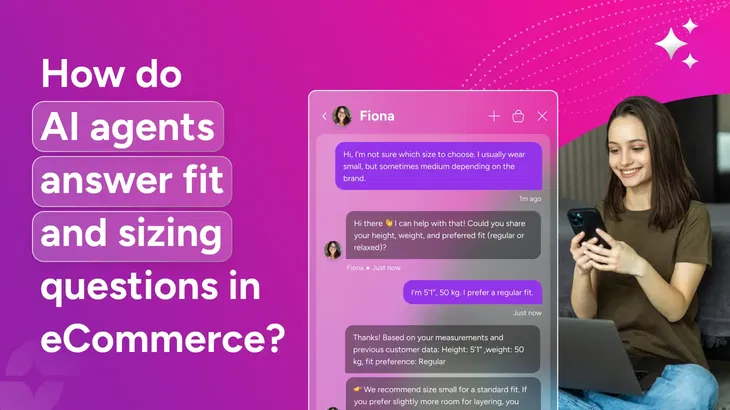
AI agents represent the latest stage of fit technology, reflecting the broader shift toward Agentic AI systems that can interpret context, make decisions, and guide shoppers through complex purchasing questions.
These systems use natural language understanding, generative AI models, and product data to answer questions like:
- “I usually wear medium but prefer a relaxed fit.”
- “Should I size up if I plan to layer this?”
The agent interprets intent, evaluates garment attributes like stretch and cut, and explains the recommendation. This turns sizing into an interactive decision process rather than a one-time guess.
In short, size charts provide reference, machine learning improves prediction, and AI agents add real-time guidance and clarification.
Next, we will examine the core technologies that make modern AI-driven fit systems possible.
The four core methodologies behind AI-powered size recommendations
Most platforms combine several technologies to reduce uncertainty and improve fit recommendations. Each method approaches the problem differently, by analyzing measurements, customer behavior, visual data, or feedback signals.
Understanding these layers explains how AI agents deliver more reliable fit guidance.
1. Digital measurement mapping
This approach matches customer measurements with garment dimensions. Shoppers enter details like height, weight, body measurements, or basic body shape information.
Its accuracy depends on well-structured product metadata such as chest width, inseam, stretch ratio, and fit type. While fast and easy to implement, it only compares numbers and cannot account for brand differences or personal fit preferences.
2. Machine learning clustering and cohort modeling
Machine learning models analyze purchase and return patterns to predict the most suitable size.
For example, if customers with a similar body type consistently keep size M, the system learns to recommend that size to new shoppers in the same group. This approach improves accuracy over time but depends on having enough historical data.
3. Computer vision and body scanning
Some platforms use smartphone cameras or scanning tools to estimate body shape and proportions, helping simulate how garments may fit on different shoppers.
While this can improve precision, adoption remains limited due to privacy concerns and the extra effort required from shoppers. Because of this, most eCommerce brands rely more on behavioral data and product attributes.
4. NLP-based review intelligence
Natural language processing analyzes customer reviews and return reasons to identify fit patterns.
If many reviews mention issues like “runs small” or “tight in the shoulders,” the system flags the product and adjusts future size recommendations. This helps capture insights that structured product data alone cannot provide.
Each method improves sizing accuracy differently. When combined, they create an intelligence layer that works alongside existing systems used by eCommerce brands to manage product data and shopper behavior.
However, prediction alone does not remove uncertainty. The real impact comes when these models work inside conversational AI agents that can answer questions and guide shoppers toward the right size in real time.
How AI agents resolve fit ambiguity in real time
Traditional sizing tools give a recommendation. AI agents go a step further by interpreting uncertainty and answering follow-up questions in real time.
Shoppers rarely ask fit questions in a structured way. They say things like, “I usually wear medium but prefer a relaxed fit.” That includes more than one signal: usual size, fit preference, and concern about comfort.
AI agents process this ambiguity in a few clear steps.








Key takeaways
Sizing and fit issues drive a large share of costly returns across the apparel industry.
Industry data shows the scale of the problem. In the United States alone, retail returns totaled $849.9 billion in 2025, highlighting how costly return logistics have become for eCommerce brands.
Across fashion eCommerce, high return rates often range from 26% to 40%, with categories like plus-size (34.2%) and petite (31.7%) clothing seeing even higher numbers.
If you run an online fashion store, you’ve likely seen this firsthand. Many fashion shoppers hesitate to purchase when they experience size confusion while evaluating products online.
That uncertainty increases return costs, contributes to cart abandonment, and reduces conversions.
AI agents help brands solve this problem by analyzing product data and shopper behavior to guide customers toward the right size in real time. These systems now act as AI shopping assistants that answer sizing questions and guide product decisions during the buying journey.
In this blog, you’ll learn how AI agents reduce sizing uncertainty, improve conversions, and help your brand lower return rates.
The evolution of fit technology: From size charts to AI agents
Sizing tools in eCommerce have evolved in stages. Each step improved accuracy, but also revealed new limitations.
What started as static charts has gradually evolved into intelligent systems that analyze data and interpret customer intent.
1. Static size charts
Static charts were the earliest solution for online sizing. They match body measurements to garment dimensions and expect shoppers to choose the correct size themselves.
This works only if customers know their exact measurements and sizing is consistent across brands. In reality, fit varies widely due to fabric stretch, garment cuts, and brand differences. Size charts provide information but do not guide the decision.
2. Rule-based size recommendation tools
Rule-based tools introduced simple automation. They ask basic inputs such as height, weight, or usual brand size, and apply predefined logic to suggest a size.
For example, if a product is labeled “slim fit,” the system may recommend sizing up. While this reduces guesswork, the logic is fixed and cannot learn from return data or changing customer behavior.
3. Machine learning size prediction engines
Machine learning models improve accuracy by analyzing real customer behavior. They study purchase history, return data, and product attributes to estimate the most likely size a shopper will keep.
If customers with similar profiles consistently keep a particular size, the system learns to recommend that size to new shoppers. However, most ML systems still deliver a single prediction without explaining the reasoning or handling follow-up questions.
4. Conversational AI agents
AI agents represent the latest stage of fit technology, reflecting the broader shift toward Agentic AI systems that can interpret context, make decisions, and guide shoppers through complex purchasing questions.
These systems use natural language understanding, generative AI models, and product data to answer questions like:
The agent interprets intent, evaluates garment attributes like stretch and cut, and explains the recommendation. This turns sizing into an interactive decision process rather than a one-time guess.
In short, size charts provide reference, machine learning improves prediction, and AI agents add real-time guidance and clarification.
Create a personal stylist for every shopper
Skara AI Fashion Agents understand style preferences, recommend full outfits, and guide shoppers from discovery to checkout.
Next, we will examine the core technologies that make modern AI-driven fit systems possible.
The four core methodologies behind AI-powered size recommendations
Most platforms combine several technologies to reduce uncertainty and improve fit recommendations. Each method approaches the problem differently, by analyzing measurements, customer behavior, visual data, or feedback signals.
Understanding these layers explains how AI agents deliver more reliable fit guidance.
1. Digital measurement mapping
This approach matches customer measurements with garment dimensions. Shoppers enter details like height, weight, body measurements, or basic body shape information.
Its accuracy depends on well-structured product metadata such as chest width, inseam, stretch ratio, and fit type. While fast and easy to implement, it only compares numbers and cannot account for brand differences or personal fit preferences.
2. Machine learning clustering and cohort modeling
Machine learning models analyze purchase and return patterns to predict the most suitable size.
For example, if customers with a similar body type consistently keep size M, the system learns to recommend that size to new shoppers in the same group. This approach improves accuracy over time but depends on having enough historical data.
3. Computer vision and body scanning
Some platforms use smartphone cameras or scanning tools to estimate body shape and proportions, helping simulate how garments may fit on different shoppers.
While this can improve precision, adoption remains limited due to privacy concerns and the extra effort required from shoppers. Because of this, most eCommerce brands rely more on behavioral data and product attributes.
4. NLP-based review intelligence
Natural language processing analyzes customer reviews and return reasons to identify fit patterns.
If many reviews mention issues like “runs small” or “tight in the shoulders,” the system flags the product and adjusts future size recommendations. This helps capture insights that structured product data alone cannot provide.
Each method improves sizing accuracy differently. When combined, they create an intelligence layer that works alongside existing systems used by eCommerce brands to manage product data and shopper behavior.
However, prediction alone does not remove uncertainty. The real impact comes when these models work inside conversational AI agents that can answer questions and guide shoppers toward the right size in real time.
How AI agents resolve fit ambiguity in real time
Traditional sizing tools give a recommendation. AI agents go a step further by interpreting uncertainty and answering follow-up questions in real time.
Shoppers rarely ask fit questions in a structured way. They say things like, “I usually wear medium but prefer a relaxed fit.” That includes more than one signal: usual size, fit preference, and concern about comfort.
AI agents process this ambiguity in a few clear steps.
1. Intent detection and contextual parsing
The agent interprets natural language to identify what the shopper really means. It separates fixed inputs, such as usual size, from preferences like relaxed fit, layering, or avoiding tightness.
2. Product attribute extraction
The agent then checks garment-specific details such as stretch, cut, silhouette, fabric behavior, and fit type. This helps it judge whether the shopper should stay with their usual size or size up or down.
3. Fit profile creation
Next, the system combines available customer data, fit preferences, and past purchase behavior. For example, if a shopper kept medium in relaxed styles but returned medium in slim-fit items, that pattern helps guide the recommendation.
4. Multi-turn clarification
If the shopper asks, “What if I’m between sizes?” or “Will this shrink after wash?”, the agent adjusts the recommendation in real time. Instead of forcing one static answer, it reduces hesitation through clarification.
5. Confidence scoring and explanation layer
The final output is not just a size suggestion. It also explains the reason behind it.
For example: “Based on your preference for a relaxed fit and this garment’s low-stretch fabric, size L is likely to be more comfortable.”
This matters because shoppers trust recommendations more when they understand the logic behind them, strengthening customer trust and improving decision-making during the purchase process.
In short, AI eCommerce agents do more than predict size. They interpret shopper intent and product context to guide confident purchasing decisions.
By combining product data, shopper context, and real-time conversation, AI agents turn fit uncertainty into confident purchase decisions by providing fit-based recommendations in real time.
Reduce returns while increasing fashion conversions
Give shoppers accurate size guidance, styling suggestions, and real-time product insights that remove hesitation at checkout.
The technical architecture behind AI sizing agents
AI sizing agents, systems that recommend clothing sizes using data, rely on multiple data layers working together to generate accurate recommendations.
Instead of using a single model, modern systems combine product data, behavioral signals, language understanding, and feedback loops to interpret shopper intent and predict the most suitable size.
When these components are integrated properly, sizing becomes an adaptive system that improves with every interaction rather than a static tool.
The key features that power modern AI sizing agents include several integrated data and intelligence layers:
Together, these layers turn sizing from a static reference into an intelligent system that learns and adapts as more customer interactions occur.
Measurable eCommerce impact of AI fit intelligence
AI sizing agents are not just UX improvements. They directly influence key eCommerce metrics by increasing conversion rates and improving the overall customer experience during product selection.
Typical performance impact includes:
The exact impact varies by category and traffic volume, but the pattern is consistent across fashion eCommerce.
[I] Lower return rates
Sizing issues drive the majority of apparel returns. Across the broader retail sector, 24.5% of online purchases are returned on average, nearly three times higher than in-store return rates.
When AI agents clarify fit before checkout, fewer customers order multiple sizes or return items that do not fit.
This reduces reverse logistics costs, restocking expenses, and inventory distortion while improving customer satisfaction.
[II] Higher conversion rates
Fit uncertainty often causes hesitation at the product page and can lead to cart abandonment.
Research shows 75% of shoppers have returned clothing because it did not fit, making sizing clarity one of the biggest factors influencing purchase decisions.
When AI agents provide clear recommendations and explain the reasoning, perceived risk decreases, helping brands reduce reliance on abandoned cart recovery campaigns.
How fit intelligence becomes a merchandising asset
Most brands treat sizing as a support function. Advanced brands treat it as intelligence.
When AI agents capture structured fit data at scale, that signal extends beyond checkout and becomes a merchandising engine.
5 Best AI size recommendation tools for eCommerce
Several AI platforms help eCommerce brands reduce sizing uncertainty by analyzing product data, shopper behavior, and return patterns.
Many leading fashion brands use these tools to help shoppers choose the correct size before checkout.
1. True Fit
True Fit is one of the most widely used AI sizing platforms in fashion eCommerce.
Its technology powers tools like True Fit’s shopping agent, which analyzes large datasets of shopper behavior, brand sizing information, and product attributes.
This helps deliver personalized size guidance that allows shoppers to understand the real fit of garments directly on product pages.
2. Fit Analytics (Fit Finder)
Fit Finder by Fit Analytics uses machine learning to generate size recommendations based on shopper preferences, purchase behavior, and return data.
The platform helps retailers handle cross-brand size differences and guide customers toward the most likely size they will keep.
3. Bold Metrics
Bold Metrics uses AI-powered body modeling to create a digital twin of each shopper.
By estimating body measurements and combining them with garment attributes, the platform recommends precise sizes while also providing brands with body data insights for product development and merchandising.
4. Prime AI Size Recommender
Prime AI’s sizing engine analyzes garment metadata, customer inputs, and purchase outcomes to recommend the most suitable size.
Its models adapt across product categories and help brands reduce return rates while improving shopper confidence during checkout.
5. Sizebay
Sizebay provides personalized size recommendations by combining customer preferences with product sizing data and historical performance signals.
The platform integrates easily with eCommerce stores and helps shoppers select the correct size with minimal friction.
What are the common mistakes brands make when deploying AI sizing tools?
Common mistakes include:
Returns are not always caused by sizing problems alone. Consumer behavior also plays a role in driving return volumes. Retail studies show that some shoppers intentionally purchase multiple sizes or return used items, which increases operational costs for retailers.
Source: Capital One Shopping
Many of these challenges are part of a larger set of eCommerce mistakes that can affect customer experience, conversions, and long-term growth. We’ve explored these issues in detail in our guide on eCommerce mistakes.
Skara AI Agents: From fit intelligence to revenue execution
Skara is an AI agent platform designed to help eCommerce brands automate conversations across sales, shopping assistance, and customer support while enabling more personalized shopping experiences.
The platform understands shopper intent, takes actions, and guides conversations toward a purchase or resolution. In fashion eCommerce, this allows your store to resolve sizing uncertainty while also helping shoppers discover products, build outfits, and complete purchases with confidence.
Skara supports your eCommerce experience through:
By resolving sizing questions early and guiding shoppers throughout the buying journey, Skara helps eCommerce brands reduce size-related returns, improve conversion rates, and increase average order value.
Instead of leaving shoppers guessing about fit, Skara helps you turn product conversations into confident purchases.
Want to put your sales, support, and commerce on autopilot?
Skara AI Agents handle customer conversations, recommend products, book meetings, and trigger workflows across every channel.
Conclusion
Sizing in eCommerce is not just an operational issue; it is a decision problem. While returns are the visible cost, hesitation at the product page is the hidden one.
Every time a shopper asks, “What size should I buy?”, uncertainty can lead to abandoned carts, multiple-size orders, or post-purchase returns.
AI sizing engines improve prediction, but AI agents go further by resolving uncertainty in real time. By interpreting shopper intent, analyzing product attributes, and explaining recommendations clearly, they help customers make confident decisions before checkout.
When shoppers feel confident about fit, hesitation drops, conversions rise, and return rates decline.
In the end, AI agents don’t just recommend sizes; they remove doubt at the moment that matters most.
Frequently asked questions
1. What is an AI fashion agent?
An AI fashion agent is an AI-powered shopping assistant that helps customers discover products, answer styling questions, recommend outfits, and guide purchase decisions.
2. How accurate are AI size recommendation tools?
Accuracy depends on the data and technology used. Basic measurement-based tools offer moderate precision, while machine learning systems trained on purchase and return data typically deliver much higher accuracy. AI agents improve results further by interpreting shopper intent and clarifying fit questions in real time.
3. Do AI sizing tools require body scans?
No. Most AI sizing tools rely on inputs such as height, weight, purchase history, and product metadata. Body scanning and computer vision can improve accuracy, but are usually optional due to privacy concerns and user friction.
4. Can AI reduce eCommerce return rates?
Yes. Fit-related issues cause a large share of apparel returns. When integrated with product data and return feedback loops, AI sizing tools can reduce size-related returns by 25–50% in many eCommerce stores.
5. Are virtual fitting rooms better than AI sizing agents?
They solve different problems. Virtual fitting rooms focus on visual simulation, while AI sizing agents guide size decisions using behavioral data, product attributes, and conversational assistance. Many brands combine both approaches for better results.
6. What data do AI agents use to predict fit?
AI agents analyze product attributes, garment measurements, customer preferences, purchase history, and return patterns. Some systems also use review analysis or computer vision data to improve recommendations.
7. How do AI agents handle brand-to-brand size differences?
AI models learn from purchase and return patterns across brands. If shoppers often size up or down with certain brands, the system adjusts recommendations accordingly to improve fit accuracy.
Sonali Negi
Content WriterSonali is a writer born out of her utmost passion for writing. She is working with a passionate team of content creators at Salesmate. She enjoys learning about new ideas in marketing and sales. She is an optimistic girl and endeavors to bring the best out of every situation. In her free time, she loves to introspect and observe people.