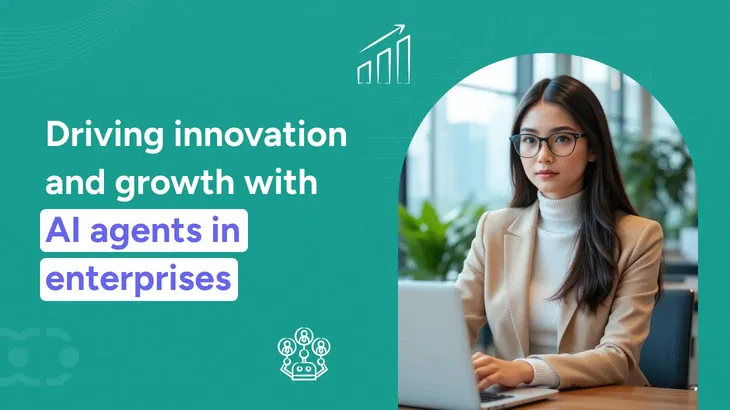
AI agents for enterprise are transforming how businesses operate in 2026. According to recent findings, 86% of CEOs now acknowledge that rising complexity isn't just a challenge, it's a barrier to growth.
This complexity has consequently pushed organizations toward more intelligent solutions.
Enterprise AI has evolved and come a long way. Now, rule-based automation helps businesses work faster and smarter.
For example, tasks like reconciling accounts, chasing approvals, or updating forecasts that once ate up hours are now handled in seconds without anyone lifting a finger.
And businesses aren’t just talking about it, the momentum is real. Today, 65% of companies are already testing agent-based systems, and nearly all of them (a staggering 99%) plan to roll them out soon.
The shift toward conversational AI as a core enterprise component is equally notable. By 2028, interactions with AI agents will account for a full third of all generative AI use within enterprises.
Deloitte’s latest research shows a big shift on the horizon: by 2026, one in four enterprises using generative AI will already be running AI agents in real-world settings and that number is expected to double by 2027.
In this blog post, we'll explore why enterprise leaders are rapidly adopting AI agents, how these technologies differ from traditional automation, and what the best AI agents for enterprise applications look like in 2026.
The shift from automation to agentic intelligence
The way businesses automate work has come a long way, from rigid, rule-following systems to smart tools that can make decisions on their own.
It’s not just a tech upgrade; it’s a complete shift in how companies think about automation.
1. From rule-based systems to autonomous agents
In the beginning, automation meant rule-based systems. They were reliable, but also stubborn, designed to handle predefined tasks and repeatable processes with little room for flexibility.
Great for consistency, but useless the moment something unexpected happened. That very rigidity, once their strength, quickly became their biggest weakness.
In contrast, agentic AI represents a transformative leap in enterprise capabilities. These advanced systems can plan intentionally, anticipate with forethought, be self-reactive, and improve through self-reflection.
Rather than replacing traditional automation, agentic AI expands its capabilities by introducing intelligence where fixed rules fall short.
2. Why conversational AI is now core to enterprise UX
Conversations have become the backbone of modern enterprise experiences because they remove the friction between businesses and the people they serve.
Instead of acting like static tools, today’s systems are woven into workflows and feel more like active teammates than background software.
This shift is fueled by changing expectations. In a world where instant messaging is second nature, waiting hours, or even minutes, for a reply feels outdated.
Employees and customers want quick, clear answers at the moment. Beyond speed, conversational systems bring flexibility: they help organizations build connected ecosystems that streamline work, simplify processes, and unlock productivity.
3. How AI agents differ from traditional automation tools
AI agents operate fundamentally differently from traditional automation workflows:
- Decision-making: While traditional automation follows predetermined steps (if X happens, do Y), AI agents are given goals and empowered to determine the steps themselves.
- Adaptability: AI agents can course-correct, modifying activities in real-time to meet changing situations.
- Data handling: Agents can process unstructured data like emails, documents, audio, and images.
- Learning capability: Unlike static automation, agents learn and evolve over time through continuous improvement from feedback.
The distinction is similar to comparing a train on tracks (traditional automation) to a car given only one destination (AI agent).
The car can choose routes, detour if needed, and make decisions along the way, offering greater flexibility but also requiring appropriate guardrails.
Want an AI agent that actually thinks for itself?
Meet Skara AI - our new “employee” that never sleeps, never complains, and actually knows what to do.
Understanding the core capabilities of AI agents
The effectiveness of AI agents for enterprise hinges on four foundational capabilities that enable them to function with unprecedented autonomy in business environments.
1. Perception: Real-time environment sensing
AI agent perception forms the cornerstone of intelligent systems, enabling them to gather and interpret data from their surroundings.
Essentially, perception acts as the "eye and ear" of agentic systems, collecting real-time visual and auditory data through multiple input channels.
For enterprise applications, this translates to real-time monitoring capabilities that process diverse data streams simultaneously, from text and voice to video and code.
Environmental perception particularly shines in business contexts where AI agents integrate sensor data with auxiliary information to provide accurate, low-cost analysis of complex situations.
Through this capability, agents can detect anomalies, identify patterns, and trigger appropriate responses with minimal delay.
Further reading: The Voice AI Agents: Simplifying your retail business.
2. Reasoning: Contextual decision-making
Beyond simple data collection, AI agents employ sophisticated reasoning to make contextually appropriate decisions.
Although current agents still lack the full business context that humans naturally bring to decision-making, they combine environmental data with domain knowledge to achieve rational outcomes.
The reasoning component serves as the "brain" of the agentic system, applying domain logic and performing causal analysis to guide decisions.
This contextual understanding allows AI agents to handle ambiguity and operate effectively in dynamic environments.
3. Execution: Task completion with autonomy
The execution capability distinguishes true AI agents from traditional automation. Research indicates that AI systems' ability to independently handle tasks is doubling approximately every seven months, with the potential to execute complex projects that today require weeks of human labor.
Autonomous execution involves following set workflows, selecting optimal paths for each request, and maintaining reliable results across similar tasks.
Despite their growing capabilities, most agentic AI systems still follow carefully designed workflows structured by humans before deployment.
4. Learning: Continuous improvement from feedback
The learning capability transforms AI agents from static tools into evolving systems. A learning agent improves performance by adapting to new experiences and data, continuously updating its behavior based on feedback.
This process addresses "catastrophic forgetting" - where models lose previously acquired knowledge when learning new information.
Feedback mechanisms enable AI agents to assess their actions, identify patterns, and adjust strategies over time.
This continuous learning cycle ensures AI systems stay effective and aligned with business objectives, fostering transparency and building trust through consistent performance improvement.
Also read: How to build AI agents from scratch in 2026 (Step-by-step guide).
How enterprises are using AI agents in 2026
Enterprises across sectors are rapidly deploying AI agents to transform operations in 2026. These implementations demonstrate the technology's versatility beyond theoretical capabilities.
1. AI agents for enterprise teams in sales and marketing
Marketing departments now employ AI agents to orchestrate campaigns autonomously, managing media buying across platforms while monitoring real-time performance data.
Salesmate’s Skara enables teams to scale quickly as these agents nurture leads, answer questions, and book meetings without human input.
In practical terms, consumer goods companies using AI agents for content creation have reduced costs by 95% while improving speed 50x.
Furthermore, these systems deliver truly personalized marketing messages based on behavior, persona attributes, and engagement history.
2. AI agents for enterprise use in IT and DevOps
Throughout DevOps workflows, AI agents now resolve issues, implement fixes, improve code quality, and create documentation.
Advanced systems automatically detect bugs and security vulnerabilities during code reviews, predict potential failures through historical data analysis, and respond to incidents using established protocols.
Indeed, tools like AWS CodeGuru optimize performance through AI-driven insights, whereas Dynatrace's Davis AI analyzes billions of dependencies in milliseconds.
3. AI agents for enterprise applications in HR and finance
Human resources departments leverage AI agents to streamline performance reviews, recommend career goals, and assist with timecard management.
IBM's AskHR tool resolves 10.1 million interactions yearly, saving 50,000 hours and $5 million annually.
Regarding adoption rates, 44% of HR leaders plan to use semi-autonomous AI agent capabilities within a year.
Meanwhile, finance teams employ AI agents for personalized wealth management and expense report processing.
Challenges and guardrails for responsible AI Agent deployment
Despite the promising capabilities of AI agents for enterprises, responsible deployment faces significant hurdles. Enterprises must navigate these challenges thoughtfully to avoid costly pitfalls.
1. Memory and persistence limitations
Current AI agent architectures suffer from ephemeral memory constraints, preventing effective collaboration and knowledge sharing across sessions.
As agents become more complex, they experience unbounded memory growth with degraded reasoning performance.
Consequently, organizations implementing enterprise AI agents must address these limitations through memory segmentation, timestamp filtering, and retrieval confidence thresholds.
2. Trust, transparency, and hallucination risks
The "black box" problem creates a paradox for enterprise AI adoption, too little transparency prevents trust, yet complete transparency eliminates vulnerability necessary for genuine trust.
Nearly 39% of executives remain hesitant about delegating tasks to agents. Furthermore, hallucinations pose substantial risks when AI produces plausible but factually incorrect outputs.
Organizations can mitigate these issues through retrieval-augmented generation, explicit user training, and creating clear verification channels.
3. Security vulnerabilities and red teaming
AI agents introduce novel security challenges beyond traditional LLM risks. Common threats include perception hijacking, prompt injection, and context leakage, where sensitive information slips out inappropriately.
Rigorous security testing through AI red teaming helps organizations proactively identify these vulnerabilities.
This approach combines scanning, evaluating, and reporting to understand how AI systems respond to adversarial probing.
4. Ethical concerns in autonomous decision-making
Enterprise AI agents raise important ethical questions regarding bias, privacy, and accountability.
AI systems can inadvertently replicate existing biases, conferring "scientific credibility" to prejudiced judgments.
Without proper oversight, algorithms may produce systematic disparate treatment for marginalized groups.
Effective guardrails include implementing data anonymization, restricting access rights, establishing human-in-the-loop processes, and creating dedicated AI security specialists.
Expert insight: AI accountability: A business imperative for 2026
Conclusion
AI agents are rewriting the playbook for automation and decision-making. We’ve moved past rigid, rule-based systems into a world of adaptive, autonomous agents, unlocking efficiency that was once unthinkable. Tasks that took hours now wrap up in seconds.
At the core are four superpowers: perception, reasoning, execution, and learning. Together, they give AI agents the ability to sense their environment, make smart choices, act on them, and continuously get better with feedback.
The impact is massive across functions:
- Sales teams move 50x faster while slashing costs by 95%.
- DevOps relies on agents to catch bugs, roll out fixes, and optimize code.
- HR saves millions with automated employee interactions.
- Finance benefits from sharper reports and more personalized services.
Of course, it’s not all smooth sailing. Memory gaps, transparency issues, security risks, and ethical concerns are real. That’s why responsible deployment, through data anonymization, human oversight, and strong security testing, is critical.
The momentum is undeniable: 72% of enterprise leaders plan to switch to AI agents by 2026. Those who wait risk being left behind, while those who adopt thoughtfully will lead the charge.
We’re at a turning point in enterprise tech. AI agents promise not just lower costs and higher productivity, but more agile, responsive organizations. The winners of this new era will be the ones who innovate boldly, while keeping responsibility at the core.
Frequently asked questions
1. How are AI agents transforming enterprise operations in 2026?
AI agents are streamlining enterprise operations by automating complex tasks, enabling faster decision-making, and improving efficiency across departments like sales, HR, and customer service.
2. What are the key differences between AI agents and traditional automation tools?
Unlike traditional automation that follows fixed rules, AI agents learn from data, adapt to new situations, and engage in natural conversations, making them more flexible and intelligent.
3. How are sales and marketing teams benefiting from AI agents?
Sales and marketing teams benefit by using AI agents to identify quality leads, personalize communication, automate repetitive tasks, and gain insights to improve campaign effectiveness.
4. What challenges do enterprises face when implementing AI agents?
Enterprises face challenges like integrating AI with legacy systems, ensuring data privacy, overcoming employee resistance, addressing skill shortages, and managing implementation costs.
5. Will AI agents replace human leadership in organizations?
AI agents will support and enhance human leadership by handling routine tasks and providing insights, but they won’t replace leaders who provide vision, creativity, and emotional intelligence.






Key takeaways
AI agents for enterprise are transforming how businesses operate in 2026. According to recent findings, 86% of CEOs now acknowledge that rising complexity isn't just a challenge, it's a barrier to growth.
This complexity has consequently pushed organizations toward more intelligent solutions.
Enterprise AI has evolved and come a long way. Now, rule-based automation helps businesses work faster and smarter.
For example, tasks like reconciling accounts, chasing approvals, or updating forecasts that once ate up hours are now handled in seconds without anyone lifting a finger.
And businesses aren’t just talking about it, the momentum is real. Today, 65% of companies are already testing agent-based systems, and nearly all of them (a staggering 99%) plan to roll them out soon.
The shift toward conversational AI as a core enterprise component is equally notable. By 2028, interactions with AI agents will account for a full third of all generative AI use within enterprises.
Deloitte’s latest research shows a big shift on the horizon: by 2026, one in four enterprises using generative AI will already be running AI agents in real-world settings and that number is expected to double by 2027.
In this blog post, we'll explore why enterprise leaders are rapidly adopting AI agents, how these technologies differ from traditional automation, and what the best AI agents for enterprise applications look like in 2026.
The shift from automation to agentic intelligence
The way businesses automate work has come a long way, from rigid, rule-following systems to smart tools that can make decisions on their own.
It’s not just a tech upgrade; it’s a complete shift in how companies think about automation.
1. From rule-based systems to autonomous agents
In the beginning, automation meant rule-based systems. They were reliable, but also stubborn, designed to handle predefined tasks and repeatable processes with little room for flexibility.
Great for consistency, but useless the moment something unexpected happened. That very rigidity, once their strength, quickly became their biggest weakness.
In contrast, agentic AI represents a transformative leap in enterprise capabilities. These advanced systems can plan intentionally, anticipate with forethought, be self-reactive, and improve through self-reflection.
Rather than replacing traditional automation, agentic AI expands its capabilities by introducing intelligence where fixed rules fall short.
2. Why conversational AI is now core to enterprise UX
Conversations have become the backbone of modern enterprise experiences because they remove the friction between businesses and the people they serve.
Instead of acting like static tools, today’s systems are woven into workflows and feel more like active teammates than background software.
This shift is fueled by changing expectations. In a world where instant messaging is second nature, waiting hours, or even minutes, for a reply feels outdated.
Employees and customers want quick, clear answers at the moment. Beyond speed, conversational systems bring flexibility: they help organizations build connected ecosystems that streamline work, simplify processes, and unlock productivity.
3. How AI agents differ from traditional automation tools
AI agents operate fundamentally differently from traditional automation workflows:
The distinction is similar to comparing a train on tracks (traditional automation) to a car given only one destination (AI agent).
The car can choose routes, detour if needed, and make decisions along the way, offering greater flexibility but also requiring appropriate guardrails.
Want an AI agent that actually thinks for itself?
Meet Skara AI - our new “employee” that never sleeps, never complains, and actually knows what to do.
Understanding the core capabilities of AI agents
The effectiveness of AI agents for enterprise hinges on four foundational capabilities that enable them to function with unprecedented autonomy in business environments.
1. Perception: Real-time environment sensing
AI agent perception forms the cornerstone of intelligent systems, enabling them to gather and interpret data from their surroundings.
Essentially, perception acts as the "eye and ear" of agentic systems, collecting real-time visual and auditory data through multiple input channels.
For enterprise applications, this translates to real-time monitoring capabilities that process diverse data streams simultaneously, from text and voice to video and code.
Environmental perception particularly shines in business contexts where AI agents integrate sensor data with auxiliary information to provide accurate, low-cost analysis of complex situations.
Through this capability, agents can detect anomalies, identify patterns, and trigger appropriate responses with minimal delay.
2. Reasoning: Contextual decision-making
Beyond simple data collection, AI agents employ sophisticated reasoning to make contextually appropriate decisions.
Although current agents still lack the full business context that humans naturally bring to decision-making, they combine environmental data with domain knowledge to achieve rational outcomes.
The reasoning component serves as the "brain" of the agentic system, applying domain logic and performing causal analysis to guide decisions.
This contextual understanding allows AI agents to handle ambiguity and operate effectively in dynamic environments.
3. Execution: Task completion with autonomy
The execution capability distinguishes true AI agents from traditional automation. Research indicates that AI systems' ability to independently handle tasks is doubling approximately every seven months, with the potential to execute complex projects that today require weeks of human labor.
Autonomous execution involves following set workflows, selecting optimal paths for each request, and maintaining reliable results across similar tasks.
Despite their growing capabilities, most agentic AI systems still follow carefully designed workflows structured by humans before deployment.
4. Learning: Continuous improvement from feedback
The learning capability transforms AI agents from static tools into evolving systems. A learning agent improves performance by adapting to new experiences and data, continuously updating its behavior based on feedback.
This process addresses "catastrophic forgetting" - where models lose previously acquired knowledge when learning new information.
Feedback mechanisms enable AI agents to assess their actions, identify patterns, and adjust strategies over time.
This continuous learning cycle ensures AI systems stay effective and aligned with business objectives, fostering transparency and building trust through consistent performance improvement.
How enterprises are using AI agents in 2026
Enterprises across sectors are rapidly deploying AI agents to transform operations in 2026. These implementations demonstrate the technology's versatility beyond theoretical capabilities.
1. AI agents for enterprise teams in sales and marketing
Marketing departments now employ AI agents to orchestrate campaigns autonomously, managing media buying across platforms while monitoring real-time performance data.
Salesmate’s Skara enables teams to scale quickly as these agents nurture leads, answer questions, and book meetings without human input.
In practical terms, consumer goods companies using AI agents for content creation have reduced costs by 95% while improving speed 50x.
Furthermore, these systems deliver truly personalized marketing messages based on behavior, persona attributes, and engagement history.
2. AI agents for enterprise use in IT and DevOps
Throughout DevOps workflows, AI agents now resolve issues, implement fixes, improve code quality, and create documentation.
Advanced systems automatically detect bugs and security vulnerabilities during code reviews, predict potential failures through historical data analysis, and respond to incidents using established protocols.
Indeed, tools like AWS CodeGuru optimize performance through AI-driven insights, whereas Dynatrace's Davis AI analyzes billions of dependencies in milliseconds.
3. AI agents for enterprise applications in HR and finance
Human resources departments leverage AI agents to streamline performance reviews, recommend career goals, and assist with timecard management.
IBM's AskHR tool resolves 10.1 million interactions yearly, saving 50,000 hours and $5 million annually.
Regarding adoption rates, 44% of HR leaders plan to use semi-autonomous AI agent capabilities within a year.
Meanwhile, finance teams employ AI agents for personalized wealth management and expense report processing.
Challenges and guardrails for responsible AI Agent deployment
Despite the promising capabilities of AI agents for enterprises, responsible deployment faces significant hurdles. Enterprises must navigate these challenges thoughtfully to avoid costly pitfalls.
1. Memory and persistence limitations
Current AI agent architectures suffer from ephemeral memory constraints, preventing effective collaboration and knowledge sharing across sessions.
As agents become more complex, they experience unbounded memory growth with degraded reasoning performance.
Consequently, organizations implementing enterprise AI agents must address these limitations through memory segmentation, timestamp filtering, and retrieval confidence thresholds.
2. Trust, transparency, and hallucination risks
The "black box" problem creates a paradox for enterprise AI adoption, too little transparency prevents trust, yet complete transparency eliminates vulnerability necessary for genuine trust.
Nearly 39% of executives remain hesitant about delegating tasks to agents. Furthermore, hallucinations pose substantial risks when AI produces plausible but factually incorrect outputs.
Organizations can mitigate these issues through retrieval-augmented generation, explicit user training, and creating clear verification channels.
3. Security vulnerabilities and red teaming
AI agents introduce novel security challenges beyond traditional LLM risks. Common threats include perception hijacking, prompt injection, and context leakage, where sensitive information slips out inappropriately.
Rigorous security testing through AI red teaming helps organizations proactively identify these vulnerabilities.
This approach combines scanning, evaluating, and reporting to understand how AI systems respond to adversarial probing.
4. Ethical concerns in autonomous decision-making
Enterprise AI agents raise important ethical questions regarding bias, privacy, and accountability.
AI systems can inadvertently replicate existing biases, conferring "scientific credibility" to prejudiced judgments.
Without proper oversight, algorithms may produce systematic disparate treatment for marginalized groups.
Effective guardrails include implementing data anonymization, restricting access rights, establishing human-in-the-loop processes, and creating dedicated AI security specialists.
Conclusion
AI agents are rewriting the playbook for automation and decision-making. We’ve moved past rigid, rule-based systems into a world of adaptive, autonomous agents, unlocking efficiency that was once unthinkable. Tasks that took hours now wrap up in seconds.
At the core are four superpowers: perception, reasoning, execution, and learning. Together, they give AI agents the ability to sense their environment, make smart choices, act on them, and continuously get better with feedback.
The impact is massive across functions:
Of course, it’s not all smooth sailing. Memory gaps, transparency issues, security risks, and ethical concerns are real. That’s why responsible deployment, through data anonymization, human oversight, and strong security testing, is critical.
The momentum is undeniable: 72% of enterprise leaders plan to switch to AI agents by 2026. Those who wait risk being left behind, while those who adopt thoughtfully will lead the charge.
We’re at a turning point in enterprise tech. AI agents promise not just lower costs and higher productivity, but more agile, responsive organizations. The winners of this new era will be the ones who innovate boldly, while keeping responsibility at the core.
Frequently asked questions
1. How are AI agents transforming enterprise operations in 2026?
AI agents are streamlining enterprise operations by automating complex tasks, enabling faster decision-making, and improving efficiency across departments like sales, HR, and customer service.
2. What are the key differences between AI agents and traditional automation tools?
Unlike traditional automation that follows fixed rules, AI agents learn from data, adapt to new situations, and engage in natural conversations, making them more flexible and intelligent.
3. How are sales and marketing teams benefiting from AI agents?
Sales and marketing teams benefit by using AI agents to identify quality leads, personalize communication, automate repetitive tasks, and gain insights to improve campaign effectiveness.
4. What challenges do enterprises face when implementing AI agents?
Enterprises face challenges like integrating AI with legacy systems, ensuring data privacy, overcoming employee resistance, addressing skill shortages, and managing implementation costs.
5. Will AI agents replace human leadership in organizations?
AI agents will support and enhance human leadership by handling routine tasks and providing insights, but they won’t replace leaders who provide vision, creativity, and emotional intelligence.
Pawan Kumar
Digital Marketing ManagerMarketing Head at Salesmate | Digital Storyteller | Poll Enthusiast | 📈 Data-Driven Innovator | Building bridges between tech and people with engaging content, stories, and creative marketing strategies. Let's turn ideas into impact! 🌟