Every customer interaction is a fork in the road. You can send a generic email, make a premature sales call, or push the same offer to everyone on a list. Or you can pause, read the signals, and choose the single move most likely to help your customer and grow your business.
That second approach is what next best action (NBA) is all about. As customer journeys become more fragmented and interactions happen across more channels, businesses need a better way to decide what to do next. That is where next best action (NBA) comes in.
This guide explains what NBA looks like in a modern CRM, how unified data, business rules, predictive models, AI, and omnichannel execution shape each decision, and how to put it into practice across sales, marketing, and support workflows with Salesmate.
What is next best action in modern CRM?
Most CRMs tell you what a customer did. Next Best Action helps answer what you should do next.
It uses customer data, behavior, and context to choose the most relevant action for each customer. That could be a follow-up, product recommendation, helpful content, sales outreach, or even no action.
This is where NBA differs from traditional campaign marketing. A campaign starts with the audience, message, and offer, then fits customers into that campaign.
NBA starts with the customer's current situation, evaluates possible actions, and chooses the one that makes the most sense.
Traditional campaign: Audience → Message → Offer → Channel → Send
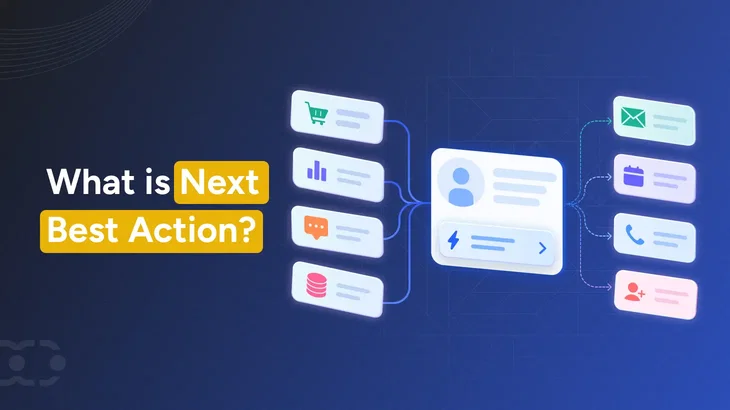
Next Best Action: Customer behavior → Context → Possible actions → Best action → Channel
How does next best action work?
Next best action turns customer signals into the most relevant action for that moment.
- Capture signals: Gather data from interactions, behavior, purchases, support, and CRM activity, using past data alongside live inputs.
- Add context: Consider intent, lifecycle stage, recent interactions, preferences, customer history, the current context, and evolving customer needs.
- Apply rules: Filter actions based on eligibility, consent, frequency limits, and business priorities within next best action models.
- Choose the action: Use rules, predictive scores, predictive insights, predictive models, AI, and machine learning to rank the available options in real time, so next best action strategies reach the right moment and drive positive outcomes.
- Take action: Execute or recommend the action through the right channel, whether that's email, SMS, a call, a task, or no action.
- Measure the outcome: Track the result and use it to improve future decisions, since feedback helps refine decisions over time and supports stronger loyalty and retention.
Unlike static models, NBA can adapt because static models do not learn from new customer behavior, and delayed feedback loops can slow campaign adjustments.
Core building blocks of a next best action strategy
Sales, marketing, and support use cases for next best action
Here's where NBA gets tangible. Instead of treating every customer the same, teams can use past behavior, engagement patterns, interaction history, and user intent to decide what action makes the most sense at a given moment.
Next best action in sales
For sales teams, NBA can help answer two practical questions: Who should I focus on right now, and what should I do next?
A prospect who repeatedly engages with emails, visits product pages, or shows other buying signals may deserve a faster sales follow-up than a lead that has gone quiet.
Salesmate's lead scoring helps teams prioritize prospects based on factors such as behavior, interest, and engagement, making it easier for reps to focus on stronger signals.
The next action can also depend on the prospect's stage and interaction history. Someone showing strong buying intent may be ready for a call or meeting, while another prospect may need an educational email or more time in a nurture journey.
With if then rules, teams can trigger a sales task when a prospect reaches high churn risk, re-engages, or a customer completes a key action such as booking a demo or revisiting pricing.
Salesmate Sequences help teams automate follow-ups across email, text, calls, and activities to support more personalized responses, while automation can turn defined customer or deal signals into tasks, updates, notifications, and follow-up actions.
Next best action in marketing
Next best action marketing changes the way marketing teams think about campaigns. Traditional campaign marketing often starts with a predefined audience, message, offer, and schedule.
For example, someone engaging with educational content may be better served by another helpful resource, while a prospect repeatedly interacting with product or pricing content may be ready for a stronger conversion message.
This supports one-to-one engagement, helping marketers respond to changing customer needs instead of relying on static segments.
A newly converted customer may need onboarding content instead of another promotional offer. This makes NBA particularly relevant to lifecycle marketing, where the right action changes throughout the entire customer lifecycle. McKinsey reports that 71% of customers expect personalized experiences.
Salesmate supports segmentation, lead scoring, automated journeys, email and SMS campaigns, push notification delivery, and multi-channel engagement, helping marketing teams create more customer-based journeys instead of sending the same message to everyone.
And because every interaction creates another signal, engagement data can continuously shape the next move. A personalized discount can also be a useful re-engagement action when behavior suggests declining interest.
Campaign analytics, conversion tracking, reporting, and testing help teams understand what customers respond to and refine their marketing strategy around those patterns.
Recommended read: AI agents in customer service: Transforming support from the ground up.
Next best action in customer support
In customer service, the best next action is often about solving a problem rather than selling something.
A customer's interaction history can provide important context. Someone who has raised multiple tickets about the same issue may need proactive intervention or a more detailed resolution, and support teams can use NBA to deliver personalized responses based on prior issues and behavior.
A customer who has just had a poor support experience should probably receive a helpful follow-up rather than an upsell.
On the other hand, a customer showing strong engagement and satisfaction may be more receptive to a relevant product recommendation or expansion conversation.
This is where customer satisfaction, NPS, and customer effort can become useful decision signals alongside tickets and conversation history.
Salesmate's survey capabilities support collecting feedback such as NPS and customer satisfaction data, giving teams another source of customer sentiment to consider when planning their next interaction.
Don't miss reading: Agentic CRM: AI Agents transforming CRM into a system of action.
Future of next best action: From rules to Agentic AI
NBA is evolving from static rules to predictive models and now toward agentic AI as AI and machine learning push next best action models beyond rules-based systems into more adaptive decisioning.
BCG argues that NBA programs need to evolve toward agent-native architectures, where AI can select, sequence, and compose personalized actions in real time, while traditional approaches often depend heavily on past data and can be less adaptive.
It highlights foundation models, composable architectures, and reinforcement learning as key technology shifts in that evolution.
The solution is agent-native systems where AI agents compose individualized action sequences, functioning as a self-improving system that learns from positive outcomes over time and adapts without manual rule rewrites.
This is where CRM-native AI agents such as Skara become relevant. Rather than simply recommending a next step, an agent can use customer context to qualify intent, update CRM records, trigger workflows, or hand the interaction to a human when needed.
But human guardrails remain essential - leaders still define objectives, acceptable risk, and business rules while AI handles the heavy lifting.





Key takeaways
Every customer interaction is a fork in the road. You can send a generic email, make a premature sales call, or push the same offer to everyone on a list. Or you can pause, read the signals, and choose the single move most likely to help your customer and grow your business.
That second approach is what next best action (NBA) is all about. As customer journeys become more fragmented and interactions happen across more channels, businesses need a better way to decide what to do next. That is where next best action (NBA) comes in.
This guide explains what NBA looks like in a modern CRM, how unified data, business rules, predictive models, AI, and omnichannel execution shape each decision, and how to put it into practice across sales, marketing, and support workflows with Salesmate.
What is next best action in modern CRM?
Next Best Action (NBA) is a decisioning approach that uses customer data, behavior, and context to determine the most relevant action for each customer moment. Instead of automatically pushing the same offer or message to everyone, it evaluates what a customer is doing, what they might need, and which action is most likely to create value for both the customer and the business.
Most CRMs tell you what a customer did. Next Best Action helps answer what you should do next.
It uses customer data, behavior, and context to choose the most relevant action for each customer. That could be a follow-up, product recommendation, helpful content, sales outreach, or even no action.
This is where NBA differs from traditional campaign marketing. A campaign starts with the audience, message, and offer, then fits customers into that campaign.
NBA starts with the customer's current situation, evaluates possible actions, and chooses the one that makes the most sense.
Traditional campaign: Audience → Message → Offer → Channel → Send
Next Best Action: Customer behavior → Context → Possible actions → Best action → Channel
How does next best action work?
Next best action turns customer signals into the most relevant action for that moment.
Unlike static models, NBA can adapt because static models do not learn from new customer behavior, and delayed feedback loops can slow campaign adjustments.
Core building blocks of a next best action strategy
Every NBA strategy rests on the following four pillars, which also support next best action marketing.
Next best action vs. next best offer
Next best offer recommends what to sell or promote. Next best action determines what should happen next, which may include an offer but can also be a sales call, educational content, a support intervention, a channel change, a follow-up task, or no action.
Unified customer data: The foundation for every best action
NBA decisions are only as good as the underlying data, especially when comprehensive records support more personalized marketing decisions. Here's what a good foundation looks like:
Next Best Action can increase customer lifetime value significantly when those decisions stay relevant and timely.
Turn unified customer data into the next best action
Connect customer signals, conversations, and workflows in one place to help your teams make smarter decisions at every customer moment.
Sales, marketing, and support use cases for next best action
Here's where NBA gets tangible. Instead of treating every customer the same, teams can use past behavior, engagement patterns, interaction history, and user intent to decide what action makes the most sense at a given moment.
Next best action in sales
For sales teams, NBA can help answer two practical questions: Who should I focus on right now, and what should I do next?
A prospect who repeatedly engages with emails, visits product pages, or shows other buying signals may deserve a faster sales follow-up than a lead that has gone quiet.
Salesmate's lead scoring helps teams prioritize prospects based on factors such as behavior, interest, and engagement, making it easier for reps to focus on stronger signals.
The next action can also depend on the prospect's stage and interaction history. Someone showing strong buying intent may be ready for a call or meeting, while another prospect may need an educational email or more time in a nurture journey.
With if then rules, teams can trigger a sales task when a prospect reaches high churn risk, re-engages, or a customer completes a key action such as booking a demo or revisiting pricing.
Salesmate Sequences help teams automate follow-ups across email, text, calls, and activities to support more personalized responses, while automation can turn defined customer or deal signals into tasks, updates, notifications, and follow-up actions.
Next best action in marketing
Next best action marketing changes the way marketing teams think about campaigns. Traditional campaign marketing often starts with a predefined audience, message, offer, and schedule.
For example, someone engaging with educational content may be better served by another helpful resource, while a prospect repeatedly interacting with product or pricing content may be ready for a stronger conversion message.
This supports one-to-one engagement, helping marketers respond to changing customer needs instead of relying on static segments.
A newly converted customer may need onboarding content instead of another promotional offer. This makes NBA particularly relevant to lifecycle marketing, where the right action changes throughout the entire customer lifecycle. McKinsey reports that 71% of customers expect personalized experiences.
Salesmate supports segmentation, lead scoring, automated journeys, email and SMS campaigns, push notification delivery, and multi-channel engagement, helping marketing teams create more customer-based journeys instead of sending the same message to everyone.
And because every interaction creates another signal, engagement data can continuously shape the next move. A personalized discount can also be a useful re-engagement action when behavior suggests declining interest.
Campaign analytics, conversion tracking, reporting, and testing help teams understand what customers respond to and refine their marketing strategy around those patterns.
Next best action in customer support
In customer service, the best next action is often about solving a problem rather than selling something.
A customer's interaction history can provide important context. Someone who has raised multiple tickets about the same issue may need proactive intervention or a more detailed resolution, and support teams can use NBA to deliver personalized responses based on prior issues and behavior.
A customer who has just had a poor support experience should probably receive a helpful follow-up rather than an upsell.
On the other hand, a customer showing strong engagement and satisfaction may be more receptive to a relevant product recommendation or expansion conversation.
This is where customer satisfaction, NPS, and customer effort can become useful decision signals alongside tickets and conversation history.
Salesmate's survey capabilities support collecting feedback such as NPS and customer satisfaction data, giving teams another source of customer sentiment to consider when planning their next interaction.
Future of next best action: From rules to Agentic AI
NBA is evolving from static rules to predictive models and now toward agentic AI as AI and machine learning push next best action models beyond rules-based systems into more adaptive decisioning.
BCG argues that NBA programs need to evolve toward agent-native architectures, where AI can select, sequence, and compose personalized actions in real time, while traditional approaches often depend heavily on past data and can be less adaptive.
It highlights foundation models, composable architectures, and reinforcement learning as key technology shifts in that evolution.
The solution is agent-native systems where AI agents compose individualized action sequences, functioning as a self-improving system that learns from positive outcomes over time and adapts without manual rule rewrites.
This is where CRM-native AI agents such as Skara become relevant. Rather than simply recommending a next step, an agent can use customer context to qualify intent, update CRM records, trigger workflows, or hand the interaction to a human when needed.
But human guardrails remain essential - leaders still define objectives, acceptable risk, and business rules while AI handles the heavy lifting.
Frequently asked questions
1. Can next best action work with predefined rules?
Yes. Predefined business rules often start with simple if-then logic to determine which actions are allowed based on factors such as consent, lifecycle stage, deal status, or communication frequency. AI and customer data can add more context as the strategy matures.
2. Does next best action always require automation?
No. Next best action can recommend an action without executing it automatically. The outcome could be an automated message, sales task, support escalation, channel change, or waiting for a better opportunity.
3. How do you measure next best action?
Measure next best action against its intended business outcome and define KPIs that support broader business goals, such as conversion rate, revenue, retention, renewal rate, response rate, or customer satisfaction. Compare results across different actions to identify what works best.
4. Can next best action work across multiple channels?
Yes. Omnichannel next best action can coordinate customer interactions across email, SMS, phone, web, in-app messaging, and other channels. Shared customer context helps prevent repetitive or conflicting communication.
5. When should a business implement next best action?
Start when you have reliable customer data and a specific decision to improve. Begin with one high-value use case, define the business rules and success metric, test the results, and expand as your customer data and AI capabilities mature.
Shivani Tripathi
Shivani TripathiShivani is a passionate writer who found her calling in storytelling and content creation. At Salesmate, she collaborates with a dynamic team of creators to craft impactful narratives around marketing and sales. She has a keen curiosity for new ideas and trends, always eager to learn and share fresh perspectives. Known for her optimism, Shivani believes in turning challenges into opportunities. Outside of work, she enjoys introspection, observing people, and finding inspiration in everyday moments.