AI agents can sound confident even when they’re working with outdated or incomplete information. So, what makes an AI agent actually reliable?
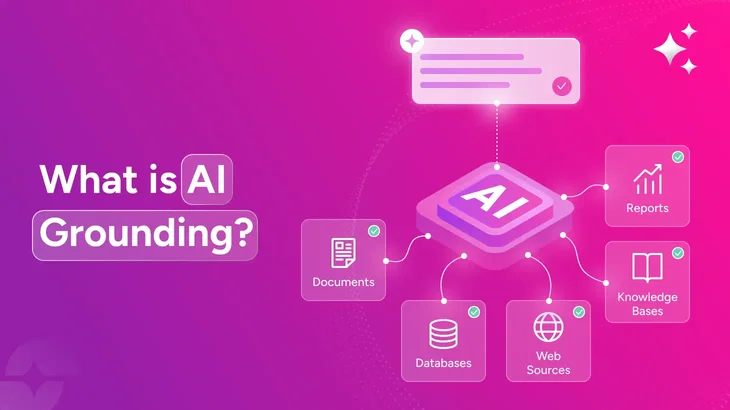
AI grounding refers to connecting an AI system to trusted, up-to-date information so it can generate responses based on real-world facts rather than assumptions.
Large language models learn patterns from their training data, but they don't automatically know your business's latest product details, policies, customer records, inventory, or order status.
For businesses, grounding determines whether an AI agent simply sounds right or actually gives the right answer based on the company's current data and rules.
AI grounding helps agents check orders, recommend products, qualify leads, and update CRM records using accurate, business-specific context.
That is why grounding AI is becoming essential for reliable AI agents.
In this guide, we'll explain what AI grounding is, how it works, how it differs from RAG and fine-tuning, and how businesses can build grounded AI systems that are accurate, secure, and reliable.
What happens when AI isn’t grounded?
When an AI agent lacks access to reliable business data and clear rules, it may fill gaps with assumptions, leading to hallucinations. A wrong answer can create a real business consequence.
Common risks include:
- Wrong information: Outdated pricing, product details, policies, or service information.
- Made-up policies: Incorrect claims about refunds, discounts, returns, or delivery timelines.
- Inconsistent experiences: Different customers get different answers to the same question.
- Data exposure: Internal or sensitive information reaches users who shouldn't see it.
- Unauthorized actions: AI changes records, processes requests, or triggers workflows beyond its permissions.
- More manual work: Teams spend time correcting AI mistakes instead of benefiting from automation.
Grounding improves LLM responses by reducing hallucinations, but it does not fully eliminate them or impose truthfulness on model outputs.
Grounded vs. Ungrounded AI: What changes?
The key difference is where the AI gets its information and how it handles uncertainty.
| Grounded AI | Ungrounded AI |
|---|
| Uses current, trusted business information | Relies more heavily on learned knowledge |
| Follows defined business rules | May infer or generalize rules |
| Retrieves relevant customer or business context for better relevance | May lack current context |
| Avoids unsupported claims | Can generate plausible but incorrect answers |
| Respects access and action permissions | May have unclear boundaries |
| Can ask, clarify, or escalate when information is missing | May attempt to answer anyway |
| Responses and actions can be traced to business data, with citations or source links | Traceability can be limited |
For example, if a customer asks, “Where is my order?”, an ungrounded AI may provide a generic delivery estimate.
A grounded agent can retrieve the authenticated order status, respond using current information, and point back to the source record.
How does AI grounding work?
AI grounding connects a user's request to the right data, context, rules, and actions. A reliable system typically follows five steps:
- Understand the request: The system validates and interprets the user's input, uses prompts and available context to determine what the user needs, and clarifies what information is required before retrieval begins.
- Retrieve relevant information: The agent pulls information from trusted sources such as the CRM, knowledge base, product catalog, order system, structured databases, documents, and other unstructured data.
- Build the context: The relevant information is combined into a focused context the agent can use to respond and may connect current request details with past interactions or preferences when authorized.
- Set response boundaries: The agent should only make claims supported by the available context. If information is missing or unclear, it should ask for clarification or escalate instead of guessing.
- Control actions: It may call approved tools when preparing or executing actions to complete complex tasks while accounting for constraints and available resources.
AI grounding vs. Retrieval-augmented generation (RAG) vs. Fine-tuning
These concepts are related, but they solve different problems.
| AI grounding | RAG | Fine-tuning |
|---|
| Connects AI to trusted business context and rules | Retrieves relevant information for the AI | Trains the model on specific data |
| Uses current information at runtime | Can retrieve updated information | Requires retraining for new information |
| Can enforce permissions and action boundaries | Focuses on information retrieval | Shapes model behavior |
| Example: Checks an order and applies the right return policy | Example: Retrieves the return policy | Example: Trains AI to follow a specific response style |
With in-context learning, a model can ground a response by receiving relevant details directly in the prompt, while RAG pulls that context from external sources; this approach is frequently used with generative AI and large language models rather than treated as a special-case technique.
How does AI grounding improve AI security?
Grounding and security are closely connected because AI agents need controlled access to business information, and that connection is crucial for reliability.
- Data minimization: Retrieve only the information required for the current request. A customer asking about an order doesn't necessarily need the agent to access their complete account history.
- Role-based access: An AI agent should have permissions appropriate to its role. A customer support agent may need order status but shouldn't have access to internal margins or employee notes.
- Field-level controls: Access should also be controlled at the field level. Even when an agent can access a CRM record, individual fields may contain information that shouldn't be exposed to customers.
- Authentication: Customer-specific information should only be retrieved when the system can establish that the requester is authorized to access it.
- Action permissions: Information access and action permissions should be treated separately. An agent may be allowed to read an order without being allowed to modify it.
- Auditability: Teams should be able to understand what information an agent used, log which verifiable data sources were referenced, and, where appropriate, expose citations or source links, along with what actions it took.
What data should AI agents be grounded in (eCommerce-specific)?
For eCommerce AI agents, grounding starts with giving them access to current, trusted data across products, policies, customers, and orders.
1. Product catalog and specifications
Product data helps AI agents answer questions about size, fit, materials, compatibility, ingredients, and availability using current catalog information.
Grounding connects structured product data with extracted attributes from unstructured content to improve accuracy and retrieval, and knowledge graphs can represent relationships such as compatibility, variants, or ingredient connections.
When product information is fragmented or outdated across systems, grounding exposes those gaps immediately. Accuracy depends on data quality, not automation complexity.
2. Policies and help center content
Policies and help center content stored in a controlled knowledge base define the rules the AI must follow.
Shipping timelines, return and exchange conditions, warranty terms, payment methods, and tax guidance should live in a single, versioned source.
When policies change, older versions must be retired. Otherwise, the AI can apply rules correctly based on outdated information.
3. Orders and customer context
For support use cases, grounding is far more effective when the AI can access order-specific context.
This is how teams ground agents with order status, delivery timelines, item eligibility, and, when authorized and useful for personalization, relevant customer information, and preferences.
Access to this data must be gated. Only authenticated users should trigger order lookups, and only information appropriate for customer communication should be retrieved.
4. Internal SOPs and escalation rules
Internal SOPs guide how the AI responds when standard rules do not apply. They define escalation paths, exception handling, and handoffs to human teams.
These playbooks should inform decision logic, not customer-facing responses. Maintaining a clear separation prevents policy leakage and confusion.
When these data sources are clean, scoped, and actively maintained, grounding becomes reliable instead of fragile.
Forrester recommends:
Place AI agents close to the data and business systems they interact with, particularly when real-time performance matters. For example, a sales agent working directly with CRM data can access customer, contact, and deal context without relying on disconnected sources.
How to implement AI grounding without overengineering
You don't need to ground every possible AI workflow from day one. Start with use cases where the information is clear, the business rules are well defined, and the value of automation is easy to measure.
1. Start with policies and WISMO
Shipping timelines, return rules, and order status questions make up a large share of support volume. They are also rule-based and easy to verify.
If your policies are clean and your order data is accessible, you can automate a meaningful portion of conversations safely right away.
2. Move to the catalog and product grounding
Once product data is reliable, AI can handle size, fit, compatibility, ingredients, and availability questions with far fewer errors.
This unlocks guided shopping and pre-purchase support without increasing returns or confusion.
3. Add sensitive actions with strict guardrails
Actions like returns, exchanges, cancellations, or address changes should only be automated after clear rules and approval paths are in place.
The AI should never decide exceptions on its own. It should follow defined flows and escalate when needed.
4. Expand gradually based on confidence, not ambition
Grounding works best when accuracy is proven before the scope is expanded gradually across different scenarios and industries, including healthcare and finance, where trust requirements are high.
In real-world scenarios, grounding matters even more because constraints and consequences are higher.
Teams that move step by step build trust internally and avoid the cleanup that comes from rushing automation.
Explore more: The future of AI agents: Key trends to watch in 2026.
Skara AI is your one-stop solution
Skara AI brings grounding into sales, eCommerce, and customer support by connecting agents with the business data and systems they need to complete tasks. This moves theoritical concepts to substantial use by:
- Support customers: Retrieve order and customer information to answer questions using current context.
- Recommend products: Use product and catalog data to provide relevant recommendations.
- Qualify leads: Use CRM and conversation context to qualify prospects and route them appropriately.
- Update CRM records: Access and update approved CRM data through defined workflows.
- Escalate when needed: Hand conversations to human teams when information is missing, ambiguous, or outside the agent's authority.
Instead of a chatbot it uses business-specific context, permissions, workflows, and guardrails to determine what it can say and do.
Grounding gives AI the context. Guardrails give it boundaries. Workflows give it a controlled way to act.
AI grounding evaluation checklist
Before putting an AI agent into production, evaluate more than its response quality.
Use this checklist:
| Area | What to evaluate |
|---|
| Data accuracy | Does the agent use current, authoritative information? |
| Retrieval | Does it retrieve the information relevant to the request? |
| Context | Does it receive enough information to answer correctly? |
| Permissions | Can it access only the data required for its role? |
| Response boundaries | Does it avoid unsupported claims? |
| Action controls | Can it take only authorized actions? |
| Escalation | Does it know when to involve a human? |
| Security | Can it prevent sensitive information from being exposed? |
| Consistency | Does it apply the same rules across similar requests? |
| Traceability | Can teams investigate the information and actions behind an outcome? |
| Monitoring | Can teams identify and correct grounding failures after deployment? |
The most important question
Don't ask only:
"How often does the AI answer correctly?"
Also ask:
"How does the AI behave when it doesn't have enough information to answer correctly?"
That second question is critical for customer-facing AI.
Grounded AI is the foundation for smarter agents
AI agents are becoming capable of doing far more than generating text, and grounded systems are expanding beyond text-only use cases through multimodal understanding.
They can interact with customers, work with business systems, make recommendations, qualify opportunities, update records, and trigger actions.
This form of multimodal comprehension lets a language model combine language with sensory signals such as video for better understanding in physical or operational environments.
That makes grounding increasingly important.
An AI agent can be fast, helpful, and impressively conversational, but none of that matters if it gives the wrong answer or takes the wrong action.
Grounding is what keeps AI connected to the facts that matter. It gives agents access to current business data, the right customer context, and the rules they need to make better decisions.
Your competitors are already using it. What about you?









Key takeaways
AI agents can sound confident even when they’re working with outdated or incomplete information. So, what makes an AI agent actually reliable?
AI grounding refers to connecting an AI system to trusted, up-to-date information so it can generate responses based on real-world facts rather than assumptions.
Large language models learn patterns from their training data, but they don't automatically know your business's latest product details, policies, customer records, inventory, or order status.
For businesses, grounding determines whether an AI agent simply sounds right or actually gives the right answer based on the company's current data and rules.
AI grounding helps agents check orders, recommend products, qualify leads, and update CRM records using accurate, business-specific context.
That is why grounding AI is becoming essential for reliable AI agents.
In this guide, we'll explain what AI grounding is, how it works, how it differs from RAG and fine-tuning, and how businesses can build grounded AI systems that are accurate, secure, and reliable.
What happens when AI isn’t grounded?
When an AI agent lacks access to reliable business data and clear rules, it may fill gaps with assumptions, leading to hallucinations. A wrong answer can create a real business consequence.
Common risks include:
Grounding improves LLM responses by reducing hallucinations, but it does not fully eliminate them or impose truthfulness on model outputs.
Grounded vs. Ungrounded AI: What changes?
The key difference is where the AI gets its information and how it handles uncertainty.
For example, if a customer asks, “Where is my order?”, an ungrounded AI may provide a generic delivery estimate.
A grounded agent can retrieve the authenticated order status, respond using current information, and point back to the source record.
How does AI grounding work?
AI grounding connects a user's request to the right data, context, rules, and actions. A reliable system typically follows five steps:
AI grounding vs. Retrieval-augmented generation (RAG) vs. Fine-tuning
These concepts are related, but they solve different problems.
With in-context learning, a model can ground a response by receiving relevant details directly in the prompt, while RAG pulls that context from external sources; this approach is frequently used with generative AI and large language models rather than treated as a special-case technique.
How does AI grounding improve AI security?
Grounding and security are closely connected because AI agents need controlled access to business information, and that connection is crucial for reliability.
Grounding AI in the real world
Agents need to understand the current state of the systems they interact with and use real-world feedback to guide what they do next. As Amazon Science explains, real-world grounding helps agentic AI connect its reasoning and actions to the environment it operates in. For businesses, this means an agent should not only know the right policy or customer data, but also understand the current situation before taking action.
What data should AI agents be grounded in (eCommerce-specific)?
For eCommerce AI agents, grounding starts with giving them access to current, trusted data across products, policies, customers, and orders.
1. Product catalog and specifications
Product data helps AI agents answer questions about size, fit, materials, compatibility, ingredients, and availability using current catalog information.
Grounding connects structured product data with extracted attributes from unstructured content to improve accuracy and retrieval, and knowledge graphs can represent relationships such as compatibility, variants, or ingredient connections.
When product information is fragmented or outdated across systems, grounding exposes those gaps immediately. Accuracy depends on data quality, not automation complexity.
2. Policies and help center content
Policies and help center content stored in a controlled knowledge base define the rules the AI must follow.
Shipping timelines, return and exchange conditions, warranty terms, payment methods, and tax guidance should live in a single, versioned source.
When policies change, older versions must be retired. Otherwise, the AI can apply rules correctly based on outdated information.
3. Orders and customer context
For support use cases, grounding is far more effective when the AI can access order-specific context.
This is how teams ground agents with order status, delivery timelines, item eligibility, and, when authorized and useful for personalization, relevant customer information, and preferences.
Access to this data must be gated. Only authenticated users should trigger order lookups, and only information appropriate for customer communication should be retrieved.
4. Internal SOPs and escalation rules
Internal SOPs guide how the AI responds when standard rules do not apply. They define escalation paths, exception handling, and handoffs to human teams.
These playbooks should inform decision logic, not customer-facing responses. Maintaining a clear separation prevents policy leakage and confusion.
When these data sources are clean, scoped, and actively maintained, grounding becomes reliable instead of fragile.
Forrester recommends:
How to implement AI grounding without overengineering
You don't need to ground every possible AI workflow from day one. Start with use cases where the information is clear, the business rules are well defined, and the value of automation is easy to measure.
1. Start with policies and WISMO
Shipping timelines, return rules, and order status questions make up a large share of support volume. They are also rule-based and easy to verify.
If your policies are clean and your order data is accessible, you can automate a meaningful portion of conversations safely right away.
2. Move to the catalog and product grounding
Once product data is reliable, AI can handle size, fit, compatibility, ingredients, and availability questions with far fewer errors.
This unlocks guided shopping and pre-purchase support without increasing returns or confusion.
3. Add sensitive actions with strict guardrails
Actions like returns, exchanges, cancellations, or address changes should only be automated after clear rules and approval paths are in place.
The AI should never decide exceptions on its own. It should follow defined flows and escalate when needed.
4. Expand gradually based on confidence, not ambition
Grounding works best when accuracy is proven before the scope is expanded gradually across different scenarios and industries, including healthcare and finance, where trust requirements are high.
In real-world scenarios, grounding matters even more because constraints and consequences are higher.
Teams that move step by step build trust internally and avoid the cleanup that comes from rushing automation.
Skara AI is your one-stop solution
Skara AI brings grounding into sales, eCommerce, and customer support by connecting agents with the business data and systems they need to complete tasks. This moves theoritical concepts to substantial use by:
Instead of a chatbot it uses business-specific context, permissions, workflows, and guardrails to determine what it can say and do.
Grounding gives AI the context. Guardrails give it boundaries. Workflows give it a controlled way to act.
Give Your AI the Context to Act Smarter
See how Skara connects AI agents with your business data, rules, and workflows to handle conversations, qualify leads, support customers, and take action with confidence.
AI grounding evaluation checklist
Before putting an AI agent into production, evaluate more than its response quality.
Use this checklist:
The most important question
Don't ask only:
Also ask:
That second question is critical for customer-facing AI.
Grounded AI is the foundation for smarter agents
AI agents are becoming capable of doing far more than generating text, and grounded systems are expanding beyond text-only use cases through multimodal understanding.
They can interact with customers, work with business systems, make recommendations, qualify opportunities, update records, and trigger actions.
This form of multimodal comprehension lets a language model combine language with sensory signals such as video for better understanding in physical or operational environments.
That makes grounding increasingly important.
An AI agent can be fast, helpful, and impressively conversational, but none of that matters if it gives the wrong answer or takes the wrong action.
Grounding is what keeps AI connected to the facts that matter. It gives agents access to current business data, the right customer context, and the rules they need to make better decisions.
Your competitors are already using it. What about you?
Frequently asked questions
1. What are the different types of AI grounding?
AI grounding can use different sources and techniques, including grounding through structured business data, knowledge bases, retrieval systems, APIs, databases, and real-time business systems. The right approach depends on what information the AI needs and whether it also needs to take actions.
2. Does AI grounding eliminate hallucinations?
No. AI grounding can reduce hallucinations by giving an AI agent access to relevant, trusted information, but it cannot guarantee that every response will be correct. Strong grounding also requires retrieval controls, clear instructions, permissions, validation, and escalation when the available information is insufficient.
3. How do you ground an AI agent with your own data?
You can ground an AI agent by connecting it to approved sources such as company knowledge bases, CRM records, product catalogs, databases, APIs, and business policies. The agent should retrieve only relevant information, apply access controls, and use defined rules to determine what it can say or do.
4. Can AI agents be grounded in real-time data?
Yes. AI agents can be connected to real-time or frequently updated sources such as CRM systems, inventory platforms, order management systems, and databases. This allows agents to work with current information instead of relying solely on static training data.
5. How do you test whether an AI agent is properly grounded?
Test the agent against real business scenarios, including questions with missing, conflicting, outdated, and sensitive information. Evaluate whether it retrieves the correct data, follows business rules, respects permissions, avoids unsupported claims, takes only authorized actions, and escalates when it cannot safely complete a request.
Shivani Tripathi
Shivani TripathiShivani is a passionate writer who found her calling in storytelling and content creation. At Salesmate, she collaborates with a dynamic team of creators to craft impactful narratives around marketing and sales. She has a keen curiosity for new ideas and trends, always eager to learn and share fresh perspectives. Known for her optimism, Shivani believes in turning challenges into opportunities. Outside of work, she enjoys introspection, observing people, and finding inspiration in everyday moments.